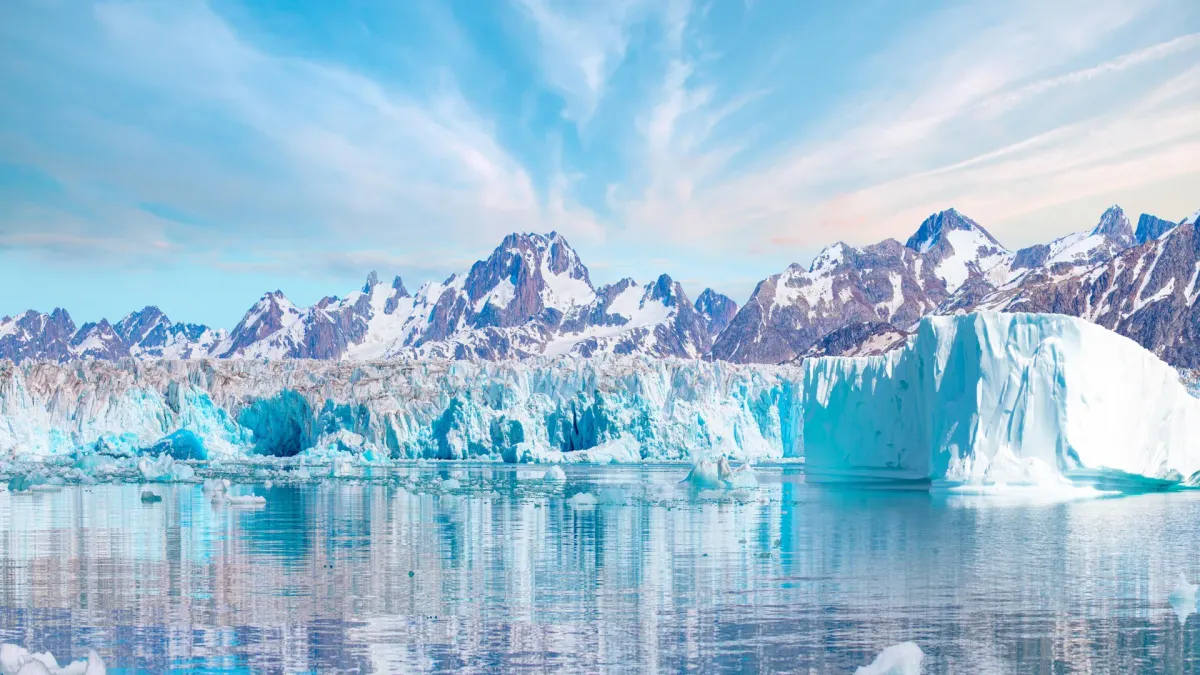
Scientists have found huge swirling structures deep inside the Greenland ice sheet. These formations have puzzled researchers for over ten years. Now, scientists from the University of Bergen (UiB) believe they have an explanation. They used mathematical models similar to those that study how Earth's continents move.
A "Boiling Pot of Pasta" in the Ice
A new study suggests these mysterious plumes are caused by thermal convection. This is a slow, circulating movement within the ice. It happens because of temperature differences between deeper and shallower layers. Thermal convection is usually linked to very hot material moving inside Earth's mantle, not ice.
Andreas Born, a professor at UiB, co-authored the research. He said, "We typically think of ice as a solid material. So, finding that parts of the Greenland ice sheet actually undergo thermal convection, resembling a boiling pot of pasta, is as wild as it is fascinating." Born has studied Northern Hemisphere ice sheets for over 15 years.
We're a new kind of news feed.
Regular news is designed to drain you. We're a non-profit built to restore you. Every story we publish is scored for impact, progress, and hope.
Start Your News DetoxLead author Robert Law, a glaciologist, called it an "exciting freak of nature." He explained that while it seems strange, the physics make sense because ice is much softer than Earth's mantle. The research has been accepted by The Cryosphere journal and was chosen as a "highlight paper."
Born believes these findings could help scientists make better predictions about the Greenland ice sheet's future. He noted, "Our discovery could be key to reducing uncertainties in models of future ice sheet mass balance and sea-level rise."
Softer Ice, Not Necessarily Faster Melting
The study suggests that ice deep in northern Greenland might be about ten times softer than previously thought. However, this doesn't automatically mean the ice sheet will melt faster.
Law said, "Improving our understanding of ice physics is a really major way to be more certain about the future. But on its own, softer ice does not necessarily mean that the ice will melt faster or that sea level rise will be higher. We need further studies to fully isolate that."
Law emphasized that the new findings do not predict huge changes in Greenland or elsewhere. Instead, they show how complex and active the ice sheet truly is. He added, "The more we learn about the hidden processes inside the ice, the better prepared we'll be for the changes coming to coastlines around the world."
Deep Dive & References
The study was conducted by researchers from the University of Bergen, NASA Goddard Space Flight Center, the University of Oxford, and ETH Zurich. They looked at whether the plume-like structures in the Greenland ice sheet could be explained by thermal convection. Their analysis suggests these features are likely caused by this slow churning motion. The results also indicate that deep ice in northern Greenland could be about ten times softer than previously assumed. These findings may help improve predictions of future sea level rise.