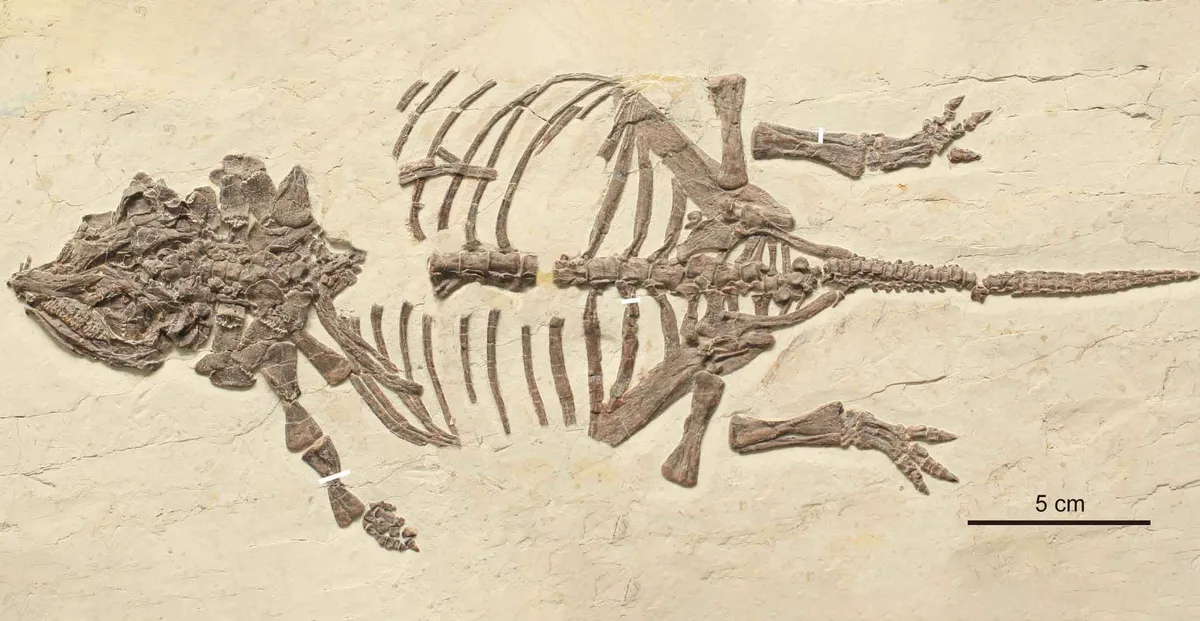
For over twenty years, paleontologists kept running into the same puzzle: fossils of a dinosaur called Liaoningosaurus paradoxus were always impossibly small. Each skeleton measured less than 40 centimeters—about the length of a ruler—while adult armored dinosaurs of the same type typically stretched three meters or longer. The question haunted researchers since the species was first described in 2001: Were these tiny creatures a separate miniature species, or something else entirely?
A new study published in the Journal of Vertebrate Paleontology finally answers that question. The fossils don't represent small adults at all. They're babies—and one specimen is so young it appears to have just hatched, making it the earliest-stage ankylosaur ever found in the fossil record.
How Scientists Read Dinosaur Age
The breakthrough came from looking inside the bones themselves. Bone tissue preserves growth lines similar to tree rings, with each line marking roughly one year of life. By counting these lines and measuring the spacing between them, researchers can estimate both age and growth rate.
We're a new kind of news feed.
Regular news is designed to drain you. We're a non-profit built to restore you. Every story we publish is scored for impact, progress, and hope.
Start Your News DetoxWhen scientists examined two Liaoningosaurus fossils—one of the largest known specimens and one of the smallest—they found no visible growth lines in either. Both animals were less than one year old when they died. The smaller fossil showed something even more telling: a hatching line, a small ring-like feature in the bone that forms at the moment an animal breaks free from its egg.
"The smaller fossil showed characteristics that we can see in other newborn dinosaurs, such as the presence of a hatching line," explained Professor Paul Barrett, a dinosaur expert and coauthor of the study. "So, we can say that this individual had very recently hatched at the time of its death."
What Baby Dinosaurs Reveal
All known Liaoningosaurus fossils come from Liaoning Province in northeastern China, a region famous for preserving Cretaceous-era creatures with extraordinary detail. After these animals died roughly 130 million years ago, their remains settled into shallow lakes. Volcanic ash from the region's frequent eruptions buried and sealed the lakebeds, creating ideal conditions for fossilization.
Young ankylosaur fossils are rare enough that scientists have never had a clear picture of how these armored dinosaurs developed from hatchlings to adults. Some researchers previously suspected that the heavy armor plates didn't appear until later in life. The Liaoningosaurus babies suggest otherwise: they already had some armor plating shortly after hatching, meaning these protective features developed early.
"Liaoningosaurus is really the only good window we have into what ankylosaurs are like just after they hatch," Barrett said. "Now that we know they are babies and not miniature adults, we can say that these kinds of features came in quite early during the animal's growth."
The next piece of the puzzle would be finding an adult Liaoningosaurus. That would let researchers trace the full arc of development—seeing exactly how babies transformed into their fully armored adult form. For now, these tiny fossils stand as the earliest chapter in an ankylosaur's life story we've ever been able to read.