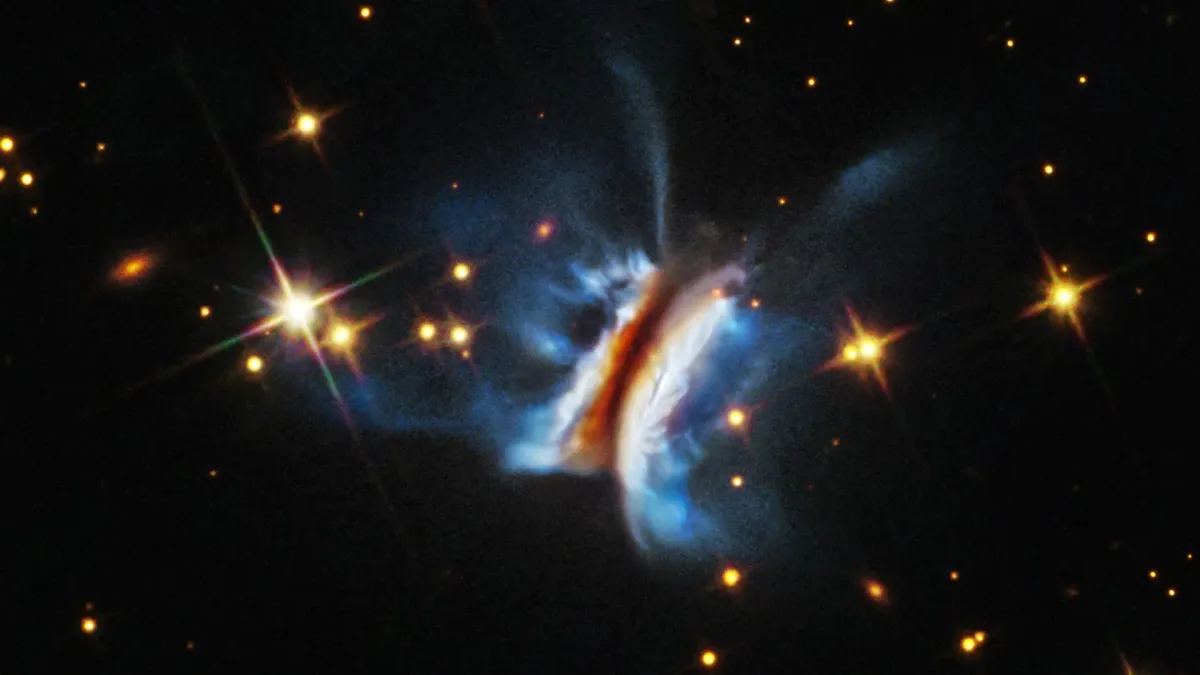
Just when you thought space couldn't get any weirder, NASA's Hubble Space Telescope has delivered a cosmic mic drop: the largest planet-forming disk ever spotted around a young star. And it's not just big; it's a chaotic, turbulent mess, complete with towering wisps of gas and dust that make our own solar system's early days look like a perfectly organized toy box.
But here's the kicker: these massive, filament-like structures are only visible on one side. Imagine a cosmic hamburger, but only one half has all the toppings. This discovery, published in The Astrophysical Journal, offers a rare peek at how planets might form in truly extreme environments, proving Hubble still has a few tricks up its sleeve.
The Universe's Messiest Nursery
The system, officially known as IRAS 23077+6707, has been affectionately (or perhaps wryly) nicknamed "Dracula's Chivito" by scientists. It’s about 1,000 light-years away and stretches nearly 400 billion miles across. To put that in perspective, it's roughly 40 times wider than our entire solar system, extending well past what we call the Kuiper Belt. That's a lot of cosmic real estate.
We're a new kind of news feed.
Regular news is designed to drain you. We're a non-profit built to restore you. Every story we publish is scored for impact, progress, and hope.
Start Your News DetoxAt its heart, a young star (or maybe two, scientists are still debating) is shrouded in a thick cloak of dust and gas. Kristina Monsch, lead author from the Center for Astrophysics | Harvard & Smithsonian, noted the unprecedented detail. She explained that these new Hubble images show planet nurseries can be far more active and chaotic than anyone imagined. With the disk seen almost edge-on, those wispy upper layers and lopsided features are particularly striking.
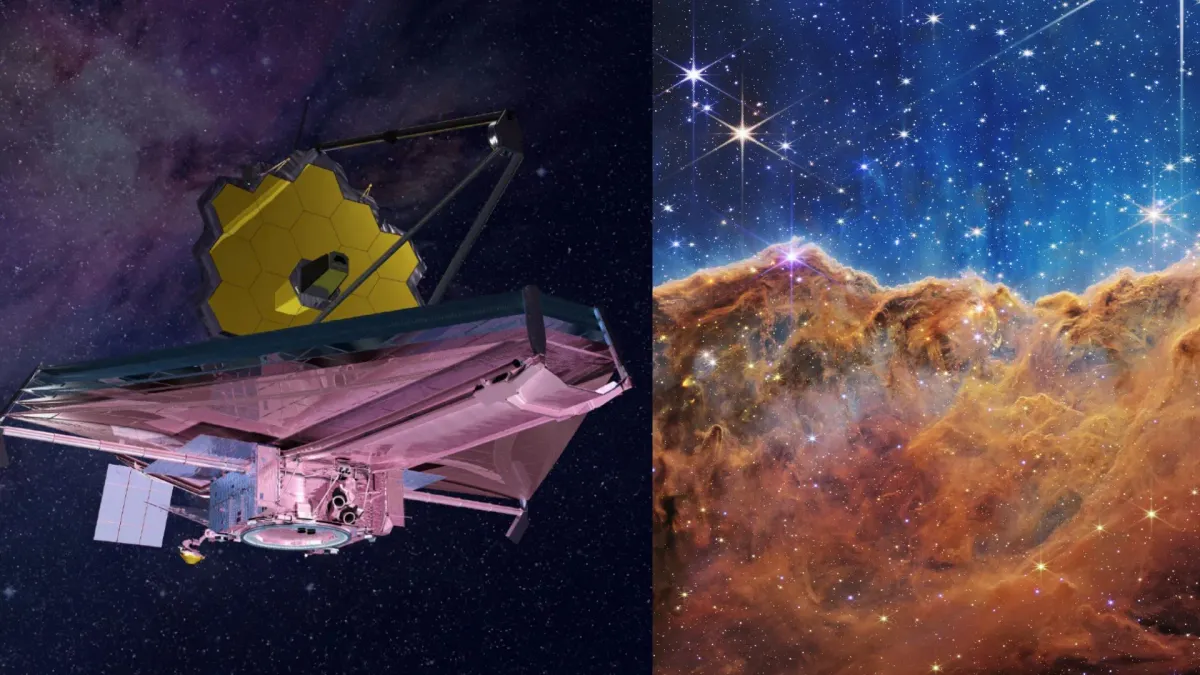
While both Hubble and the James Webb Space Telescope have seen similar structures, "Dracula's Chivito" offers a unique, crystal-clear view in visible light, allowing scientists to trace its intricate details. This makes it a one-of-a-kind cosmic lab for studying how, and where, planets actually get their start.
And the name? It’s a delightful mashup of the researchers' backgrounds: one from Transylvania, another from Uruguay, where a "chivito" is a popular sandwich. When viewed from the side, the disk apparently resembles a cosmic hamburger, with a dark center and glowing layers above and below. Because apparently that's where we are now: naming celestial objects after sandwiches and vampires.
The Mystery of the One-Sided Filaments
The real head-scratcher is the disk's unevenness. Hubble's images clearly show tall, filament-like structures erupting from only one side, leaving the other side strangely clear. Scientists suspect this peculiar asymmetry could be due to active processes within the system, like fresh material falling into the disk or interactions with its surroundings. It's like one side of the cosmic burger is getting all the toppings, while the other is just... bun.
Joshua Bennett Lovell, a co-investigator, expressed amazement at this lopsidedness. He noted that Hubble has given them an up-close look at the chaotic processes shaping disks as they churn out new planets — processes we're only just beginning to understand.
Planetary systems, including our own, begin as massive disks of gas and dust swirling around young stars. Over eons, some of this material gets pulled into the star, while the rest slowly coalesces into planets. This particular disk is estimated to contain 10 to 30 times the mass of Jupiter, which is more than enough raw material to forge several gas giants. Scientists are suggesting it might be an oversized, super-chaotic version of our own early solar system.
Monsch believes that "Dracula's Chivito" could theoretically host a vast planetary system. While planet formation might unfold differently in such massive, turbulent environments, the fundamental processes are likely similar. These new images are a crucial starting point for unraveling the grand, messy saga of how planets form across the universe.
Which, if you think about it, is both impressive and slightly terrifying. Imagine living on a planet formed inside a cosmic hamburger called Dracula's Chivito. Suddenly, your commute doesn't seem so bad.