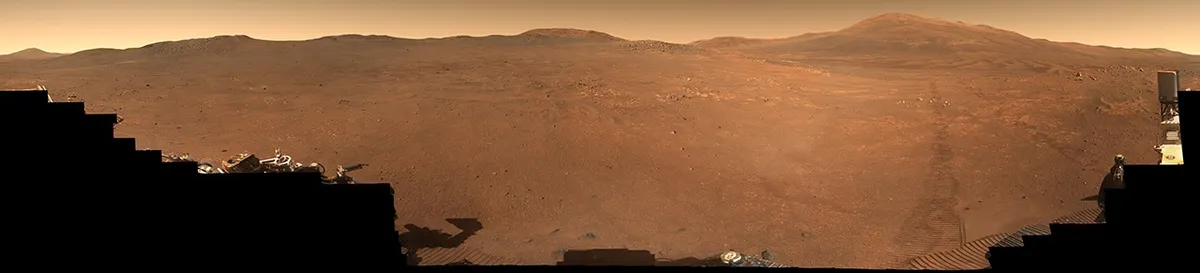
NASA's Perseverance rover, not content with just rolling around on Mars, recently stopped to take a casual 360-degree panorama of a spot charmingly dubbed "Crocodile Bridge." Because apparently, even on another planet, you need good photos for the scrapbook.
This isn't just any old Martian vista. "Crocodile Bridge" sits on the rim of Jezero Crater, a place that's basically Mars's very own geological time capsule. We're talking rocks so old, they were chilling when the Red Planet's crust and atmosphere were just figuring things out. Earth, with its constantly shifting tectonic plates, simply can't compete with this kind of ancient real estate. Mars, being a bit more... static, has preserved its primordial past beautifully.

The panorama itself is a masterpiece of patience and technology: 980 individual images, stitched together to give us a view of the landscape in natural colors. Most were snapped on December 18, 2025, with a few stragglers added on January 25, 2026. Let that satisfying number sink in.
We're a new kind of news feed.
Regular news is designed to drain you. We're a non-profit built to restore you. Every story we publish is scored for impact, progress, and hope.
Start Your News Detox"Crocodile Bridge" is more than just a scenic overlook; it's the gateway to an area called "Lac de Charmes." Perseverance is slated to spend several months exploring this new zone later this year, presumably taking even more photos that will make your phone's camera roll look decidedly amateur.
The whole operation, from the rover's movements to the Mastcam-Z instrument that captured these stunning images, is managed by NASA's Jet Propulsion Laboratory. Arizona State University leads the camera ops, collaborating with Malin Space Science Systems and the Niels Bohr Institute. Because exploring ancient alien landscapes takes a village, or at least a few very smart institutions. Which, if you think about it, is both impressive and slightly terrifying.