Turns out, the very first life forms on Earth were a bit particular. Over three billion years ago, when the planet was still figuring things out, our microbial ancestors apparently had a soft spot for molybdenum. The kicker? That metal was practically a ghost in the environment back then. It's like preferring a rare truffle when all that's available is dirt.
Today, molybdenum is the unsung hero in our cells, a tiny but mighty catalyst for reactions that keep us, and the entire global nitrogen cycle, humming along. Without it, those crucial chemical processes would slow to a crawl, making life as we know it… well, not life as we know it.
Molybdenum's Ancient Allure
Betül Kaçar, who leads a lab at the University of Wisconsin-Madison and heads NASA's MUSE astrobiology research, explains that molybdenum is central to the enzymes driving major carbon, nitrogen, and sulfur reactions. Knowing when life started using this metal is like finding the original recipe for some of life's most fundamental metabolic strategies.
We're a new kind of news feed.
Regular news is designed to drain you. We're a non-profit built to restore you. Every story we publish is scored for impact, progress, and hope.
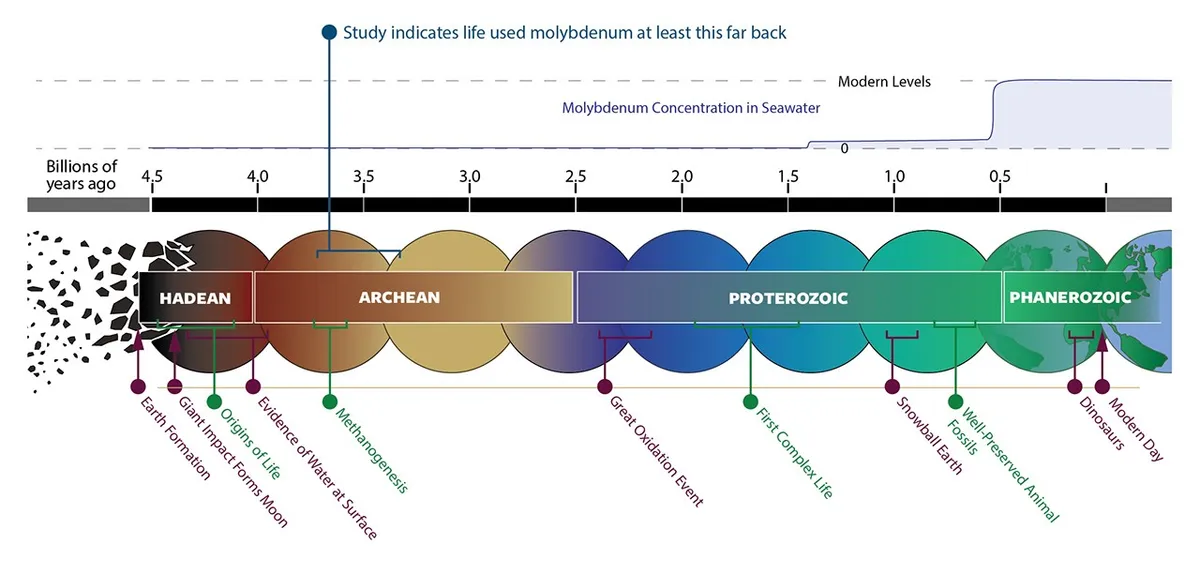
Start Your News DetoxNow, molybdenum is pretty common. But billions of years ago? Not so much. Geological records show oceans had only trace amounts. Its levels only started rising around the same time microorganisms began photosynthesizing, eventually leading to the "Great Oxidation Event" 2.45 billion years ago – when the atmosphere suddenly got a whole lot more breathable. Some scientists even thought this molybdenum boom was a prerequisite for complex life.
This led to a bit of a chicken-or-the-egg situation. Did early life use something else first, like tungsten (which behaves similarly in cells and is still used by some extreme organisms today), and then switch to molybdenum when it became more available? That was the prevailing theory.

But this new NASA-funded study? It just casually tossed that theory out the window.
Kaçar's team meticulously reconstructed molybdenum's presence across the tree of life, digging through data like archaeological detectives. They found that even when molybdenum was scarcer than a quiet Tuesday on the internet, ancient microbes were already finding ways to snap it up, right alongside tungsten.
Their work suggests that both molybdenum and tungsten enzyme systems have incredibly ancient roots, meaning early life likely leveraged both. And here's the mic drop: molybdenum use is much older than many models assumed, dating back 3.7 to 3.1 billion years ago, long before the Great Oxidation Event made it more abundant. So, life wasn't waiting for molybdenum to show up; it was actively seeking it out.
Previous research from Kaçar's MUSE team pointed to places like deep-sea hydrothermal vents as potential metal hot spots. Even if the ancient oceans were largely devoid of dissolved molybdenum, these vents could have provided enough for those early, ambitious microbes. It seems molybdenum was simply "worth choosing" for its catalytic benefits, scarcity be damned.
Cosmic Implications
This whole molybdenum saga is a pretty excellent reminder that life is incredibly resourceful, even when its preferred ingredients are hard to come by. It's a lesson we should probably take to heart when we're scanning distant exoplanets for signs of alien biology.
Finding life out there isn't about finding another modern Earth. It's about understanding Earth's own wild, ancient past. Kaçar stresses that we should be looking for biochemical strategies that make sense on planets with entirely different histories of oxygen and metal availability, not just "Earth-like life now." Because who knows what rare elements some alien microbe might have decided was worth the effort?