Astronomers using NASA's James Webb Space Telescope have found a giant planet outside our solar system. This exoplanet was hidden in one of the most studied star systems in the Milky Way.
The star, Beta Pictoris, is young and nearby. It was already known to have two giant planets: Beta Pictoris b and Beta Pictoris c. Beta Pictoris b was one of the first exoplanets ever directly photographed. The new planet, Beta Pictoris d, makes this only the second star system known to have at least three planets that have been directly imaged.
Unlike the other two, Beta Pictoris d was found by looking at the unique chemical signs in its atmosphere. This is different from just seeing a bright spot of light. This new method could change how we search for planets around other stars.
We're a new kind of news feed.
Regular news is designed to drain you. We're a non-profit built to restore you. Every story we publish is scored for impact, progress, and hope.
Start Your News Detox
Aidan Gibbs, a researcher at the University of California, San Diego, led a new study about this discovery. He said this finding adds another piece to an already interesting planetary system. Beta Pictoris has helped scientists understand how planetary systems form and change. Now, another planet helps tell that story.
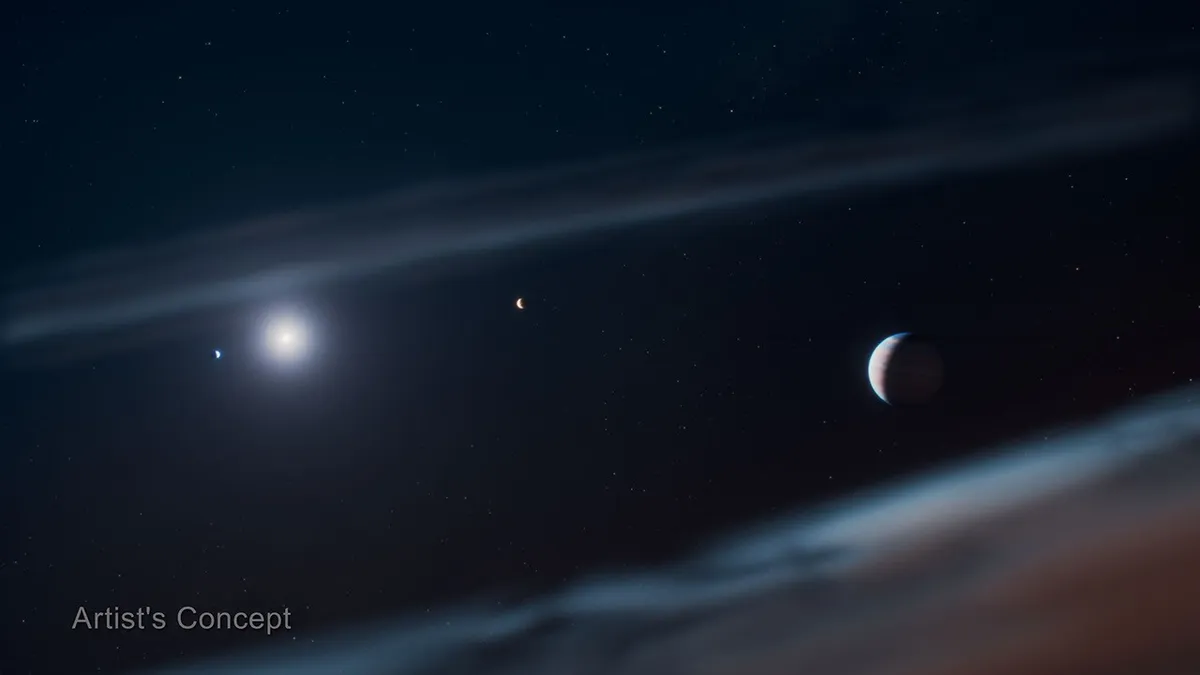
This image shows the Beta Pictoris system. The newly found giant exoplanet, Beta Pictoris d, is on the right. It has the widest orbit of the three known exoplanets in the system.
A Closer Look at Beta Pictoris d
Beta Pictoris is 63 light-years from Earth and about 23 million years old. It's a nearby system that shows how new planets interact with the dust and debris left over from their formation.
Scientists believe Beta Pictoris d is at least two times the mass of Jupiter. This makes it the smallest of the three known giant planets in the system. Models suggest it orbits its star at about 30 astronomical units. This is similar to where Neptune is in our own solar system.
It has the widest orbit of the three planets. However, it is still inside the inner edge of the debris disk.
Astronomers were not looking for a new planet with Webb. Beta Pictoris d appeared while they were using the telescope’s NIRSpec (Near-Infrared Spectrograph) to study Beta Pictoris b's atmosphere. They used NIRSpec’s Integral Field Unit, which takes both an image and a spectrum from each pixel.
Gibbs said they were trying to understand a planet they already knew about. Then, an unexpected signal showed up in the data.
This signal was a series of peaks and dips in the spectroscopic data. They expected to see a smooth spectrum from light bouncing off dust. Instead, there was a clear pattern of carbon monoxide absorption lines, like a barcode. This pattern is expected in the atmospheres of giant planets.
Spectroscopy shows not only what chemicals are present but also how an object is moving. The team used this to find the planet’s speed, position, and alignment with the debris disk. These details matched an object orbiting Beta Pictoris. It was not a background star or a brown dwarf.
Jean-Baptiste Ruffio, a research scientist at the University of California, San Diego, said there was a bright light source in the image. But he noted that bright spots in images can be false signals or other structures in the debris disk. By getting a spectrum at the same time, they quickly confirmed their suspicions.
Later observations with Webb's MIRI (Mid-Infrared Instrument) found water vapor and methane. This further confirmed the planet's identity and gave a better look at its atmosphere.
This spectroscopic method allowed researchers to find the planet and start studying its atmosphere right away.
Ruffio explained that a spectrum holds a lot of information. You learn it's a planet, and then you immediately learn about its temperature, chemistry, and movement.
Another study, led by Ben Sutlieff and Markus Bonse, also confirmed Beta Pictoris d's existence. They used data from the European Southern Observatory’s Very Large Telescope and Webb’s NIRCam (Near-Infrared Camera).
Researchers used Webb’s NIRSpec to map the chemical content of the Beta Pictoris system. This led to the discovery of Beta Pictoris d.
This image shows Beta Pictoris d, the newly found third planet orbiting Beta Pictoris. It was reconstructed from Webb’s NIRSpec data.
Why Beta Pictoris d Remained Hidden
Beta Pictoris d stayed hidden for years because it is inside one of the brightest debris disks known.
This dusty disk acts like fog. It scatters light from the star, making it hard for normal imaging to tell planets apart from the surrounding structures. Webb's spectroscopic method ignored the dust. It only focused on the specific molecular signs unique to a planet's atmosphere.
Scientists say the planet's presence might explain why the famous debris disk has such a sharp inner edge and other strange structures. Astronomers had actually predicted a planet like Beta Pictoris d to explain the disk's unusual shape.
This discovery not only helps us understand Beta Pictoris better, but it also shows a powerful new way to find exoplanets.
This is the first directly imaged planet found mainly through moderate-resolution spectroscopy. It proves that astronomers can find planets in complicated environments by looking at their atmospheric fingerprints. They don't have to rely only on traditional imaging that blocks out starlight.
Researchers plan to keep studying Webb's observations. They want to learn more about the planet's temperature, atmosphere, and orbit. This will give an even more detailed look at one of astronomy's most famous planetary systems.
The James Webb Space Telescope is the world’s top space science observatory. It solves mysteries in our solar system, looks at distant worlds around other stars, and explores the universe's origins. Webb is an international program led by NASA with partners ESA and CSA.
Deep Dive & References
A new study published - Astrophysical Journal Letters