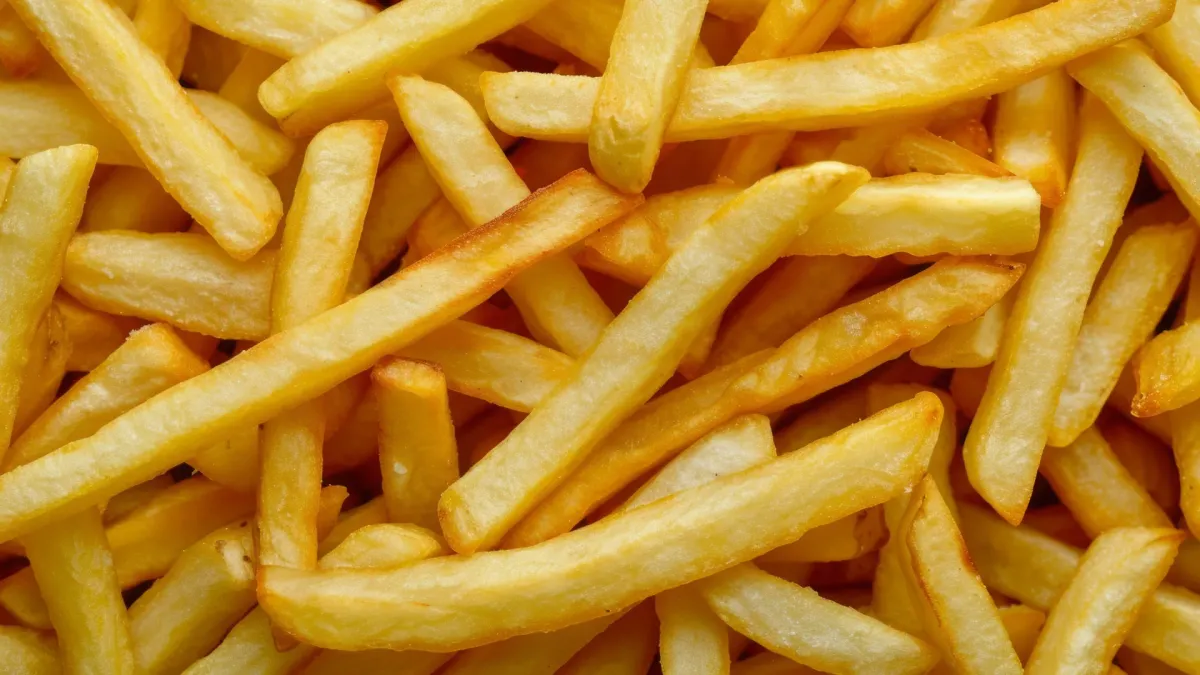
Fried foods are popular, but their high fat content can lead to health problems like obesity and high blood pressure. Researchers at the University of Illinois Urbana-Champaign are exploring how microwave frying can make French fries healthier.
Their studies suggest that combining traditional frying with microwave heating can reduce the amount of oil absorbed. This method also keeps the fries crispy and could shorten cooking times.
Pawan Singh Takhar, a professor of food engineering at U of I, explained that consumers want healthy foods, but often crave high-fat options. His team aims to lower fat content without sacrificing taste or texture. Takhar and doctoral student Yash Shah published their findings in two recent studies.
We're a new kind of news feed.
Regular news is designed to drain you. We're a non-profit built to restore you. Every story we publish is scored for impact, progress, and hope.
Start Your News DetoxHow Frying Works
The team used a special microwave fryer that operated at two frequencies: 2.45 gigahertz and 5.8 gigahertz. They prepared potato strips by rinsing, peeling, cutting, blanching, and salting them. Then, they fried the strips in soybean oil heated to 180 degrees Celsius. They measured various factors like temperature, pressure, and oil content during and after frying.
Takhar noted that a main challenge in frying is stopping oil from entering the food. Initially, potato pores are full of water. As water evaporates during cooking, empty spaces form. This creates negative pressure, which pulls oil into the food.
He compared it to a straw: "If you push air into the straw, it creates positive pressure and any liquid will be pushed out. But if you suck on the straw, the liquid moves upward." In food, positive pressure keeps oil out, while negative pressure lets it in.
Microwaves Reduce Oil
Most of the frying process happens under negative pressure, which draws oil into the food. The researchers wanted to increase the time the food was under positive pressure.
Microwaves heat food from the inside out, unlike conventional ovens that heat from the outside in. Microwaves make water molecules vibrate, creating more vapor. This shifts the pressure inside the food towards the positive side. Higher internal pressure helps prevent oil from penetrating the food.
Faster Cooking, Less Oil
The researchers also created mathematical models to understand how different factors affect frying. Their models looked at temperature, pressure, moisture, texture, volume, and oil content under various conditions.
Microwave frying led to faster moisture loss, shorter cooking times, and less oil absorption. However, microwave frying alone makes food soggy.
Takhar explained that conventional heating is still needed for crispiness. He suggests combining both methods in the same unit. Conventional heating provides crispiness, while microwave heating reduces oil intake.
A Practical Solution
The researchers believe that existing industrial fryers could be updated with microwave generators. These are affordable and widely available, making the combined method a practical solution for large-scale food production.
Deep Dive & References:
- Predicting the quality changes during microwave frying of food biopolymers by solving the hybrid mixture theory-based unsaturated transport, and electromagnetics equations - Current Research in Food Science, 2026
- The Effect of Conventional and Microwave Frying on the Quality Characteristics of French Fries - Journal of Food Science, 2025