Imagine a tiny, invisible shuttle service that makes energy zoom around inside super small materials. That's essentially what scientists just discovered: protons, those tiny parts of atoms, can secretly boost how energy moves in nanomaterials. It's a pretty big deal for future tech.
Turns out, protons and electrons often team up in chemistry. They're like the dynamic duo behind everything from how your body breathes to how plants make food. Scientists already knew they help move single packets of energy. But now, they've found a new trick.
A team led by Professor Kaifeng Wu at the Dalian Institute of Chemical Physics was looking into something called triplet energy transfer. This is a different kind of energy movement, super important in nature and in things we build.
We're a new kind of news feed.
Regular news is designed to drain you. We're a non-profit built to restore you. Every story we publish is scored for impact, progress, and hope.
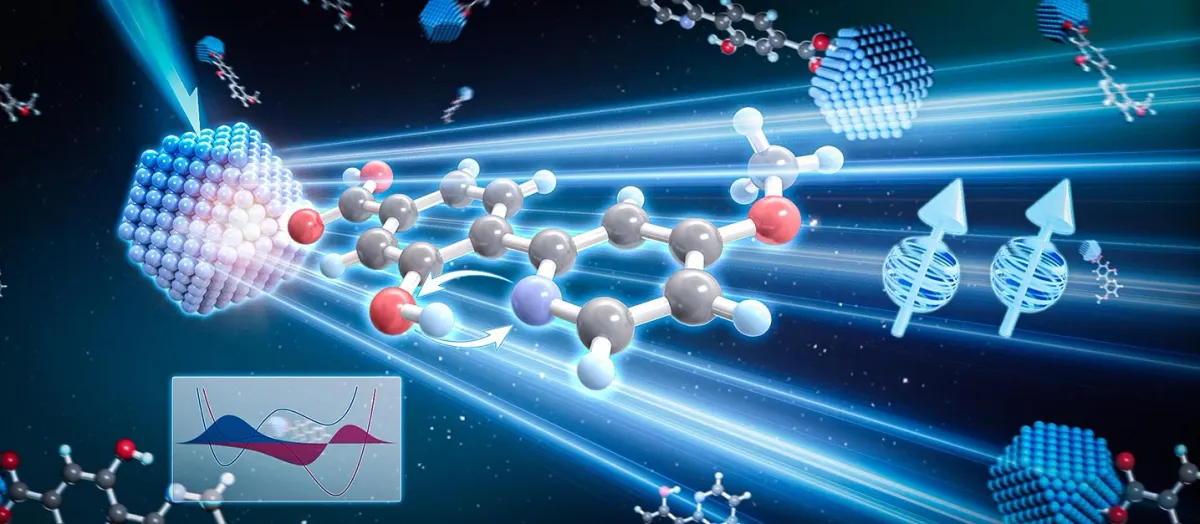
Start Your News DetoxThey found a brand-new way this happens, called proton shuttle-assisted triplet energy transfer (PS-TET). It's all thanks to tiny particles called quantum dots (specifically, ZnSe-based ones) and some special molecules (phenol-pyridine) hooked up to them.
When these quantum dots grab light, they get excited. Think of it like a little energy party. Here's the wild part: A positive charge jumps from the quantum dot to the phenol molecule. At the exact same time, a proton does a quick hop from phenol to pyridine.
Then, an electron moves, and the proton shuttles back to where it started. Even though the proton ends up back home, its quick detour makes the energy transfer way faster and more efficient. It's like a secret shortcut.
What's even cooler? This process barely changes with temperature. This hints that the proton isn't just wiggling around normally; it's likely quantum tunneling. That's a mind-bending quantum effect where particles can essentially teleport through barriers.
This discovery means we might be able to control how energy and charges move in materials using these quantum tricks, even at room temperature. That's huge.
Professor Wu thinks this could totally change how we design materials for things like solar cells, lasers, and even catalysts that clean up pollution. Sometimes you want this triplet energy transfer to happen, sometimes you want to stop it. Now, by adding or removing these tiny proton shuttles, scientists might have a clever switch to control it. Seriously cool stuff.