Most of us think of microbes in binary terms: the ones that make you sick versus the ones that keep you healthy. But beneath the soil and on every leaf of every tree, microbes are quietly orchestrating something far more consequential—they're determining whether entire ecosystems can survive drought, disease, and climate stress.
For decades, scientists noticed something odd at the edges of forests. The fungi and microbes living on trees there looked completely different from those in the forest interior. They assumed it was because different tree species grew at the edges, or because the environmental conditions—more wind, more light, more temperature swings—simply favored different microbial communities. But forests are messy places with dozens of species mixed together, making it nearly impossible to isolate the real cause.
Then Geoffrey Zahn, an assistant professor at William & Mary, found the perfect natural experiment: Pando, in Utah's Fishlake National Forest.
We're a new kind of news feed.
Regular news is designed to drain you. We're a non-profit built to restore you. Every story we publish is scored for impact, progress, and hope.
Start Your News DetoxPando is not what it appears to be. It looks like a sprawling forest covering 106 acres, but it's actually a single organism—a clonal aspen connected by one massive root system, with more than 40,000 genetically identical branches. Because every tree in Pando is genetically identical, any differences in the microbial communities living on them could only come from environmental factors: wind patterns, sunlight exposure, the way spores drift through the air.
Using DNA barcoding to map the fungal microbiome across Pando's entire expanse, Zahn's team discovered something significant: the edge effect is real for microbes, independent of the host organism. Environmental conditions at the forest's edge directly determine which fungal species arrive and which can survive. Wind-blown inputs shape the microbial community far more strongly in small or fragmented forest patches than in large, continuous forests.
This matters because of what's happening to forests globally. As deforestation increases, large forests get broken into smaller patches. More edges means more environmental variability in the microbial communities. And when microbial communities become more variable and unstable, the plants they support become less resilient—less able to bounce back from drought, disease, or climate stress.
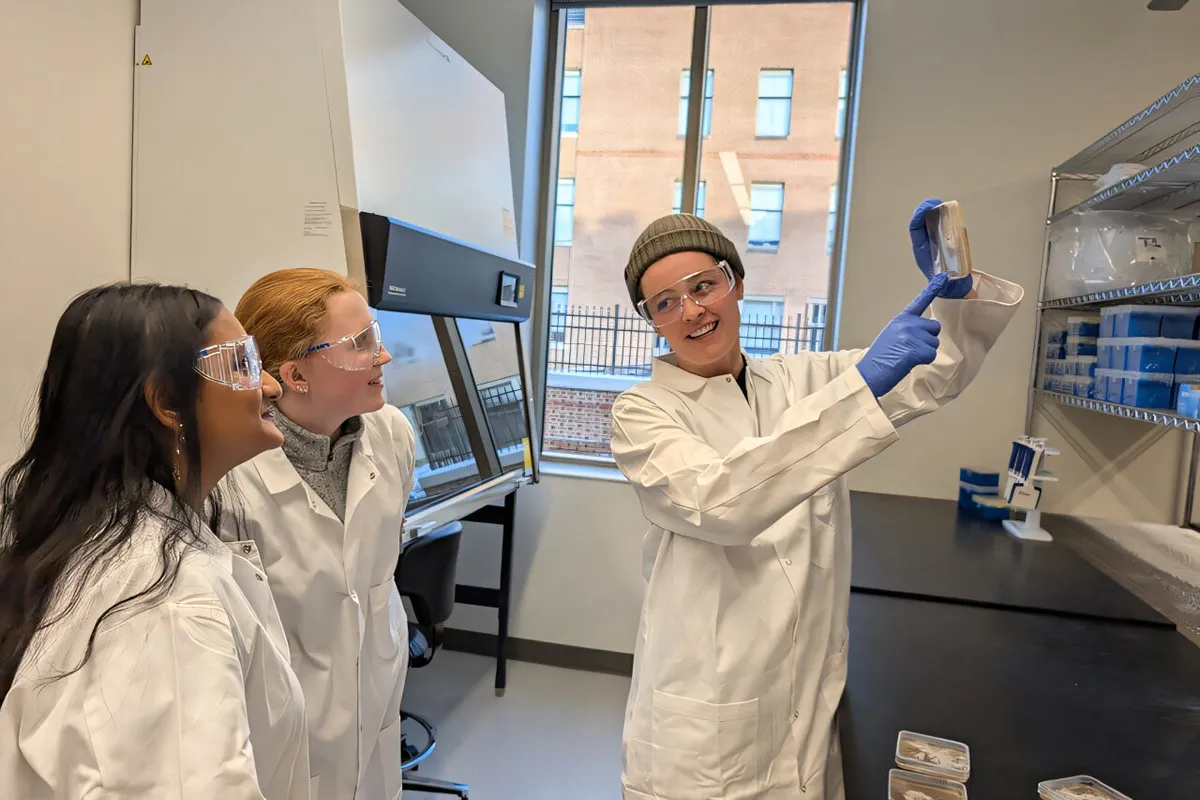
Zahn's work is part of a larger effort at William & Mary to translate microbial science into real conservation practice. His lab, TIDAL (Translational Insights into microbial Diversity, Assembly, & Linkages), combines DNA analysis with artificial intelligence to predict how microbial communities will respond to environmental change. But the real innovation is the approach: Zahn works across disciplines—with data scientists, policy experts, and conservation practitioners—to move research from the lab into the field where it can actually shape how forests are protected and restored.
He's currently collaborating on grant proposals for coastal restoration and microbiome engineering, and teaching students how to use high-performance computing to tackle large-scale ecological questions. His message to students mirrors his own journey: he started as a literature major before switching to biology. The breadth matters. In a rapidly changing world, the people who will solve problems aren't specialists in a single domain—they're people curious enough to move between them.