For decades, scientists have puzzled over a fundamental question: where did all Earth's water come from. Did icy comets deliver it during the planet's violent early days, or did Earth make its own. New research suggests the answer might be both — but with a twist that rewrites our origin story.
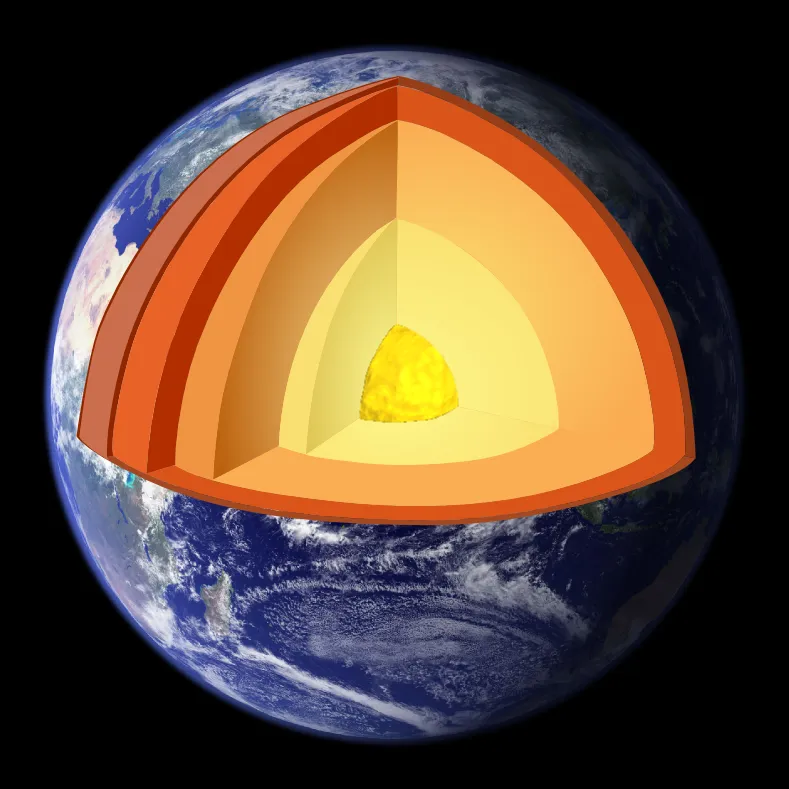
Deep inside Earth's core, there may be between 9 and 45 times as much hydrogen as exists in all our oceans combined. That's the finding from a study published in Nature Communications, and it hints that water didn't arrive as a cosmic delivery — much of it was homemade.
Hydrogen is water's essential ingredient. If the core has been sitting on this massive hydrogen reserve since Earth formed, then as some of that hydrogen escaped upward into the mantle (the molten rock layer above the core), it would have met abundant oxygen and created water. It's a chemical reaction happening on a planetary scale, deep beneath our feet.
We're a new kind of news feed.
Regular news is designed to drain you. We're a non-profit built to restore you. Every story we publish is scored for impact, progress, and hope.
Start Your News DetoxHow Scientists Looked Inside the Unreachable
Measuring what's actually in Earth's core is nearly impossible. The pressure there is crushing, the temperature is hotter than the sun's surface, and we can't drill down to check. So researchers did the next best thing: they rebuilt the core in a laboratory.
The team, led by scientists including Dongyang Huang, heated and squeezed iron, silicon, oxygen and hydrogen in conditions mimicking the core's extreme environment. As the samples cooled, hydrogen and silicon formed a specific crystal structure — one that let the researchers work backward and calculate how much hydrogen must be present in the real core.
Their finding: hydrogen makes up between 0.07% and 0.36% of the core's weight, making it the planet's largest reservoir of this light element. That number might even be conservative. During the experiment, some hydrogen likely escaped as pressure dropped, meaning the actual amount could be higher.
What This Changes
Planetary scientist Hilke Schlichting, one of the study's key voices, put it simply: this "really changes the way we think of where our water comes from." For years, the leading theory held that most of Earth's water arrived from space — hitchhiking on comets and asteroids that collided with the young planet. It's a tidy story: Earth was born dry, then got soaked by cosmic visitors.
But if the core has been holding this much hydrogen since Earth's formation, the picture gets more complex. A substantial portion of our water may have been generated right here, born from chemical reactions between the core's hydrogen and the mantle's oxygen. External delivery still likely played a role, but it wasn't the whole story.
This matters because understanding where water came from helps us understand how Earth became habitable. It also gives us clues about how water might arise on other rocky planets — suggesting that worlds with cores and mantles similar to ours might generate their own water, making them more likely candidates for life.
The researchers are careful not to overstate their findings. The core's hydrogen may have escaped more readily than their lab conditions suggest. But the work provides the strongest evidence yet that we've been overlooking a vast, ancient reservoir of the element that makes us wet. The next step is refining these measurements — and perhaps, eventually, understanding just how much of the water cycle was written into Earth's deepest layers from the very beginning.