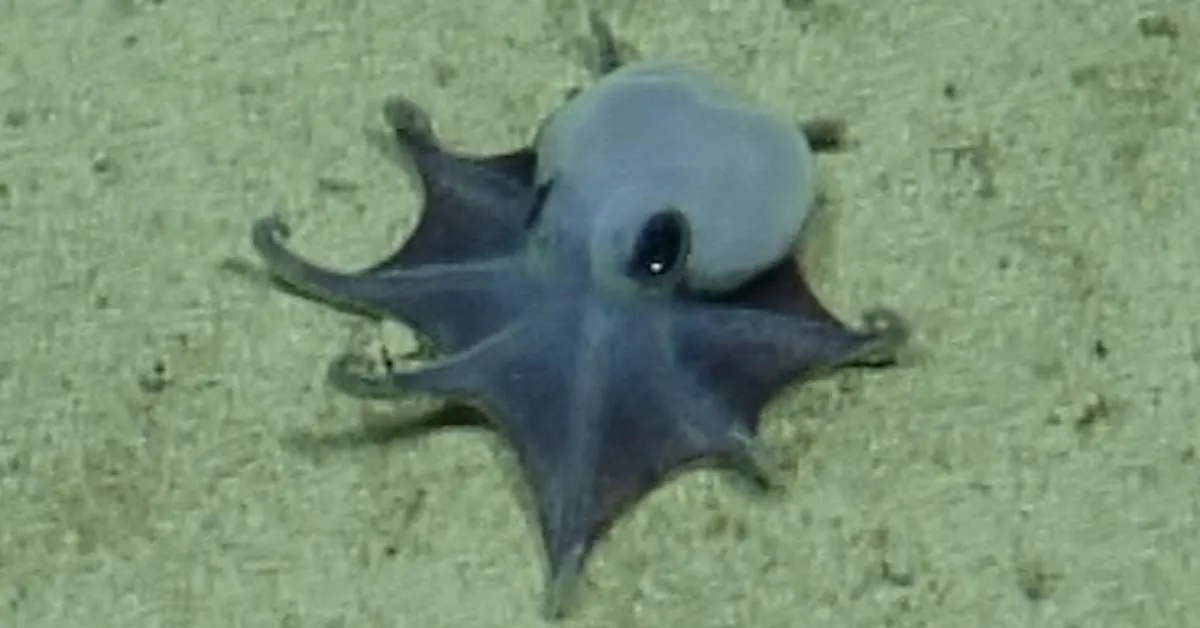
In 2015, scientists on a deep-sea trip in the Galapagos found a small, blue octopus. It was about the size of a golf ball and had short arms. A recent study confirmed this octopus is a new species.
Discovering a New Species
The octopus, named Microeledone galapagensis, was first seen by a robot submarine. This happened near an underwater mountain, about 5,800 feet deep in the Pacific Ocean. It was close to Darwin Island. Researchers from the Charles Darwin Foundation and the Galápagos National Park Directorate collected one specimen using their robot. They also saw two more octopuses on video.
The collected octopus was sent to Janet Voight, an octopus expert at the Field Museum in Chicago. Voight and her team used a CT scanner to make a 3D model of the octopus. This allowed them to study its internal organs and mouth without cutting it open.
We're a new kind of news feed.
Regular news is designed to drain you. We're a non-profit built to restore you. Every story we publish is scored for impact, progress, and hope.
Start Your News DetoxVoight explained that to describe a new octopus species, you usually need to examine its mouth, beak, and teeth. She didn't want to cut open the only specimen they had. By comparing its parts to other octopus species, they confirmed it was indeed new.
Unique Features and Deep-Sea Life
Unlike many octopuses, Microeledone galapagensis is small and squat. It has short, stubby arms with few suckers. Voight wondered how it survives in the deep sea, which has limited food, with such short arms. She thought longer arms with more suckers would be better for finding prey in the sediment.
Voight noted that finding new deep-sea octopus species is not uncommon. Few people have explored these areas. She believes many more deep-sea octopuses are waiting to be found. The Pacific Ocean is huge, and deep-sea octopuses don't travel far when they are young. This means new discoveries will likely continue for a long time.
Jim Barry, a senior scientist not involved in the study, agreed. He told CNN that we don't know much about deep-sea life. He said that discoveries like this happen on almost every dive, showing how much is still unknown.