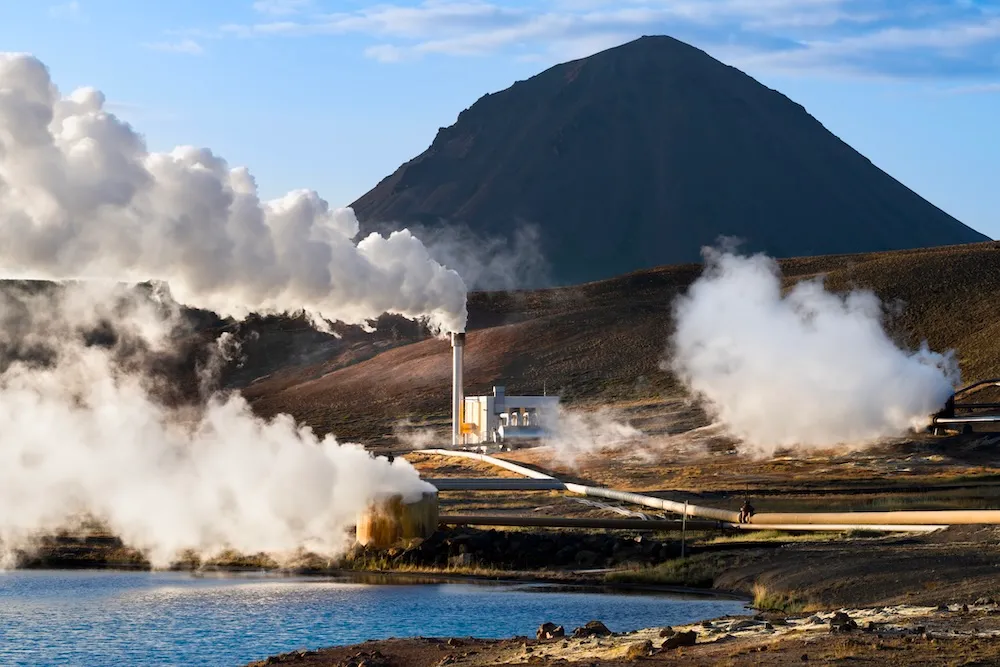
Geothermal energy, which uses heat from the Earth, is a clean and constant power source. It's available in many places but has been slow to become widely used. The Romans used it almost 2,000 years ago for things like spas. In the early 1900s, Italy was the first to produce electricity from geothermal sources.
Today, geothermal energy provides less than 1% of the world's electricity. However, some countries rely on it heavily. For example, Kenya gets over 40% of its electricity from geothermal, and Iceland uses it for nearly 30% of its electricity and 90% of its heating.
The Rise of Next-Generation Geothermal
Recently, new technologies, more private funding, and changing energy policies have sparked fresh interest in geothermal energy. If costs keep falling, the International Energy Agency (IEA) believes geothermal could meet 15% of the global electricity demand growth between 2024 and 2050. Countries like the U.S., Indonesia, New Zealand, and Turkey are making it a priority.
We're a new kind of news feed.
Regular news is designed to drain you. We're a non-profit built to restore you. Every story we publish is scored for impact, progress, and hope.
Start Your News DetoxTo generate a lot of electricity from geothermal sources, we need to expand "next-generation geothermal." This means tapping into rocks that are 100 to over 400 degrees Celsius, often several kilometers deep. U.S. Representatives Jake Auchincloss and Mark Amodei recently introduced a bill to support research into "superhot rock" geothermal energy.
MIT's Role in Geothermal Innovation
MIT has been a key player in national geothermal strategy for two decades. In 2006, a report called "The Future of Geothermal Energy," led by former MIT professor Jeff Tester, was very influential.
In 2008, researchers at MIT's Plasma Science and Fusion Center (PSFC) invented millimeter-wave drilling. This technology could be especially useful for drilling in superhot, deep rock. An MIT spinout company, Quaise Energy, is now commercializing it.
MIT's Future Energy Systems Center is also funding new geothermal projects. One project, led by Pablo Duenas-Martinez, looks at the economics of geothermal power plants combined with data centers. This is important because data centers are increasingly using geothermal energy.
MIT also held a "geothermal bootcamp" for over 40 community members. This introduced them to the basics of geothermal energy and related MIT research. Carolyn Ruppel, MITEI's deputy director of science and technology, noted that many companies are showing interest in next-generation geothermal.
Understanding Geothermal Energy
A few meters underground, temperatures stay stable all year. In some places, it's warmer than the surface in winter and cooler in summer. This allows geothermal heat pumps to regulate building temperatures. Boston University's Center for Computing and Data Science uses this system for about 90% of its heating and cooling.
Deeper, hotter geothermal sources can generate large amounts of electricity for decades. "Next-generation geothermal" refers to these high-temperature systems using advanced technologies.
- Enhanced geothermal involves circulating fluids through engineered cracks in deep, dry rock.
- Advanced geothermal uses a closed-loop system where a working fluid circulates through pipes underground to get heated.
- Superhot geothermal, still very new, will likely use enhanced geothermal technology to circulate supercritical water through rock at nearly 400 degrees Celsius.
Challenges and Solutions for Next-Generation Geothermal
Hotter rocks are almost everywhere deep beneath the continents. However, early development needs to focus on the most promising sites to test and improve drilling methods. Places like Iceland and Nevada have hotter temperatures closer to the surface because tectonic plates are separating or the Earth's crust is thinner.
Even in the southwestern U.S., reaching the high temperatures needed for electricity means drilling more than 4 kilometers deep into crystalline rock. This is much harder than drilling in the sedimentary basins where most oil and gas are found.
A suitable site needs both heat and a fluid, usually water, to carry that heat. This water can be natural or injected into the rock. The system also needs connected pathways, like engineered cracks, to prevent fluid loss and direct it to the extraction well. Closed-loop systems use a special working fluid contained in pipes instead of freely circulating water.
Scientists use various methods to find hot sites a few kilometers deep. Besides direct temperature measurements, electrical resistivity and magnetotelluric surveys help identify warmer, more permeable rocks.
Drilling is often the most expensive and time-consuming part. For next-generation geothermal, targets can be very deep, or the system might need large-scale horizontal drilling. While innovations have improved drilling, Andrew Inglis from MIT Proto Ventures notes that "you may spend $10 million on an exploratory well and find no heat."
Superhot geothermal faces unique challenges. Metal drilling tools, rocks, and fluids all behave differently at several hundred degrees. Standard materials and sensors need major changes to handle these harsh conditions. When water reaches a supercritical state above 374 degrees Celsius, it's great for extracting heat but can quickly corrode metal and cause salts and silica to build up in the borehole. Researchers are looking into using supercritical carbon dioxide instead of water.
MIT Innovations Driving Progress
The millimeter-wave drilling technology from PSFC, now being commercialized by Quaise Energy, is a major MIT innovation. It uses microwave energy to vaporize rock, potentially drilling much faster than traditional methods. PSFC and an MIT team are building a lab to study how this technology interacts with crystalline rock under realistic conditions. Steve Wukitch, interim director at PSFC, says this facility will allow testing samples 500 times larger, which is crucial for unlocking superhot geothermal energy.
MIT Proto Ventures, which helps create startups from MIT technology, has a dedicated geothermal energy channel led by Andrew Inglis. Since late 2024, Inglis has found inventions from various fields, including mechanical engineering, materials science, earth sciences, and chemistry. These include sensors for high-temperature rock, advanced metal alloys cheaper than titanium, and anti-fouling coatings to protect pipes from harsh geothermal fluids.
MITEI Spring Symposium Highlights
At a recent MITEI Spring Symposium, MIT innovators presented their technologies to MITEI member companies. Steve Wukitch discussed the planned millimeter-wave testbed, and Pablo Duenas-Martinez led a panel on power generation and storage. Terra Rogers from the Clean Air Task Force (CATF) discussed policies and regulations for expanding next-generation geothermal.
MIT students and researchers also presented posters. The Geo@MIT student group even won an award from the U.S. Department of Energy for their work in geothermal energy.