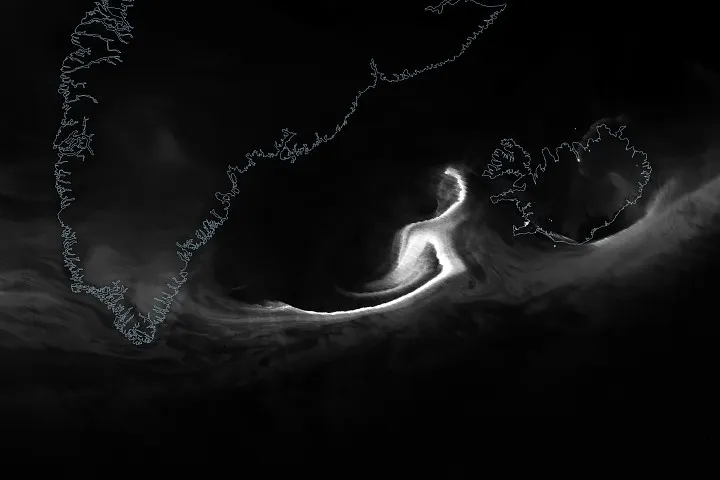
On the morning of February 16, 2026, ribbons of green and purple light swept across the Denmark Strait and eastern Canada—a visible reminder that Earth's magnetic field is constantly in conversation with the sun.
The display wasn't rare, but it was vivid. A minor geomagnetic storm—the weakest category on a scale that runs from G1 to G5—pushed the northern lights far enough south that people in Iceland, Québec, and Newfoundland and Labrador woke to an unexpected show. NASA's Suomi NPP satellite captured the moment in the early hours, its VIIRS camera detecting the aurora's glow across wavelengths from green light to near-infrared.
What made this February display scientifically interesting wasn't just the light show—it was the timing. About a week earlier, a NASA rocket launched from Poker Flat Research Range near Fairbanks, Alaska, specifically to study what was happening in the electrical environment of an aurora. The GNEISS mission (Geophysical Non-Equilibrium Ionospheric System Science) sent two sounding rockets high enough to gather data on the electrical currents flowing through the northern lights. Combined with satellite observations and ground-based measurements, that data will let scientists build a 3D map of how these currents actually work.
We're a new kind of news feed.
Regular news is designed to drain you. We're a non-profit built to restore you. Every story we publish is scored for impact, progress, and hope.
Start Your News DetoxIt sounds abstract, but it matters. Geomagnetic storms—even minor ones—can cause weak fluctuations in power grids and minor disruptions to satellites. A G2 storm, which this event escalated to later that day, occasionally pushes auroras as far south as New York and Idaho. Understanding the electrical machinery behind the aurora helps scientists predict and prepare for stronger storms that could affect infrastructure millions of people depend on.
The aurora borealis peaks in March and September, but it can appear almost any time if solar conditions align. That unpredictability is part of what makes capturing and studying these moments valuable. Each observation adds texture to the model, each dataset another piece of the puzzle of how the sun's wind interacts with Earth's magnetic shield.
As space weather monitoring improves and more missions like GNEISS gather precise data, scientists are moving from simply watching the lights dance to understanding the physics that makes them dance.