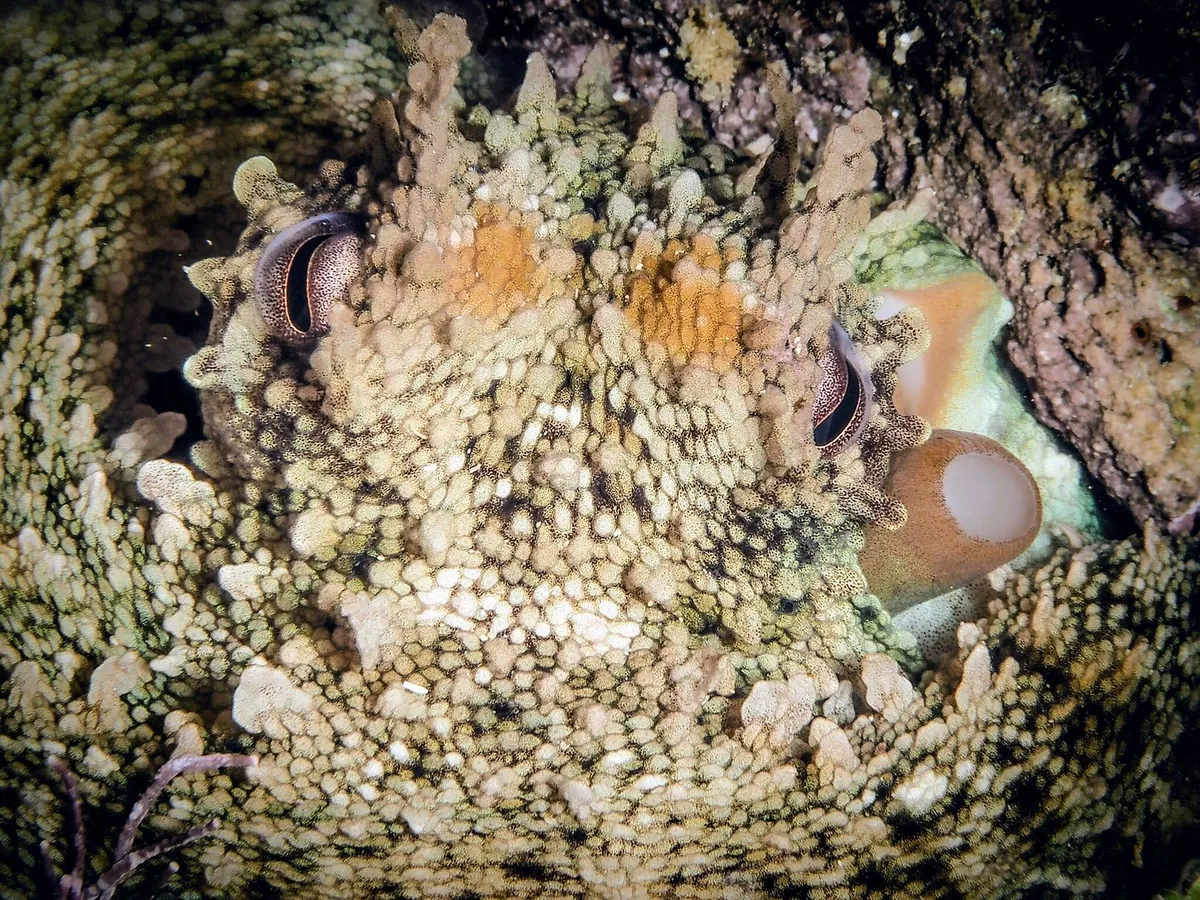
Octopuses don't just change color — they reshape their skin itself, rippling tiny projections across their bodies to match rocky seafloors or sandy bottoms. For decades, researchers have chased this dual ability in the lab, imagining what it could unlock: robots that blend into disaster zones, displays that show true depth instead of flat screens, camouflage that actually works.
Now they've done it. A team of scientists has built a flexible material that independently controls both color and surface texture, published this week in Nature. The breakthrough matters because the texture part — that's the hard bit. Anyone can make something change color. Making it reshape itself, at the fine scale an octopus manages, has stumped researchers until now.
How the Material Works
The researchers started with a polymer film — think of it as a thin plastic sheet — that swells when wet. Using a focused beam of electrons, they could control exactly where and how much the material puffed up, creating detailed textured patterns. It's precise enough that they carved a miniature El Capitan rock face into it, complete with tiny ridges and valleys.
We're a new kind of news feed.
Regular news is designed to drain you. We're a non-profit built to restore you. Every story we publish is scored for impact, progress, and hope.
Start Your News DetoxFor color, they sandwiched the polymer between two layers of gold. The gap between those layers acts like an optical cavity: change the distance, change which wavelengths of light bounce back. Stack multiple layers, expose them to water or isopropyl alcohol, and you can shift the color independently from the texture. The material does both at once.
Physicists Benjamin Renz and Na Liu, commenting on the work, called it "ingenious in both concept and execution." That's the kind of praise that matters in a field where previous attempts at color-changing synthetics existed, but nothing had nailed the texture problem.
What Comes Next
The applications are obvious enough that the research community is already excited: screens that show three-dimensional scenes with real depth, robots that genuinely vanish into their surroundings, camouflage that works because it's not just visual. But there's a catch. The material relies on liquids — water or alcohol — to change. Electronics and water don't typically get along. Sensitive circuits corrode. Batteries short.
The researchers acknowledge this. Their next move is finding a way to trigger the texture changes with electricity instead of liquid. That's the practical hurdle between "this works in the lab" and "this ships in products." It's also probably solvable. When the fundamental mechanism works this well, engineering the trigger is usually the easier problem.
What octopuses evolved over millions of years, we've now reverse-engineered in a lab. The question isn't whether it's possible anymore — it's how quickly we can make it practical.