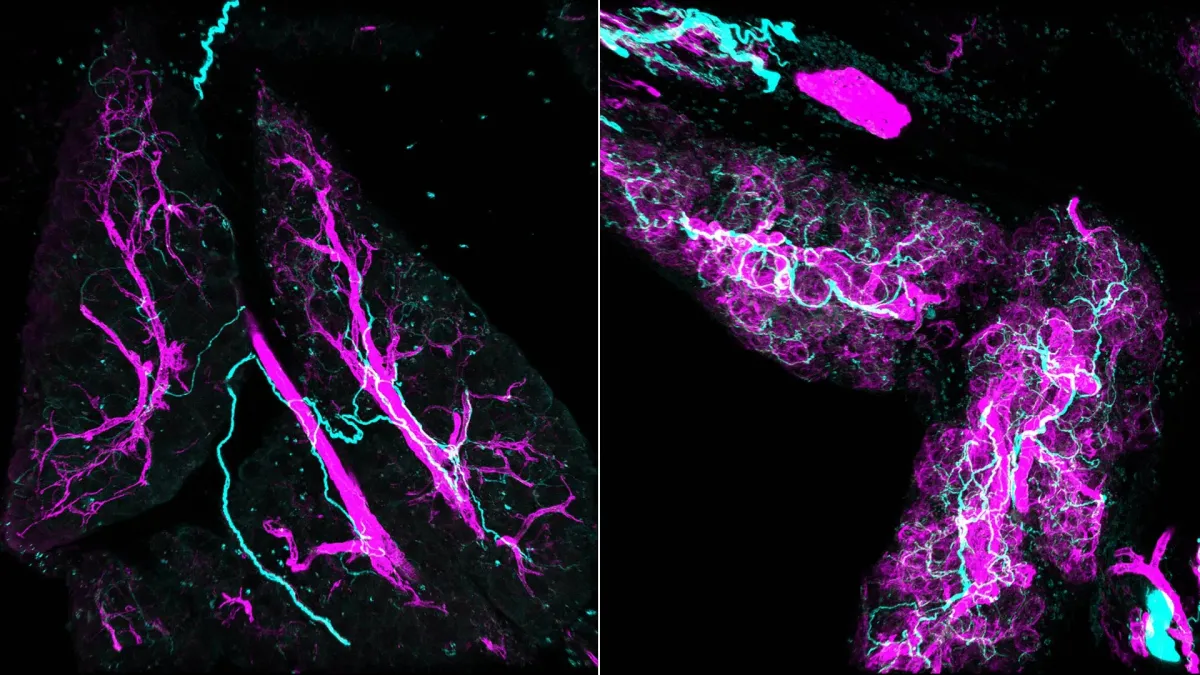
Pancreatic cancer is brutal partly because it hides. By the time most people notice symptoms, the disease has already dug in deep. But researchers at Cold Spring Harbor Laboratory have found something that changes how we think about its origins: cancer doesn't build alone. It actively recruits the body's own nervous system to help it grow—and this happens before any tumor even forms.
For years, scientists knew nerves played a role in cancer spread. What they didn't know was how early that partnership begins. The new research, published in Cancer Discovery, shows that the nervous system is essentially complicit from the start, helping create the conditions where pancreatic cancer can take hold.
The Hidden Network
The team used advanced 3D imaging to see what was actually happening inside early pancreatic lesions. What they found was striking. In traditional 2D images, nerve fibers look like scattered dots. But in three dimensions, they discovered something else entirely: a thick, interconnected web of nerves winding through the lesions like vines. "When we first saw this picture, I was shocked," says Jeremy Nigri, a postdoc in the lab. "I couldn't even imagine the lesion like this."
We're a new kind of news feed.
Regular news is designed to drain you. We're a non-profit built to restore you. Every story we publish is scored for impact, progress, and hope.
Start Your News DetoxThose nerves aren't random bystanders. They're actively recruited by tumor-supporting cells called myCAFs, which release chemical signals that draw nerve fibers closer. Once the nerves arrive, they release norepinephrine—a neurotransmitter that triggers a cascade inside the fibroblasts. This causes a surge of calcium that further activates the cancer-supporting cells, which in turn draws in even more nerves. It's a self-reinforcing loop, each side feeding the other's growth.
Disrupting the Partnership
Here's where it gets interesting. When researchers disabled this nerve activity in mice—using a neurotoxin to shut down the sympathetic nervous system—tumor growth dropped by nearly 50 percent. That's substantial. It suggests that breaking this early partnership between nerves and cancer cells could genuinely slow the disease before it becomes established.
Because this nerve-fibroblast crosstalk happens so early, before tumors are even visible, it opens a new window for intervention. The team thinks existing drugs like doxazosin—already used for other conditions—might work when combined with standard treatments like chemotherapy or immunotherapy. The goal isn't to replace current therapies, but to hit pancreatic cancer at a moment when it's still vulnerable, before it's fully fortified.
Pancreatic cancer remains one of the hardest cancers to treat, but this discovery suggests there's a pressure point we hadn't fully understood. By targeting the nervous system's involvement early, researchers might finally have a way to weaken the disease before it fully forms.