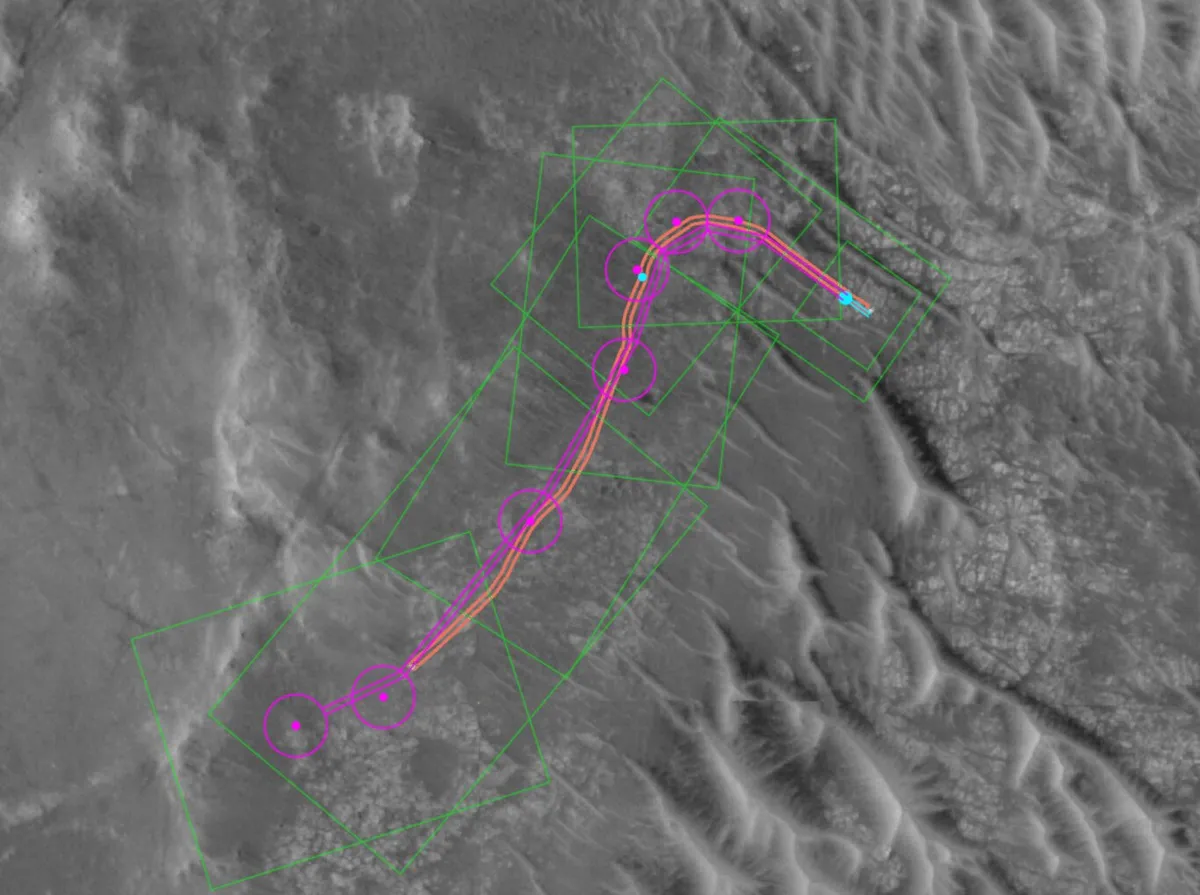
NASA's Perseverance rover just drove across Mars without a human at the controls. On December 8 and 10, the rover completed two drives—210 meters and 246 meters respectively—guided entirely by artificial intelligence that had planned the route, identified safe terrain, and generated the waypoints needed to navigate.
This might sound routine until you remember the scale of the problem. Mars sits roughly 140 million miles from Earth. Radio signals take between 5 and 20 minutes to make the journey one way, which means real-time remote control is impossible. For nearly three decades, human rover planners at NASA's Jet Propulsion Laboratory have done this work manually: analyzing satellite imagery, studying terrain slopes, sketching routes by hand, and marking waypoints—the fixed locations where the rover receives new instructions.
Now, for the first time on another world, a generative AI model did that analysis. The system studied the same high-resolution orbital imagery and terrain data that human planners use, identified critical features, and generated a continuous path with waypoints already built in.
We're a new kind of news feed.
Regular news is designed to drain you. We're a non-profit built to restore you. Every story we publish is scored for impact, progress, and hope.
Start Your News DetoxWhat changed
The shift matters because of what it enables. As rovers travel farther from Earth—and as future missions head to the Moon, Venus, or beyond—the communication delay becomes more punishing. Human planners can only send commands once a day. An AI that can analyze terrain, spot hazards, and plan routes autonomously could let rovers cover much more ground, respond to unexpected obstacles in real time, and spend less time waiting for instructions from home.
Before sending the AI's commands to Mars, JPL's engineering team ran them through a digital twin—a virtual replica of Perseverance—and verified over 500,000 telemetry variables. This wasn't a leap of faith. It was a carefully tested handoff.
"The fundamental elements of generative AI are showing a lot of promise in streamlining autonomous navigation," said Vandi Verma, a space roboticist at JPL. She points toward a future where rovers could handle kilometer-scale drives with minimal human oversight, and where AI could flag interesting geological features by sifting through thousands of rover images.
NASA Administrator Jared Isaacman framed it plainly: "Autonomous technologies like this can help missions operate more efficiently, respond to challenging terrain, and increase science return as distance from Earth grows."
Two successful drives in December are a proof of concept, not the end of the story. The next phase will test whether AI planning can scale up—whether it works for longer routes, more complex terrain, and the kind of sustained autonomous operation that future Mars missions will demand.