Researchers at the University of Konstanz have found a new kind of friction. It happens without any physical contact. Instead, magnetic forces create resistance to movement.
This discovery challenges Amontons’ law, which is a 300-year-old rule in physics. Amontons' law says that friction always increases with load. However, this new magnetic friction can peak and then decrease, especially when magnetic forces within the system become "frustrated."
Challenging an Old Law
For centuries, Amontons’ law has explained why heavier objects are harder to move. For example, pushing a heavy couch takes more effort than sliding a light chair. This is usually because heavier objects create more tiny contact points on surfaces, increasing friction.
We're a new kind of news feed.
Regular news is designed to drain you. We're a non-profit built to restore you. Every story we publish is scored for impact, progress, and hope.
Start Your News DetoxHowever, this law might not apply when movement causes big changes inside materials, like in magnetic substances. Here, sliding can actually change the magnetic order itself.
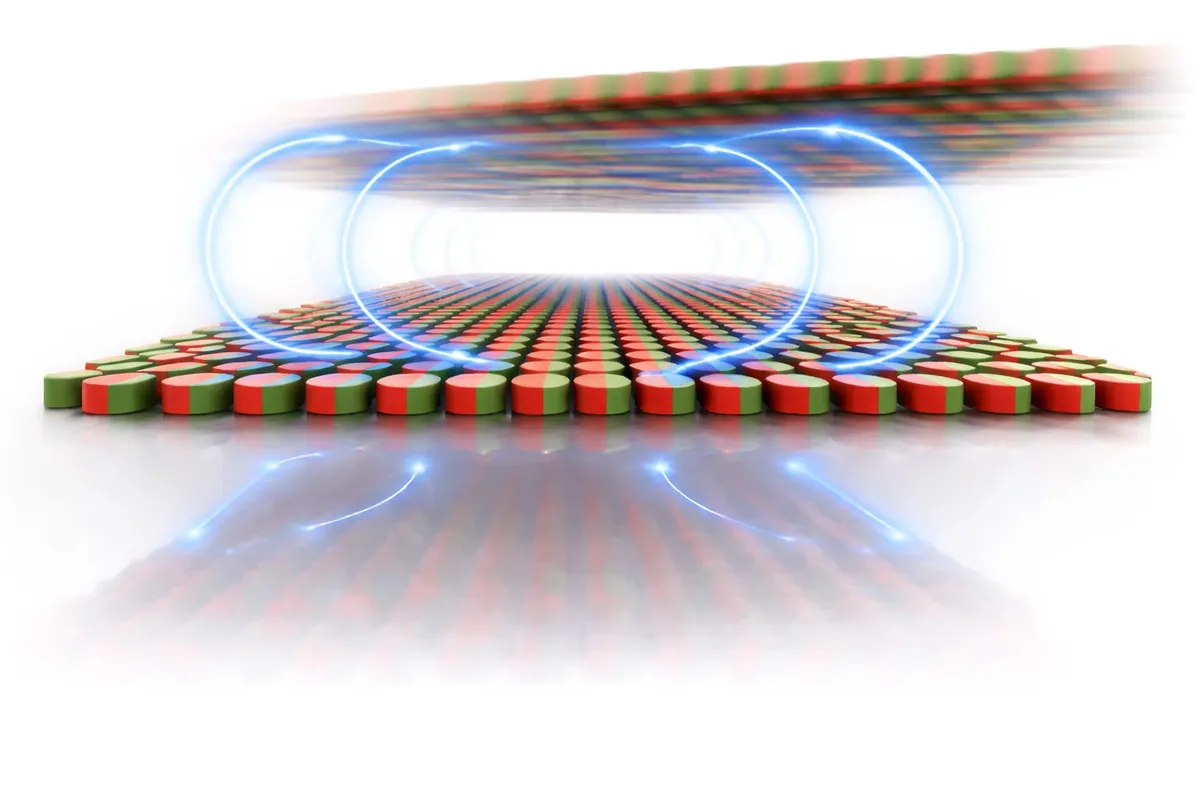
To test this, researchers set up an experiment. They used two layers of magnetic elements. The top layer had freely spinning magnets, and it was placed above a second magnetic layer. The layers never touched, but their magnetic interaction still created a measurable friction force. By changing the distance between the layers, the team could control the "load" and see how the magnetic structure changed during movement.
Magnetic Forces and Dynamic Changes
Hongri Gu, who did the experiments, explained that changing the distance between the magnetic layers made the system enter a state of competing interactions. The magnets in the top layer constantly reorganized as they slid.
Friction was lowest when the layers were either very close or very far apart. But at middle distances, competing magnetic forces took over. The top layer's magnets preferred to align in opposite directions (antiparallel), while the bottom layer's magnets preferred to align in the same direction (parallel). This mismatch created an unstable situation.
As the layers moved, the magnets repeatedly switched between these opposing setups. This switching caused energy loss and led to a strong peak in friction.
Anton Lüders, who developed the theory, noted that this system is special because friction comes from the collective movement of magnetic forces, not from physical contact. These competing magnetic interactions cause the magnets to reorient repeatedly, leading to a friction force that doesn't simply increase with load. This means the breakdown of Amontons’ law is a direct result of how the magnets behave during sliding.
Friction Without Wear
Clemens Bechinger, who oversaw the project, highlighted that this friction comes entirely from internal reorganization. There is no wear, no rough surfaces, and no direct contact. Energy is lost only through these collective magnetic changes.
Since the physics behind this effect works at different scales, these findings could apply to very thin magnetic materials. Even small movements in these materials can change their magnetic order. This opens up new ways to study and control magnetism using friction measurements.
This research could lead to new systems where friction can be adjusted without causing wear. By using magnetic "memory" (hysteresis), friction could be controlled remotely and reversibly. This could help create new technologies like friction-based metamaterials, adaptive damping systems, and contactless control devices.
Possible uses include tiny micro and nanoelectromechanical systems, where wear is a big problem. It could also benefit magnetic bearings, vibration control, and ultrathin magnetic materials. Magnetic friction offers a new way to study how groups of spins behave by measuring mechanical forces, connecting the fields of tribology (the study of friction) and magnetism in a new way.
Deep Dive & References
Non-monotonic magnetic friction from collective rotor dynamics - Nature Materials, 2026