Imagine trying to watch a hummingbird's wings beat, but only being able to see a blurry streak. Now imagine that hummingbird is smaller than a virus, and its wings are made of light. That's roughly the challenge scientists at Argonne National Laboratory just tackled, finally catching a glimpse of light's incredibly fast, intricate dance inside nanoframes.
These aren't your grandma's picture frames. These are hollow, cage-like structures made of metal, so tiny they make a dust mite look like a skyscraper. And they have a superpower: they can focus and manipulate light at scales we're usually blind to. This happens thanks to something called plasmonics, where light hits the metal and electrons start boogying together, creating super-strong electromagnetic fields. Think of it as a microscopic light vortex, useful for everything from super-sensitive sensors to energy collection.

Peeking Inside the Light Vortex
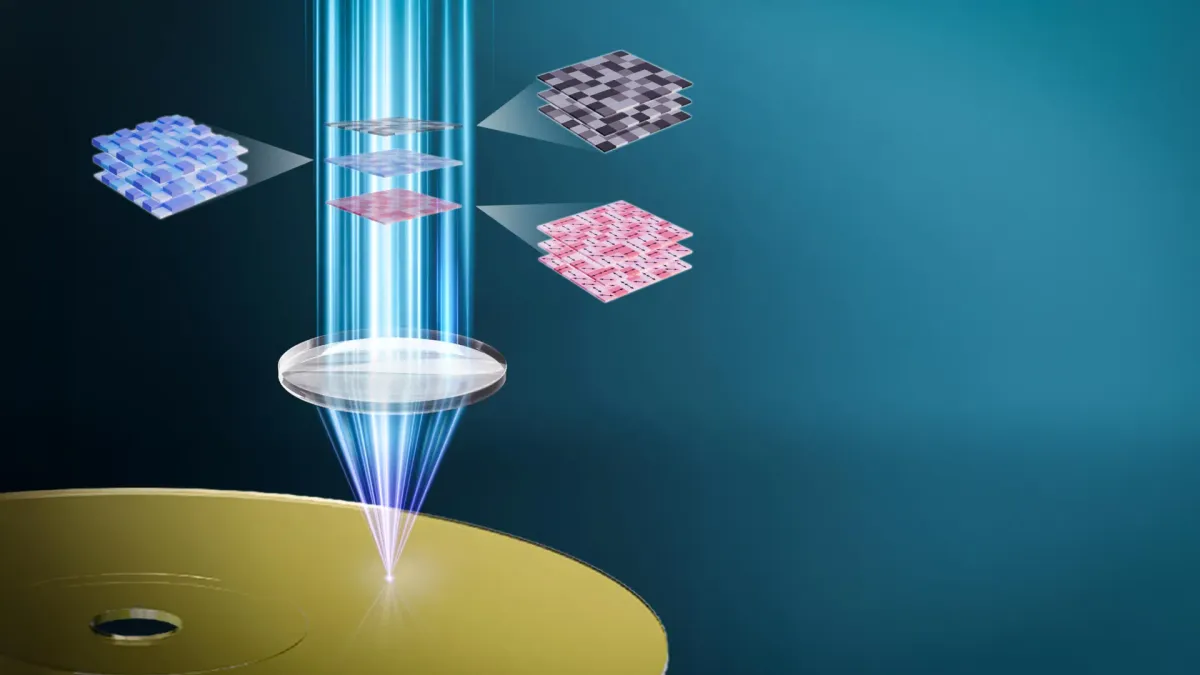
To actually see this microscopic light party, the Argonne team pulled out a fancy piece of kit: ultrafast electron microscopy, specifically a flavor called photon-induced near-field electron microscopy (PINEM). This isn't just any microscope; it’s a time machine and a magnifying glass rolled into one. It lets them capture events that unfold in femtoseconds (that's a quadrillionth of a second – blink and you'll miss a few million of them) while simultaneously zooming in on details at the nanometer scale.
We're a new kind of news feed.
Regular news is designed to drain you. We're a non-profit built to restore you. Every story we publish is scored for impact, progress, and hope.
Start Your News DetoxBy blasting these nanoframes with super-short laser pulses and then hitting them with electron beams, the researchers could literally watch the light-generated electromagnetic fields spread out and change shape. It’s like getting a slow-motion replay of a quantum ballet. Haihua Liu, one of the Argonne scientists, pointed out that combining these experiments with computer models gave them a serious leg up in understanding how these little cages interact with light. Which, if you're into biosensing or cleaner energy, is a pretty big deal.
This isn't just a cool parlor trick, though. It fills a gaping hole in nanoscience. For ages, scientists have struggled to see both the structure of these tiny materials and how they behave at lightning-fast speeds. Traditional microscopes usually force you to pick one: either you see the details, or you see the speed. PINEM says, "Why not both?" It’s now clear that the hollow, cage-like design of nanoframes isn't just for show; it's what helps them boost and contain those electromagnetic fields so effectively, making them more powerful than their solid nanoparticle cousins.

Koray Aydin, a co-senior author from Northwestern University, put it best: seeing light interact with nanostructures in both space and time "opened a new window into the nanoscale world." This newfound clarity means we can now design nanomaterials with specific superpowers, fine-tuning them for things like ultra-efficient chemical reactions, detecting incredibly small amounts of molecules, or even building better light-harvesting systems. Because apparently, even at the smallest scales, shape matters.