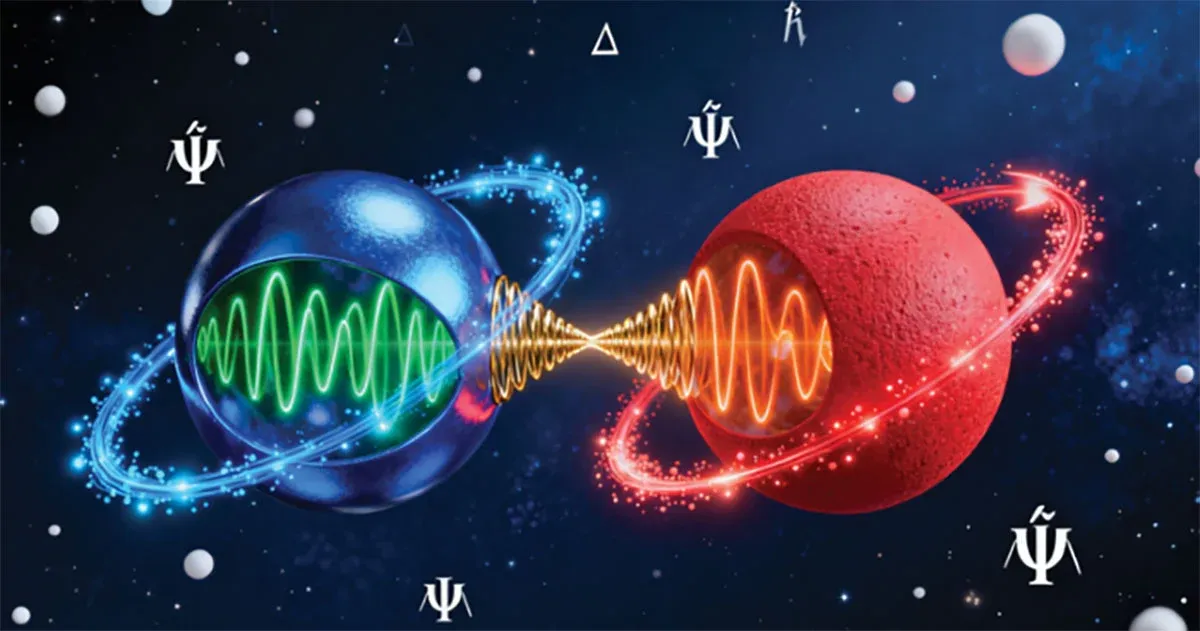
Three physicists at RIKEN have found a new way to achieve one-way quantum synchronization in phonons. Phonons are particles related to sound that carry vibrations. This new method is designed to stay stable even when real-world problems like manufacturing flaws or environmental noise would normally break delicate quantum effects.
Many technologies use components that act like one-way streets. They let particles or signals move easily in one direction but strongly block movement in the other. These "nonreciprocal" parts are already key in microwave and optical systems. They help guide signals and stop unwanted reflections.
Franco Nori from the RIKEN Center for Quantum Computing (RQC) explained that nonrecreciprocal components make signals travel along desired paths. They are greatly weakened if they try to go the other way. This is useful for things like signal processing and even invisible cloaking.
We're a new kind of news feed.
Regular news is designed to drain you. We're a non-profit built to restore you. Every story we publish is scored for impact, progress, and hope.
Start Your News DetoxOne-Way Quantum Behavior
Physicists want to create nonreciprocal quantum synchronization in the lab. This is where two quantum systems synchronize in one direction, but not in the opposite direction.
Making this idea work in practice has been tough. Earlier methods had limits that would make them hard to use in real experiments.
Adam Miranowicz, also from RQC, noted that practical quantum technologies face big problems from random manufacturing flaws and noise from the environment. These issues can severely reduce or even destroy quantum resources in older approaches.
A Stronger Path to Synchronization
Nori, Miranowicz, and Deng-Gao Lai have now proposed a way to create nonreciprocal quantum synchronization in phonons. Their method aims to avoid the practical weaknesses of earlier designs.
Nori believes this development creates a new base for making robust nonreciprocal quantum resources that can be used in the future.
The new method combines two quantum effects. It makes phonons synchronize when light or a magnetic field is applied from one direction. But it stops the same synchronization if the input comes from the opposite direction.
The strength of this effect surprised the physicists. Lai said they were excited to find that quantum synchronization still works even with many imperfections and noise. Before, people thought this was impossible without complex protection.
Towards Stronger Quantum Devices
Nori, Miranowicz, and Lai think this work could help create more practical quantum technologies. They plan to keep developing the idea.
Lai commented that their research helps make more reliable quantum processors and protected quantum resources by allowing strong nonreciprocal quantum synchronization. They are now looking into using it for quantum networking and quantum information processing that can handle errors.
Deep Dive & References
Nonreciprocal quantum synchronization - Nature Communications, 2025