Scientists have finally figured out the hidden math behind how humans see colors. This new research helps answer questions from a color perception theory proposed almost 100 years ago by physicist Erwin Schrödinger.
A team led by Los Alamos National Laboratory scientist Roxana Bujack used geometry to explain how people experience hue, saturation, and lightness. Their findings support Schrödinger's original idea. They show that these color qualities are basic parts of the color system itself.
Unlocking Color's Intrinsic Properties
Bujack explained that these color qualities don't come from outside influences like culture. Instead, they reflect the natural properties of how we measure color. This measurement system uses geometry to show how different two colors appear to someone.
We're a new kind of news feed.
Regular news is designed to drain you. We're a non-profit built to restore you. Every story we publish is scored for impact, progress, and hope.
Start Your News DetoxBy clearly defining these color traits, the researchers believe they have found a key missing piece in Schrödinger's long-held vision. He wanted a complete model that could define hue, saturation, and lightness using only geometric relationships between colors.
The Geometric Basis of Color Vision
Our eyes have three types of cone cells that detect color. Each one is mainly sensitive to red, blue, and green light. This creates a three-dimensional space that scientists use to organize colors. It's called color space.
In the 1800s, mathematician Bernhard Riemann suggested that these perceptual spaces might be curved, not flat. Schrödinger built on this idea in the 1920s. He created mathematical definitions for hue, saturation, and lightness using a Riemannian model of color perception.
For many years, Schrödinger's work was the basis for understanding color. But while creating algorithms for scientific visualization, the Los Alamos researchers found problems in the math behind the theory. These issues led the team to improve the framework.
Solving the Neutral Axis Puzzle
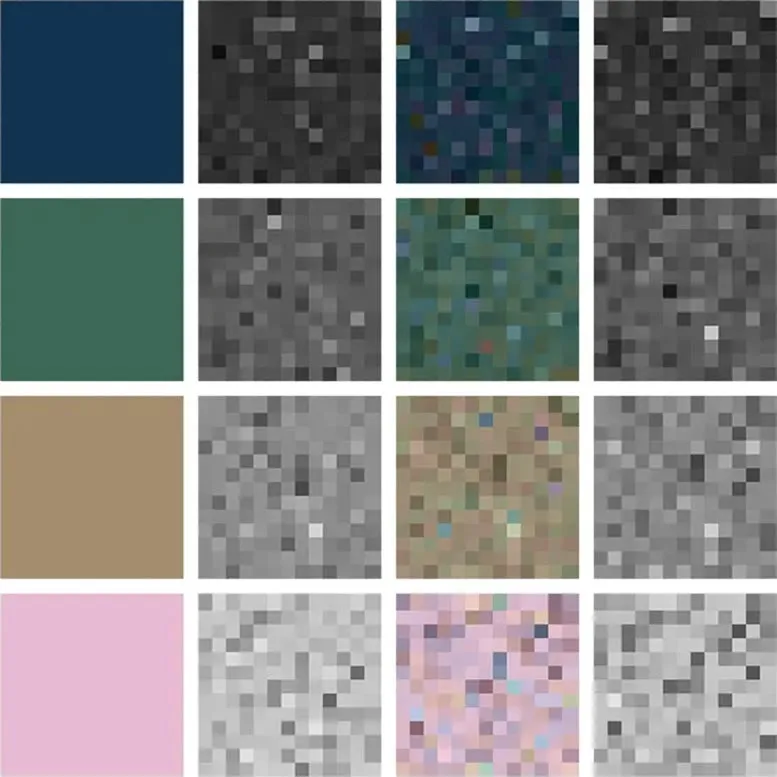
One big challenge was the "neutral axis." This is the line of gray shades from black to white. Schrödinger's definitions depended on a color's position relative to this axis. However, he never defined the axis itself mathematically. Without that, the model wasn't fully complete.
The researchers' biggest breakthrough was defining the neutral axis using only the geometry of the color measurement. To do this, the team went beyond the usual Riemannian framework. This was a major step forward in visualization mathematics.
The team also fixed two other problems in color perception models. One was the Bezold-Brücke effect. This is when changes in light intensity can make a hue look different. Instead of using straight lines, the researchers used the shortest possible path through the perceptual color space. They used this same shortest-path method in a non-Riemannian space. This helped explain why it's harder to tell the difference between very similar colors.
Advancing Visualization Science
This work was presented at the Eurographics Conference on Visualization. It's the result of a larger color perception project. That project also led to a major paper published in 2022 in the Proceedings of the National Academy of Sciences.
A more accurate understanding of color perception could have many uses. Visualization science is important in photography, video, scientific imaging, and data analysis. Good color models help researchers understand complex information better. This supports fields from advanced simulations to national security science. The study also sets the stage for future color modeling in non-Riemannian space.
Deep Dive & References
The Geometry of Color in the Light of a Non-Riemannian Space - Computer Graphics Forum, 2025 PNAS 2022 paper - Proceedings of the National Academy of Sciences, 2022