Portable solar panels are popular for off-grid camping and backpacking. They are light, quiet, and efficient. However, solar power needs the sun. When it's night, cloudy, or winter, solar panels become useless.
Ventyra, a new Denver startup, aims to solve this problem with wind power. The company launched a crowdfunding campaign for the Ventyra R1. This is a compact, ultra-portable wind power system for adventurers who care about weight.
Portable Wind Power for Off-Grid Adventures
Small wind generators are not new. But they have usually been larger units for marine use or off-grid cabins. Hiking with these turbines meant carrying heavy poles and complex charge controllers.
We're a new kind of news feed.
Regular news is designed to drain you. We're a non-profit built to restore you. Every story we publish is scored for impact, progress, and hope.
Start Your News DetoxVentyra has made the hardware much smaller for backpacking. The full kit weighs just 2.2 pounds (1 kg). The foldable tripod and four-blade turbine fit inside a standard multi-day hiking pack.
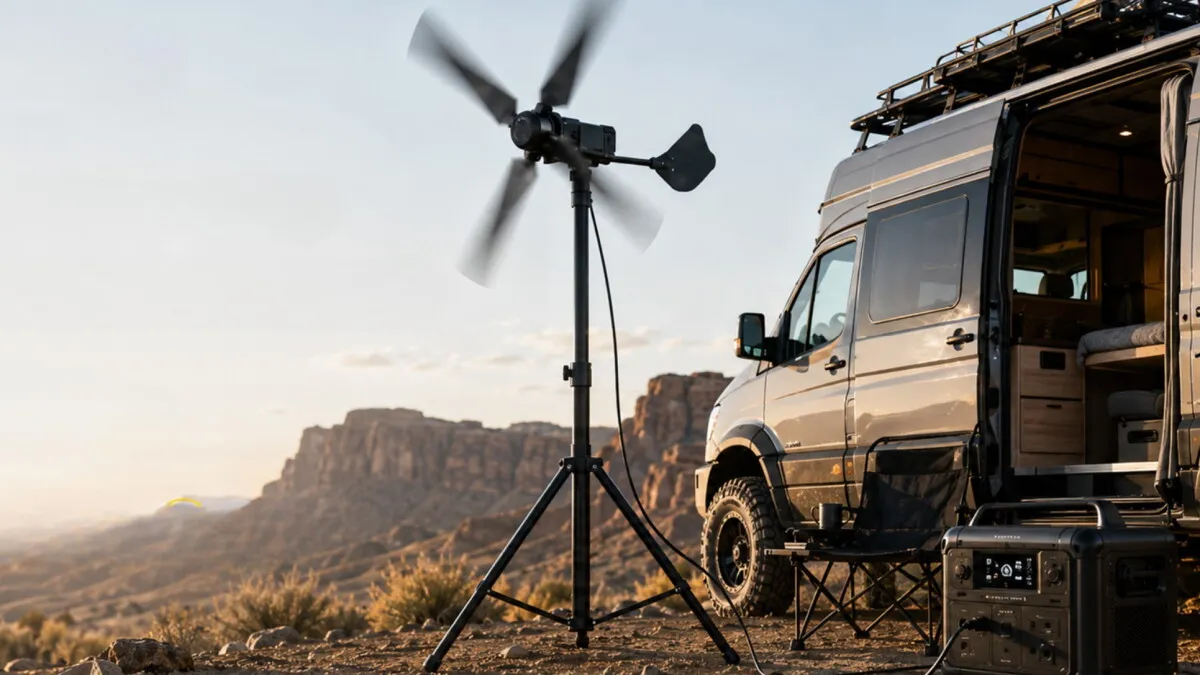
The R1 uses a clever flexible four-blade design. The blades fold inward, flat against the main generator housing. This means you don't need to detach blades or use tools in the field, reducing the risk of losing small parts.
When packing, the legs fold parallel to the main body. The whole unit becomes slim and fits into a backpack pocket or main compartment. To set up the R1, you unfold the tripod legs, place it on stable ground, and open the turbine blades until they click. The turbine automatically finds the best direction for the wind.
Despite its small size, the R1 claims a 75-W peak power output. It sends electricity through an XT60 cable to a power hub (not included) with standard USB ports. This lets users charge electronics, power banks, and headlamps.
The turbine starts working in very low wind. It begins at just 6.7 mph (3 m/s), which is a gentle breeze. You don't need strong winds to get power. However, the structure looks a bit flimsy. A strong gale might blow the lightweight device away.
The R1 joins other portable wind tech like the Micro Wind Turbine from 2016, the Wind Catcher, and the Shine 2.0. The R1's design, weight, and output are comparable to these.

Engineers have some concerns. The R1 is not waterproof. The creators suggest taking it apart during heavy rain to keep the power hub dry. Also, ground wind is often turbulent. A steady 50-W output usually needs more consistent high-altitude airflow, which a small ground-level tripod might rarely get.
This appears to be Ventyra’s first product. The creators are designers, engineers, and outdoor explorers. They aim to make clean energy portable for backcountry adventures. Hardware startups often face delays in manufacturing and shipping their first products.
The R1 is live on Kickstarter. Pledge levels start at US$179, which is 40% off the expected retail price. Crowdfunding campaigns have risks, but the page shows pre-production testing and a working prototype. The project is already fully funded. Shipping is estimated to start in December if all goes as planned.