Pregnancy Rewires the Brain to Enhance Motherhood
The phrase "baby brain" has long been weaponized—a dismissive way to suggest pregnant women become scattered and less capable. But a large-scale study now shows something more precise is happening: the pregnant brain is actually reorganizing itself, shedding grey matter in ways that appear to sharpen a woman's capacity to bond with and care for her newborn.
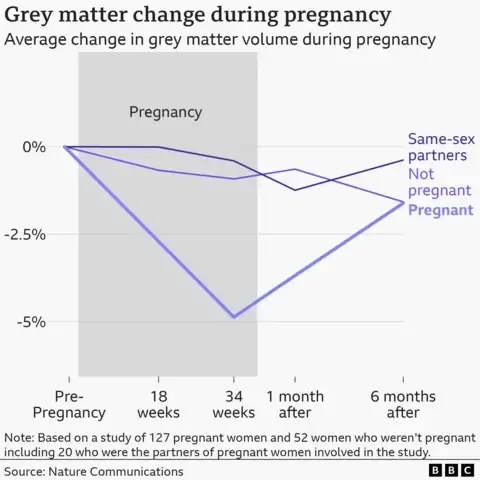
Researchers at the Gregorio Marañón Health Research Institute in Madrid tracked 127 pregnant women through brain scans before, during, and after pregnancy, comparing them to 52 non-pregnant women. The results were clear. By week 34 of pregnancy, grey matter—the information-processing tissue involved in emotions and empathy—had decreased by roughly 5% on average. Rather than decline, scientists describe this as the brain "pruning" itself, much like cutting branches from a tree so it grows more efficiently.
The changes cluster in the default mode network—a region tied to self-awareness, empathy, and thinking about others' mental states. This restructuring mirrors what happens in the teenage brain during adolescence, when grey matter thins as the brain matures. It's not loss. It's specialization.
We're a new kind of news feed.
Regular news is designed to drain you. We're a non-profit built to restore you. Every story we publish is scored for impact, progress, and hope.
Start Your News Detox
What This Actually Means
The study found something striking: women who experienced greater grey matter changes reported stronger emotional bonding with their babies. This suggests the brain's reorganization isn't incidental—it's functional. Hormones, particularly rising estrogen, appear to drive much of the shift, tracked through urine and saliva samples across the study.

Prof Susana Carmona, who led the research, reframes what new mothers actually acquire: "New mums learn a whole set of new skills." The forgetfulness some women report during pregnancy—struggling to recall a colleague's name, losing track of routine tasks—likely stems from the metabolic demands of pregnancy itself: less sleep, less energy, divided attention. It's not stupidity. It's resource allocation.
Ana Mudrinic, a London mother in the study, experienced this shift firsthand. She found herself forgetting details unrelated to her baby but becoming more resilient to workplace stress. "Some things are not as important as they used to be," she said. Her brain didn't break. It reprioritized.
Why This Matters Beyond Pregnancy

This research does something quiet but important: it treats pregnancy as a legitimate neurological event, not a temporary glitch. The findings could eventually help researchers understand postpartum depression, improve support for new mothers, and shift how we talk about what happens to women's bodies and minds during this period.
Carmona is careful to note that parenting isn't exclusive to pregnancy—adoptive parents, partners, and others can be excellent caregivers without experiencing these brain changes. But for those who do become pregnant, the research offers validation: you're not losing your mind. Your mind is becoming something different, something oriented toward another person's survival and wellbeing.

Tania Esparza, a study participant, was drawn to motherhood partly by Carmona's earlier research. "I was excited by the idea that I could meet a new, different version of myself," she reflected. She now advocates for society to recognize mothers as people undergoing profound transformation: "They are coming outside of a cocoon and becoming something different."
The study, published in Nature Communications, represents early mapping of how pregnancy reshapes the brain. Much remains to be understood about this pivotal period—work that could fundamentally change how we support and value the women going through it.