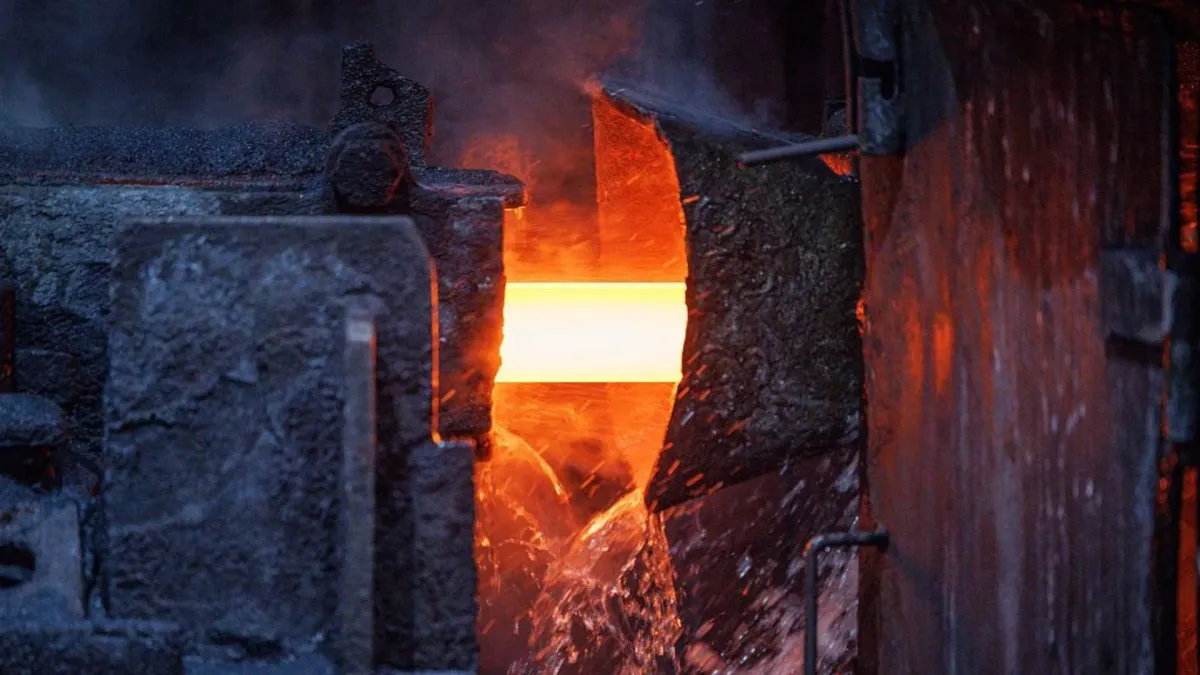
For as long as blacksmiths have worked metal, heat has meant softness. Warm the steel, and the atoms loosen their grip on each other. Bend it. Shape it. This rule has held so steady that it's become invisible—just how physics works.
Until now.
Researchers at Northwestern University have found that when you hit pure metal fast enough, heat does the opposite. It hardens. The atoms, vibrating wildly from the impact and the temperature, actually lock together more tightly, pushing back against the force trying to deform them.
The team discovered this by firing microscopic particles at metal surfaces at hundreds of meters per second—so fast that a billion impacts could happen in the time it takes a car to crash. Using a specialized micro-ballistic rig, they watched what happened to pure metals like nickel and gold as temperatures climbed toward 155°C. Instead of softening as expected, the metals got harder. Slightly alloyed versions of the same metals behaved the old way—softer with heat, as the textbooks promised.
We're a new kind of news feed.
Regular news is designed to drain you. We're a non-profit built to restore you. Every story we publish is scored for impact, progress, and hope.
Start Your News Detox"If we smack a pure metal really fast, we're asking the atoms to move faster than they really want to," explained Chris Schuh, the study's lead author. "So they resist and push back. That's where their source of strength comes from."
The physics is counterintuitive but elegant. During these ultra-fast impacts—happening in fractions of a microsecond—the metal's atoms oscillate so violently that they physically obstruct the path of deformation. As temperature rises, these vibrations intensify, creating a chaotic, resistant barrier that paradoxically strengthens the surface against high-speed stress. It's like a crowd of people being jostled so hard they accidentally lock arms.
What Changes Now
This isn't just a curiosity for materials scientists. The finding opens a design space that didn't exist before. Hypersonic aircraft, satellite hulls, structures built on other planets—these environments punish materials in ways we've never fully optimized for. Now engineers know they can treat purity itself as a design parameter, creating metals that thrive under conditions that would destroy conventional materials.
The researchers are already imagining defensive applications: satellite hulls that intentionally heat up when struck by micrometeorite impacts, hardening themselves in real time. It's the kind of counterintuitive solution that only emerges when someone is willing to question what "everyone knows."
For a field built on rules established centuries ago, this is a reminder that extreme conditions reveal truths the everyday world keeps hidden. The atoms always knew how to behave at the edge. We're only just now learning to listen.