Imagine a solid that doesn't behave like a solid at all. Researchers from universities across Germany and the US have discovered crystals made from spinning particles that do something almost alive: they spontaneously shatter into fragments, then reassemble themselves back into their original structure.
These aren't theoretical abstractions. An international team led by Professor Hartmut Löwen at Heinrich Heine University Düsseldorf has studied these materials in detail and described their findings in the Proceedings of the National Academy of Sciences. What they found challenges our basic assumptions about how matter behaves.
How Spinning Particles Create Strange Matter
The crystals form when countless spinning components pack tightly together. At high concentrations, something unexpected happens: the system develops what physicists call "odd elasticity." In normal materials, if you pull on something, it stretches in the direction you're pulling. In these odd elastic crystals, pulling produces twisting instead. The material responds perpendicular to the force applied.
We're a new kind of news feed.
Regular news is designed to drain you. We're a non-profit built to restore you. Every story we publish is scored for impact, progress, and hope.
Start Your News DetoxThis counterintuitive behavior stems from "transverse forces"—interactions that act at right angles to the line connecting two objects. The phenomenon isn't new to physics, but seeing it create stable crystal structures is. The researchers found that starfish embryos in the ocean exhibit similar transverse interactions, their swimming motions causing them to circle around each other. Now the same principle shows up in engineered materials.
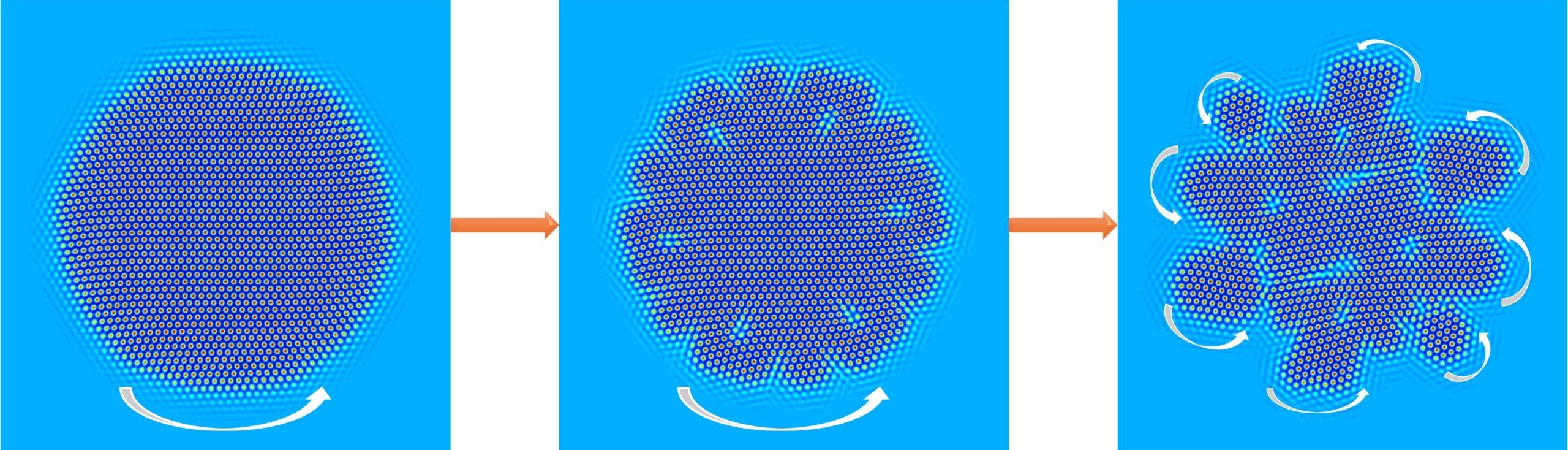
What makes these crystals truly unusual is their instability. When the rotating components rub against each other with enough force, the entire crystal spontaneously fragments into smaller spinning pieces. But here's where it gets strange: these pieces can recombine and reform the original crystal structure without any external intervention.
Breaking the Rules of Crystal Growth
The behavior also defies conventional crystal physics. Normally, when conditions favor growth, crystals get progressively larger. These odd crystals work differently. Large crystals tend to break down into smaller units, while smaller fragments grow only until they hit a specific size limit. It's the opposite of what thermodynamics would predict.
Professor Zhi-Feng Huang from Wayne State University and his team developed a theoretical framework that explains this across different scales. Their computer models revealed how these materials form and pointed toward practical uses. The key insight: there's a fundamental relationship between fragment size and rotation speed that determines when reassembly happens.
Another finding adds another layer of control. Professor Raphael Wittkowski from RWTH Aachen University discovered that defects within these crystals have their own dynamics—and can be deliberately influenced from outside. This means the material's properties aren't fixed; they can be tuned for specific applications.
What Comes Next
The implications extend far beyond this single material class. Dr. Michael te Vrugt from the University of Mainz emphasizes that the theory applies to any system with transverse interactions, from colloids to biological systems. Early applications could include new types of technical switches that exploit these novel elastic properties. The spinning crystals that break and heal themselves might seem like laboratory curiosities, but they're revealing how matter can behave in ways we're only beginning to understand.