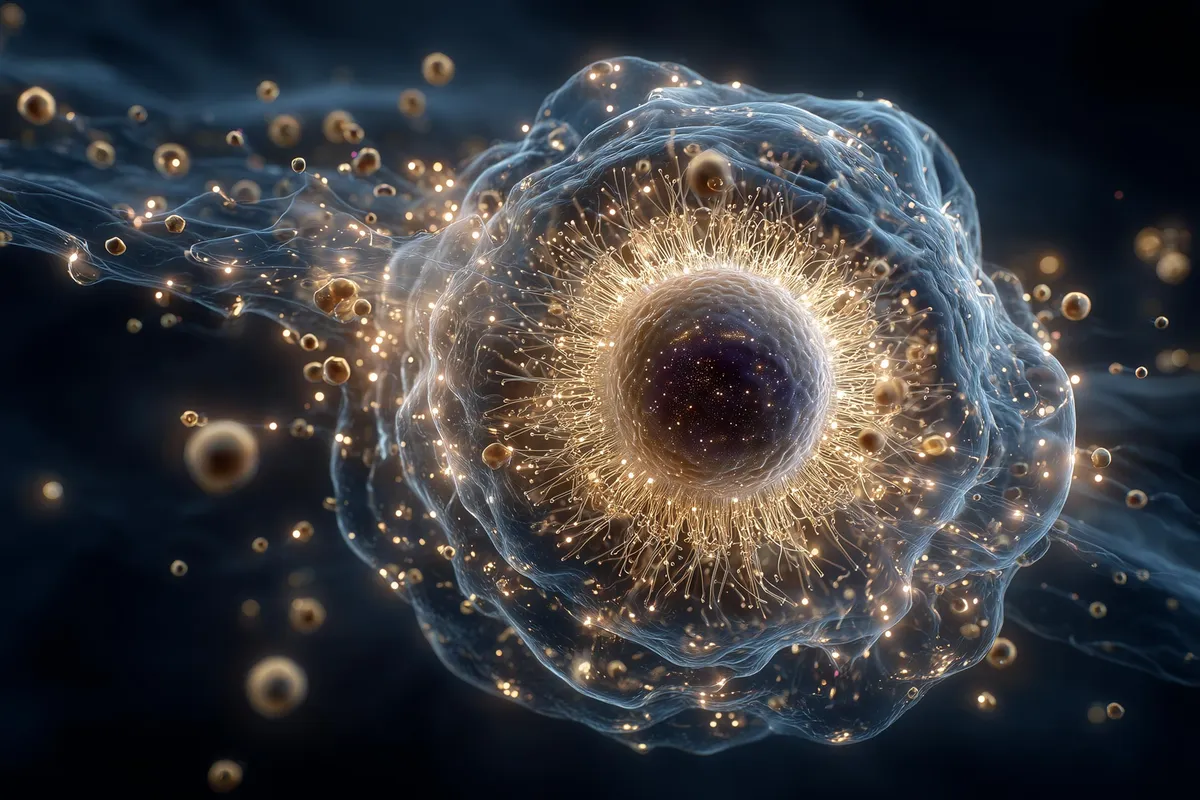
Every organism alive today traces back to a single common ancestor that lived about four billion years ago. Scientists call it the "last universal common ancestor," and it's the oldest point in evolutionary history we could reliably study—until now.
Researchers at Oberlin College, MIT, and the University of Wisconsin-Madison have found a way to peer even further back, into life before that ancestor existed. The key is hidden in genes that appear in nearly every living thing on Earth, duplicated across billions of years of evolution.
Reading the Genetic Record
Most genes appear once in an organism's genome. But some genes exist in multiple copies—called "paralogs." In humans, for example, there are eight different hemoglobin genes, all descended from a single ancestral gene that duplicated around 800 million years ago. Each copy gradually evolved its own tweaks and specializations.
We're a new kind of news feed.
Regular news is designed to drain you. We're a non-profit built to restore you. Every story we publish is scored for impact, progress, and hope.
Start Your News DetoxUniversal paralogs are rarer and far more revealing. These are gene families that appear in at least two copies in nearly every living organism on Earth. The fact that they're so widespread suggests something profound: the original duplication happened before the last universal common ancestor appeared. Both copies then got passed down through every evolutionary branch that followed—surviving four billion years of change.
"Some of the genes in the last universal common ancestor's genome were much older than the ancestor itself," explains Aaron Goldman from Oberlin College. "Universal paralogs are the only information we'll ever have about these earliest cellular lineages."
When researchers reviewed every known universal paralog identified so far, a pattern emerged. Nearly all of them are involved in two things: building proteins and transporting molecules across cell membranes. This suggests that these two functions were among the very first biological processes to evolve—older than anything else we can measure.
Goldman's lab went further. They reconstructed what one of these ancient proteins likely looked like billions of years ago, using evolutionary and computational biology methods. The rebuilt ancestral protein was simpler than modern versions, but it could still attach to cell membranes and interact with the machinery that builds proteins. It probably helped early, primitive proteins embed themselves in the first cell membranes—a crucial step in how basic cells functioned.
What Comes Next
As artificial intelligence and specialized computing tools improve, scientists expect to identify more universal paralog families and reconstruct their ancient ancestors in greater detail. "By following universal paralogs," says Betül Kaçar from Wisconsin-Madison, "we can connect the earliest steps of life on Earth to the tools of modern science. They give us a chance to transform the deepest unknowns of evolution into discoveries we can actually test."
For the first time, we're not just theorizing about life's origins—we're getting evidence we can hold up to scrutiny.