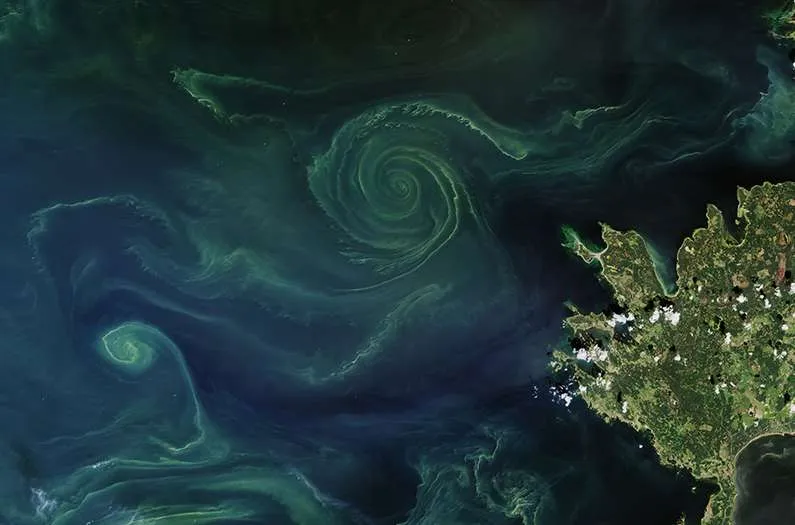
The ocean, bless its vast, briny heart, already does us a huge favor by slurping up about a third of the carbon dioxide we pump into the atmosphere. But what if we could give it a little boost? Scientists have been pondering the idea of ocean iron fertilization (OIF) — essentially sprinkling iron into the sea to supercharge tiny, carbon-gobbling organisms called phytoplankton.
Sounds simple, right? Like adding plant food to your garden. Except this garden is 70% of the planet, and getting it wrong could have consequences that are decidedly less than ideal.
Location, Location, Location
New research in the journal Nature suggests that if we're going to play ocean gardener, we need to be very, very particular about where we do it. The impact of OIF on the environment, and even its effectiveness, hinges entirely on its location.
We're a new kind of news feed.
Regular news is designed to drain you. We're a non-profit built to restore you. Every story we publish is scored for impact, progress, and hope.
Start Your News DetoxA team from the University of California, Irvine, found that going for higher latitudes, far from the equator, could significantly dial down the environmental risks while still effectively pulling carbon from the air. Think of it as finding the Goldilocks zone for oceanic intervention.
Jun Yu from UCI's earth systems science department put it plainly: the Central Pacific is a no-go zone due to its high ecological risks. The Southern Ocean, however, might just be the best bet, offering a balance of carbon removal and manageable environmental risk over the long haul. Because apparently that's where we are now: carefully calculating where to dump iron into the ocean for decades.
OIF isn't just a theoretical daydream. There have been past field tests, short-term experiments to see if iron could limit phytoplankton growth. But scaling that up to a climate solution? That's a whole different kettle of fish. And speaking of fish, that's where things get tricky.
Large-scale, long-term OIF could lead to a whole host of problems: biodiversity loss, expanding low-oxygen zones, and harming fish habitats. Why? Because adding iron can hog other vital nutrients, which means less zooplankton. And zooplankton are basically the snack food for, well, almost everything else in the ocean.
Yu, J. Keith Moore, Adam Martiny, and their colleagues ran a model to analyze OIF's potential and its effects on ten ocean areas over 60 years. They found OIF could remove up to 5.3 parts per million of carbon dioxide, or a satisfying 0.70 gigatons per year. The Southern Ocean and the equatorial Pacific showed the biggest plankton blooms, making them carbon-removal superstars.
But here's the kicker: while fertilizing just 0.35% of the equatorial Pacific led to a 10% drop in zooplankton, doing the same for 0.2% of the Southern Ocean actually led to a 10% increase in zooplankton. Which, if you think about it, is both impressive and slightly terrifying in its delicate balance.
The next step, Yu notes, is to figure out OIF's impact on fisheries. Because nobody wants to save the planet only to find out we've accidentally canceled sushi night forever.