Researchers have identified an unusual iron sulfate on Mars that may be a completely new mineral — one that's never been seen on Earth. The discovery comes from combining lab experiments with data from orbiting spacecraft, and it reveals something wild: parts of Mars stayed chemically active far more recently than anyone expected.
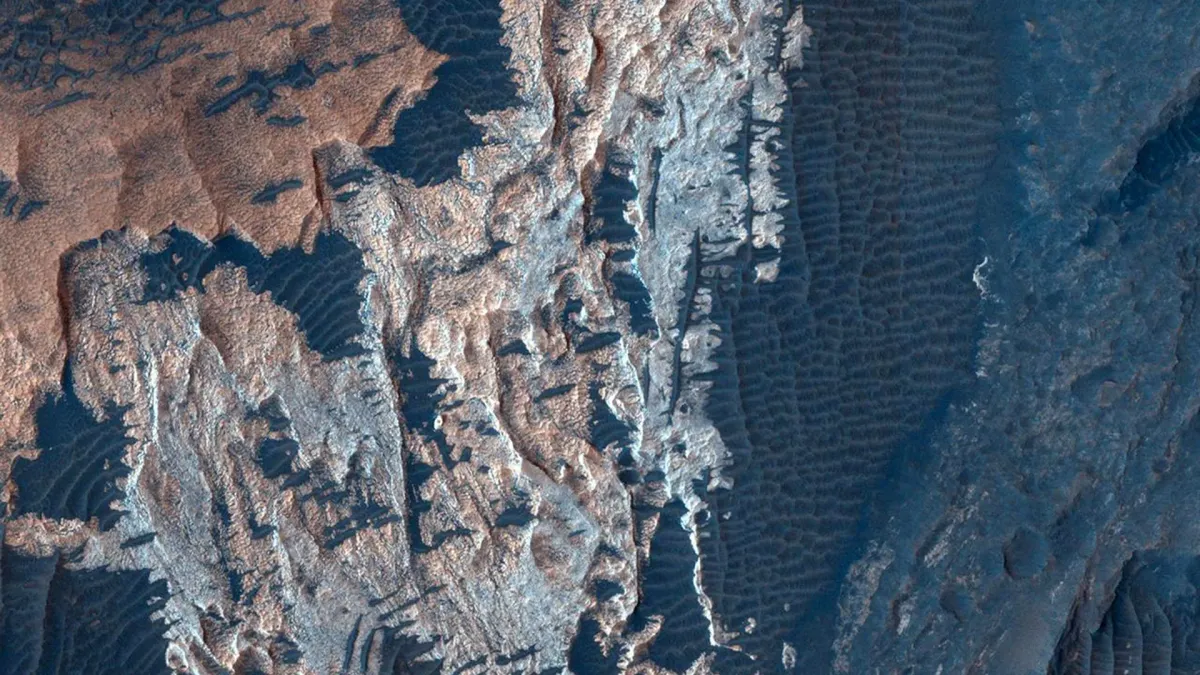
The mineral, called ferric hydroxysulfate, was found in layered deposits near Valles Marineris, one of the largest canyon systems in the solar system. It likely formed when ancient sulfate deposits left behind by water were heated by volcanic or geothermal activity, transforming their chemistry. The findings were published in Nature Communications by a team led by Dr. Janice Bishop at the SETI Institute and NASA's Ames Research Center.
Here's why this matters: Mars is bone-dry now, but it wasn't always. Billions of years ago, water flowed across the surface and left behind minerals. On Earth, those minerals would dissolve in rainwater and disappear. On Mars, with virtually no rain, they just sat there — perfectly preserved, like a geological time capsule. Scientists can read these minerals like a book, learning what Mars was like when water still existed.
We're a new kind of news feed.
Regular news is designed to drain you. We're a non-profit built to restore you. Every story we publish is scored for impact, progress, and hope.
Start Your News DetoxThe puzzle that took two decades to solve
For nearly 20 years, researchers had noticed strange layered iron sulfates on Mars that didn't match any known mineral. The spectral signals — basically the mineral's fingerprint when scanned from orbit — were unusual. Nobody could figure out what they were looking at.
The breakthrough came from the lab. Scientists heated common sulfate minerals and watched what happened. When they warmed polyhydrated sulfates (minerals loaded with water molecules) to just 50 degrees Celsius, they transformed into a different form with less water. Push the temperature above 100 degrees Celsius, and something new appeared: ferric hydroxysulfate.
This is the key insight: the mineral layers on Mars tell a story of temperature change. At two study sites — Aram Chaos and Juventae Chasma, both near Valles Marineris — researchers found a distinct pattern. The uppermost layers contained polyhydrated sulfates. Below them sat monohydrated sulfates. And deeper still, in just a few small pockets, they found ferric hydroxysulfate.
That arrangement makes sense only if heat moved through the deposits after they formed. The researchers believe geothermal energy — heat rising from beneath the surface — did the job, transforming the minerals layer by layer, like a slow-motion chemical transformation happening underground.
What this tells us about Mars
The newly identified mineral probably formed less than three billion years ago, during what scientists call the Amazonian period. That's relatively recent in geological time. It suggests that parts of Mars experienced volcanic heat or geothermal activity long after the planet's wet phase ended — meaning the planet's interior remained active and warm for longer than previously thought.
There's another implication buried in this discovery: if parts of Mars were warm and had liquid water underground, even recently, those conditions might have supported microbial life. We're not saying it did — just that the possibility stays open longer than we thought.
One catch: to officially recognize ferric hydroxysulfate as a new mineral, scientists need to find it on Earth too. So far, they haven't. The material exists in the lab now, created by heating ferrous sulfates in the presence of oxygen. Whether it occurs naturally somewhere on our planet remains an open question.
The research shows how orbital data and old-fashioned lab work combine to unlock Mars' secrets. Scientists use the CRISM instrument on orbiting spacecraft to detect the spectral signatures of minerals from thousands of miles away. Then they recreate those conditions in the lab, experimenting with heat and chemistry until the pieces fit. It's detective work on a planetary scale.