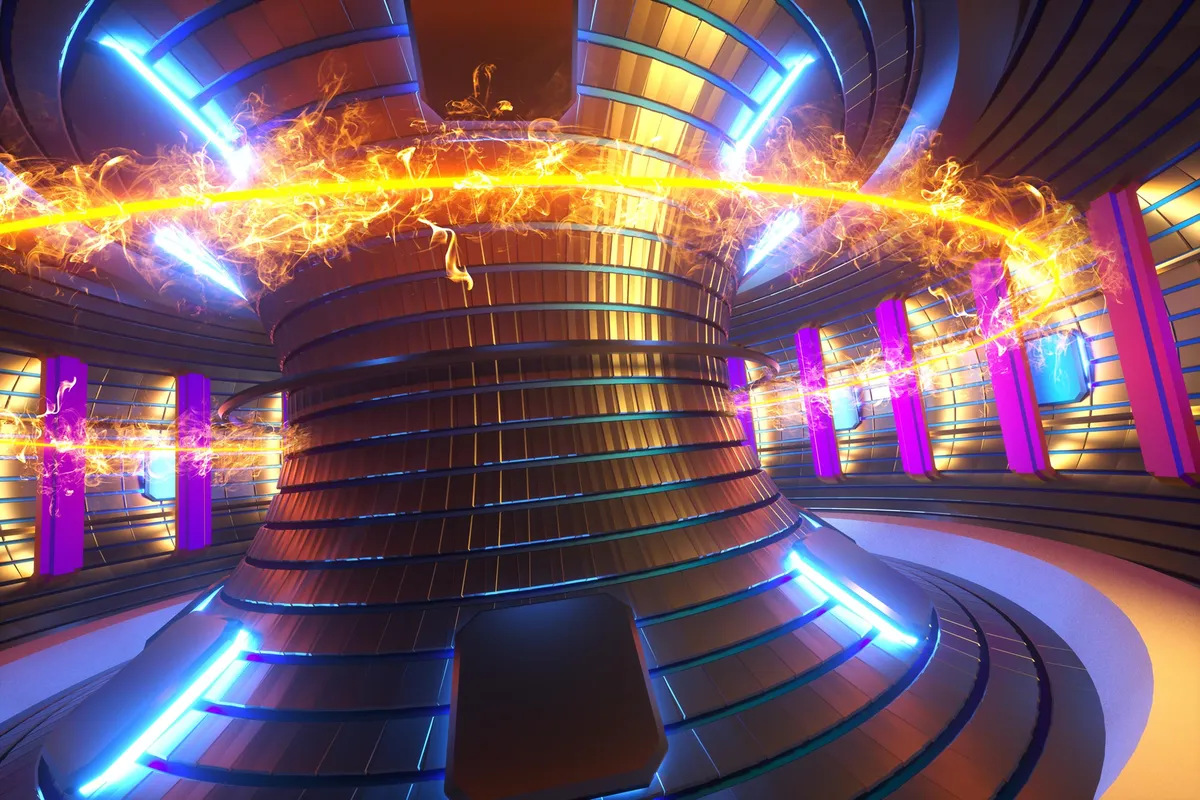
Imagine trying to bottle a piece of the sun. That's essentially what fusion scientists are doing, heating matter to temperatures hotter than our star's core, then wrangling it with magnets. It's a fantastic idea for clean energy, but it comes with a couple of rather fiery challenges.
First, the sheer heat. The exhaust system, called the divertor, has to contend with an inferno akin to a spacecraft re-entering Earth's atmosphere. Second, this superheated gas, or plasma, can throw temper tantrums. These aren't just little flickers; they're powerful energy bursts that can seriously damage the reactor walls.
Now, a team in China might have found a way to tackle both problems at once. Because apparently, that's where we are now: solving two of fusion's biggest headaches in one go.
We're a new kind of news feed.
Regular news is designed to drain you. We're a non-profit built to restore you. Every story we publish is scored for impact, progress, and hope.
Start Your News DetoxThe Plasma Whisperers
Professor Guosheng Xu and his crew at the Institute of Plasma Physics (under the Chinese Academy of Sciences) have been tinkering with the EAST fusion device. They've developed a new plasma operating mode that sounds like something out of a sci-fi novel, but is very much real.
Their method reduces the heat on crucial reactor parts, completely stops those damaging plasma bursts, and keeps the whole superheated mess nicely contained. They managed to maintain this for about a minute in a metal-walled reactor, which, if you think about it, is both impressive and slightly terrifying. Their findings were published in Physical Review Letters.
So, how did they pull off this plasma-taming feat? It comes down to a precise ballet of light impurity gases. By carefully adjusting these gases, they created what they call the Detached divertor and Turbulence-dominated Pedestal (DTP) regime.
This DTP regime achieves a partial 'detachment' of the plasma from the divertor, significantly dropping the heat hitting those vulnerable plates. Even better, it completely stopped the dreaded edge-localized modes (ELMs) – those mini solar flares that wreak havoc. Plus, the plasma's energy confinement actually improved.
Essentially, they figured out how to create a controlled turbulence at the plasma's edge. This specific kind of turbulence, driven by temperature gradients, naturally pushes excess heat and particles outward. This prevents pressure from building up and causing ELMs, allowing for stable, high-performance plasma. It's like giving the plasma a perfectly designed, self-regulating pressure release valve.
This isn't just a clever trick; it's a significant step toward continuous fusion power. If they can scale this up, it means less wear and tear on reactors and a smoother path to a future where we're all powered by a bottled sun. Which, let's be honest, sounds pretty good right about now.