Physicists have figured out how to make molecules spin inside liquid helium while it's in a superfluid state—a quantum oddity where matter flows without any friction at all. It's the first time anyone has deliberately controlled molecular rotation in these conditions, and it opens a window into how particles behave in one of nature's strangest environments.
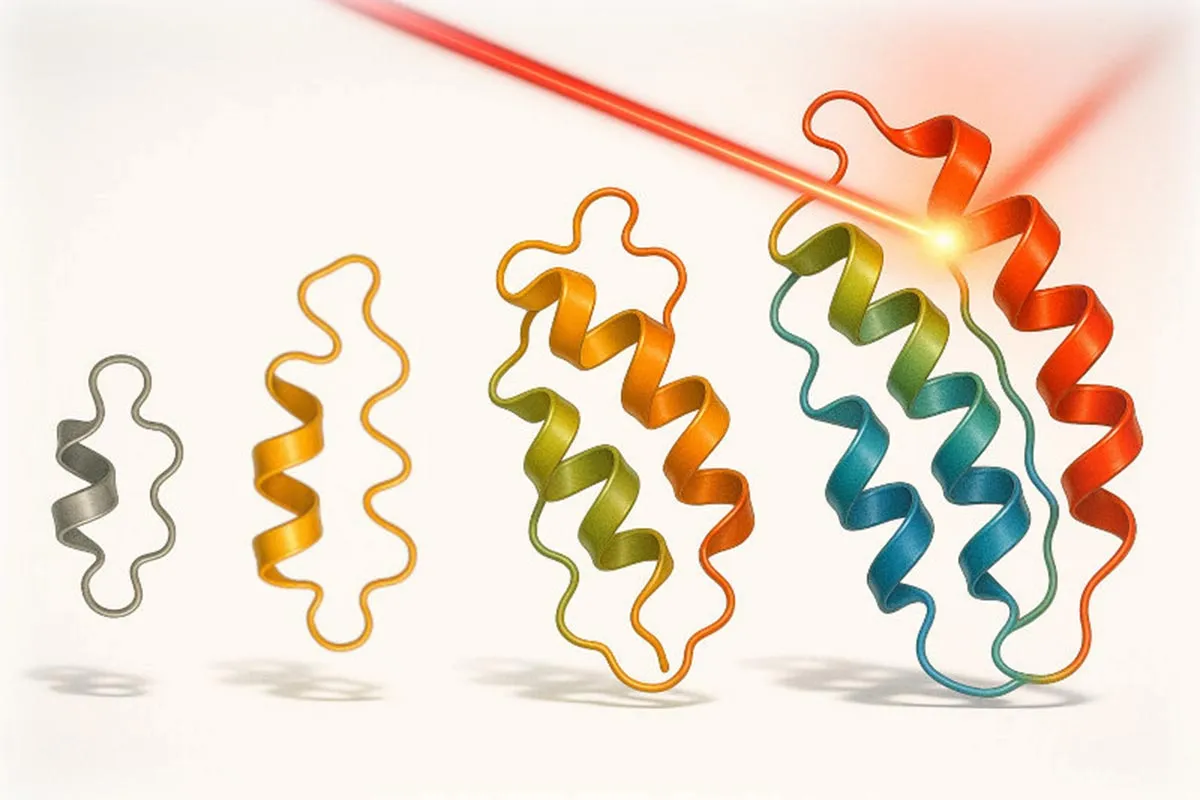
The breakthrough came from researchers at the University of British Columbia who redesigned an optical centrifuge—essentially a tool that uses laser pulses to make molecules rotate. The trick was introducing a precise delay between laser pulses, creating interference that produces a gentler, steadier spin. Think of it like the difference between yanking a rope and letting it unwind gradually. That shift in approach made all the difference.
"Controlling the rotation of a molecule dissolved in any fluid is a challenge," says Dr. Valery Milner, the lead researcher. "Dissolved molecules interact with the atomic or molecular constituents of the fluid, effectively getting bigger and harder to spin up. Imagine making a snowball: It's very easy to move it when it's small, but gets harder and harder as more snow gets attached to it."
We're a new kind of news feed.
Regular news is designed to drain you. We're a non-profit built to restore you. Every story we publish is scored for impact, progress, and hope.
Start Your News DetoxWhy This Matters
Superfluids exist in a realm most of us will never directly experience—they only form at temperatures near absolute zero, where quantum mechanics takes over and the normal rules of fluid dynamics stop applying. Liquid helium is the most famous example. Yet despite lacking friction, these fluids still interact with molecules inside them, creating a puzzle physicists have struggled to solve: What actually changes for a molecule when the surrounding fluid transitions from normal to superfluid?
That question isn't purely academic. Understanding how molecules behave in quantum environments has implications for quantum computing, materials science, and our broader grasp of how matter works at the smallest scales. Every tool that lets researchers peek into these conditions is a step toward answering questions we don't yet know how to ask.
The UBC team used helium nano-droplets—tiny clusters of liquid helium—doped with molecules of nitric oxide. By varying the rotation frequency with their improved optical centrifuge, they can now gradually spin molecules faster and faster until something unexpected happens: a critical threshold where the molecules suddenly lose their rotational stability and the superfluid state begins to break down.
"It is not well understood how and when—for example, at what frequency—this transition will happen at such a tiny atomic scale," Milner says. "That's the key area we're investigating at the moment."
This research represents a shift in how scientists approach superfluid experiments. For decades, optical centrifuges worked reliably with molecules in gases, but the superfluid environment was too hostile—the quantum interactions too complex. By introducing that strategic delay in the laser pulses, the team didn't just solve a technical problem. They created what Milner calls a new "control knob" for probing the boundaries of quantum behavior.
What comes next is mapping those boundaries. As rotation rates increase, the team expects to find the point where superfluid properties can no longer hold. That threshold—wherever it lands—will tell us something fundamental about the limits of quantum matter itself.