Uranus has always been the solar system's odd one out—literally spinning sideways like a rolling ball while its siblings orbit normally. Now, for the first time, we're seeing just how strange its upper atmosphere really is.
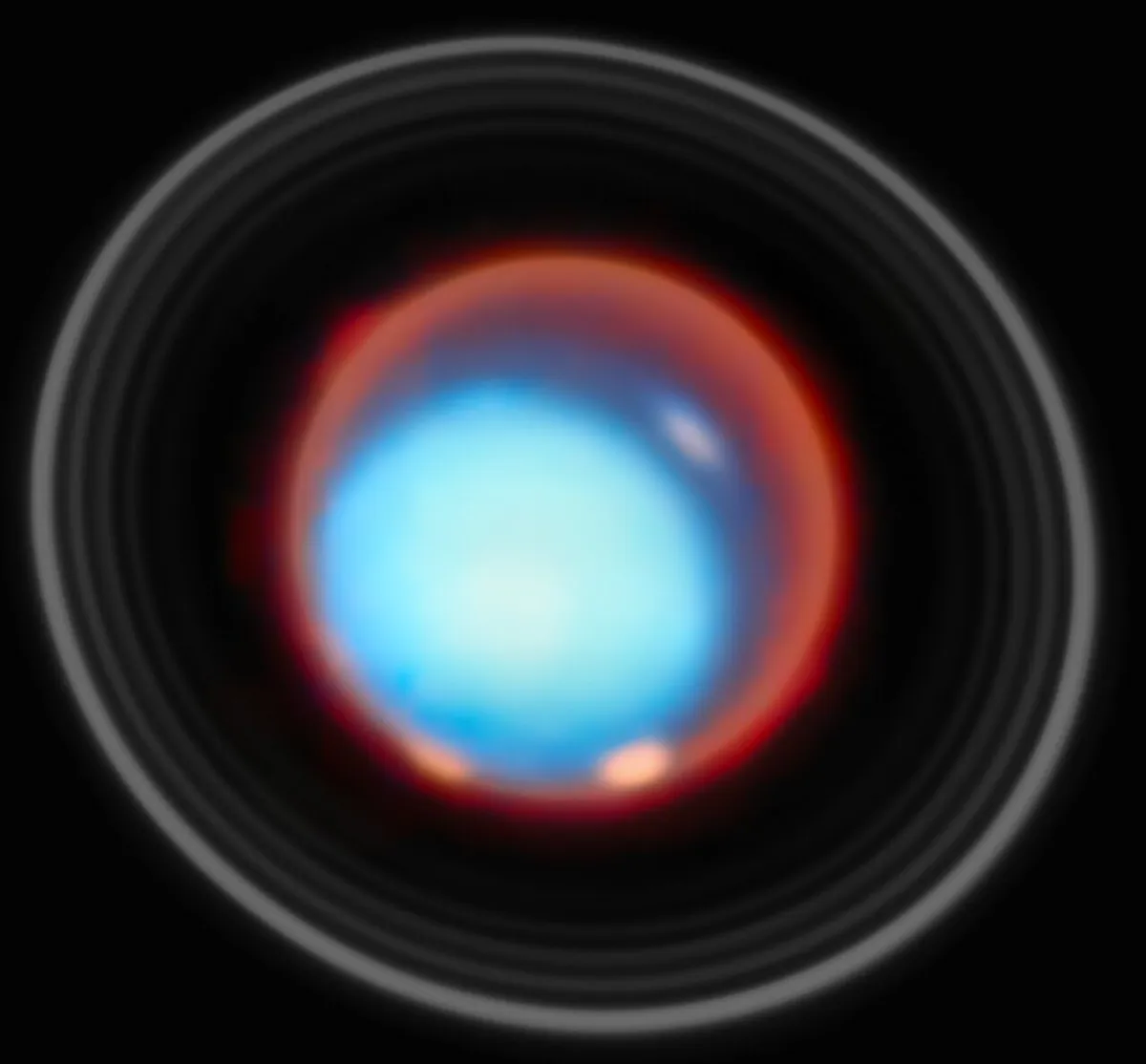
Using the James Webb Space Telescope in January 2025, researchers mapped Uranus' high atmosphere in three dimensions and discovered it's lopsided, unevenly distributed, and studded with auroras that glow golden-pink near the planet's magnetic poles. The findings, published in Geophysical Research Letters, reveal how a planet's twisted magnetic field can reshape its entire upper layer.
The Sideways Planet Reveals Its Secrets
Uranus has been understudied since Voyager 2 flew past it in 1986—the only spacecraft to ever visit the ice giant. Its upper atmosphere remained largely mysterious until now. Planetary scientist Paola Tiranti and her team used Webb's infrared spectrograph to track positively charged hydrogen molecules across the planet during one full rotation (about 15 hours). The data showed something unexpected: the atmosphere isn't evenly wrapped around the planet. It rises higher in some regions and dips lower in others, creating a lumpy, asymmetrical shell extending roughly 3,100 miles above the clouds.
We're a new kind of news feed.
Regular news is designed to drain you. We're a non-profit built to restore you. Every story we publish is scored for impact, progress, and hope.
Start Your News DetoxThe culprit is Uranus' magnetic field, which is tilted and offset from the planet's rotation axis—essentially misaligned with the planet itself. Imagine a bar magnet planted inside a spinning ball, but the magnet is crooked and off-center. That's Uranus. As solar particles interact with this wonky magnetic field, they create auroras that sweep across the surface in complex patterns, leaving golden-pinkish signatures in the upper atmosphere that Webb could finally detect.
The observations also confirmed that Uranus' upper atmosphere has been cooling since the 1990s, with temperatures around 307 degrees Fahrenheit—colder than previously measured.
Why This Matters Beyond Uranus
What makes this discovery significant isn't just the pretty aurora maps. Astronomer Heidi Hammel, part of the James Webb project team, explains that auroras are essentially the only way to study a planet's magnetic field from a distance without sending a spacecraft there. For ice giants like Uranus and Neptune, which are expensive and difficult to reach, that matters. Understanding how Uranus' magnetic field shapes its atmosphere could help scientists decode how similar planets—including distant exoplanets around other stars—interact with their space environments.
It also fills a 39-year gap in our knowledge. Since 1986, our picture of Uranus has been frozen in time. Webb's infrared vision, which can see heat signatures invisible to human eyes, has suddenly brought the planet into focus. The lopsided atmosphere and its auroras aren't just curiosities—they're windows into how extreme magnetic fields can fundamentally reorganize planetary chemistry and physics.
More missions to Uranus are being discussed, but for now, Webb's three-dimensional map stands as our clearest view of how one of the solar system's most tilted worlds actually works.