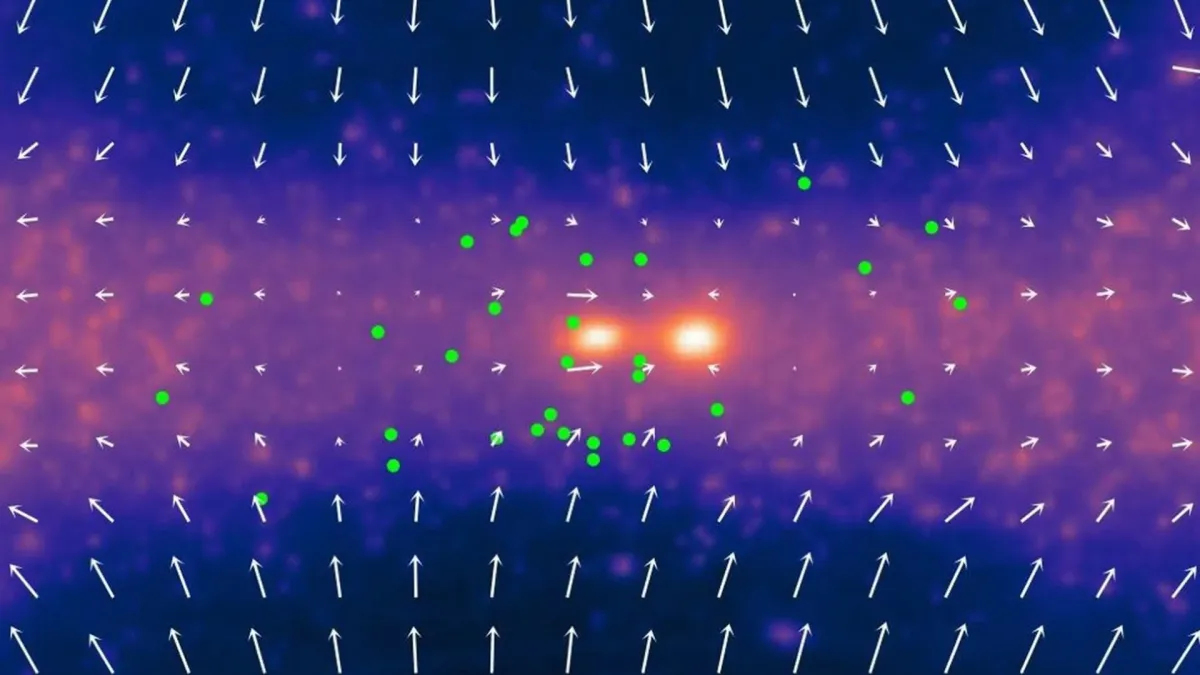
For nearly a century, one of astronomy's great puzzles has been staring us in the face: why do most galaxies near the Milky Way move away from us instead of toward us, given that our galaxy's gravity should pull them inward.
Now an international team of researchers believes they've solved it. Using computer simulations that reconstruct the universe from its earliest moments to today, they've discovered that the matter surrounding our Local Group—the Milky Way, Andromeda, and dozens of smaller galaxies—isn't distributed evenly in all directions. Instead, it's arranged like a vast, flattened sheet stretching tens of millions of light-years across.
This sheet includes both ordinary matter and the invisible dark matter that holds galaxies together. Above and below this cosmic plane lie enormous empty voids. The arrangement acts like a gravitational balancing act: while the Local Group's combined mass does pull on nearby galaxies, the additional matter spread throughout the same plane counterbalances that pull. Galaxies within the plane are caught in this equilibrium, moving away from us at speeds that now match what astronomers actually observe.
We're a new kind of news feed.
Regular news is designed to drain you. We're a non-profit built to restore you. Every story we publish is scored for impact, progress, and hope.
Start Your News DetoxHow They Built a Universe Model
The team, led by PhD graduate Ewoud Wempe at the Kapteyn Institute in Groningen, started with measurements from the cosmic microwave background—the ancient light left over from the Big Bang. These measurements told them how matter was distributed in the infant universe. They then fed this data into powerful computers and let them evolve the universe forward in time, billions of years compressed into calculations.
The result was what researchers call a "virtual twin" of our cosmic neighborhood. The simulation reproduced the masses, locations, and motions of the Milky Way and Andromeda. It also matched the positions and velocities of 31 galaxies just outside the Local Group—all without being told what those positions should be. The model simply calculated how gravity would have shaped the universe from those early conditions to today.
What makes this breakthrough significant is that it connects two separate puzzles that have bothered astronomers for decades. The first is the Big Bang itself: we know the universe expanded from an incredibly hot, dense point. The second is our local problem: why do nearby galaxies move the way they do. For the first time, a single model explains both.
Astronomer Amina Helmi, commenting on the work, noted that being able to determine a mass distribution purely from how galaxies move is a major step forward. The findings suggest that our corner of the universe isn't randomly arranged—it has structure, geometry, and a logic we're only now beginning to read.
The next phase involves testing whether this model holds up as more precise measurements of distant galaxies become available. In the coming years, new telescopes and surveys will map the universe with even greater accuracy, either confirming this picture or revealing new wrinkles in how matter arranges itself on the largest scales.