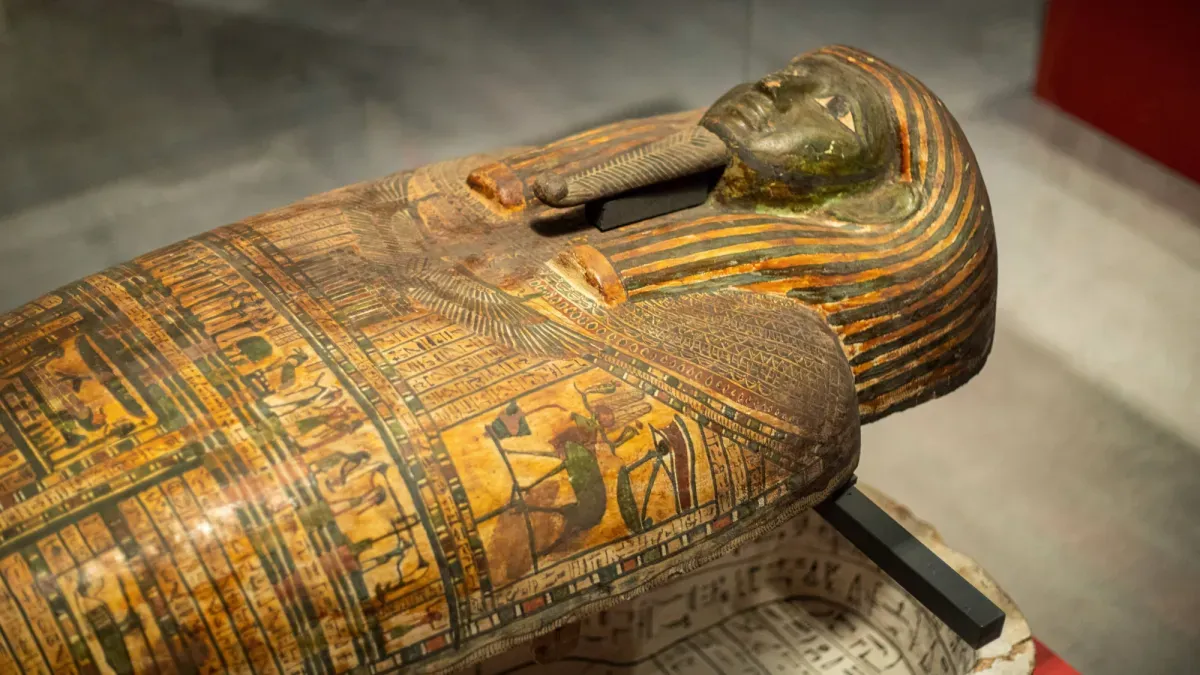
Walk into an Egyptian mummification exhibit soon, and you might smell myrrh, natron, and cedar—not from imagination, but from actual molecular analysis of 3,000-year-old artifacts.
Scientists at the Max Planck Institute of Geoanthropology have figured out how to detect chemical fingerprints left on ancient objects, then use those traces to reconstruct what things actually smelled like. It's a shift from looking at the past to experiencing it.
Barbara Huber, an archaeo-chemist at the institute and University of Tübingen, worked with art historian Sofia Collette Ehrich and perfumer Carole Calvez to turn this research into something museums can actually use. They developed portable scent cards and fixed diffusion stations to accompany Egyptian mummification exhibits—turning molecular data into something you can smell.
We're a new kind of news feed.
Regular news is designed to drain you. We're a non-profit built to restore you. Every story we publish is scored for impact, progress, and hope.
Start Your News Detox"This research represents a significant shift in how scientific results can be shared beyond academic publications," Huber explained. The collaboration brought together three worlds: ancient chemistry, sensory storytelling, and perfumery. Calvez used the team's biomolecular findings to recreate the actual scents from mummification practices, grounding the experience in real evidence rather than guesswork.
What makes this work is the specificity. Researchers didn't guess what ancient Egypt smelled like. They extracted molecular data from mummies, burial wrappings, and preserved containers—the actual chemical residue of oils, resins, and spices used in burial rituals. From those particles, they reverse-engineered the original scent profile.
This opens a door most museums haven't walked through yet. Touch and sound have been added to exhibits for years, but smell remained mostly off-limits—too unpredictable, too hard to control, too easy to get wrong. Now that archaeology can tell us what we're actually supposed to be smelling, museums can build those experiences with confidence.
The research was published in Frontiers in Environmental Archaeology. As more museums adopt this approach, the past becomes less abstract—less something you read about, and more something you encounter.