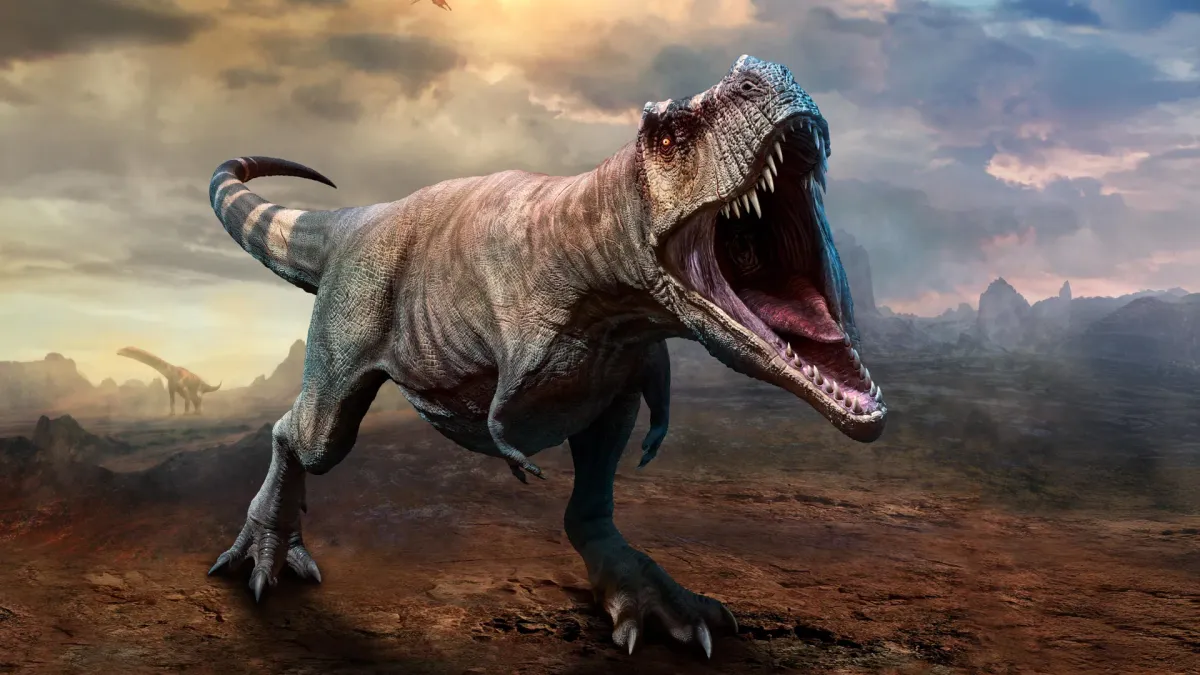
Typrannosaurus rex didn't sprint to adulthood. A new analysis of fossilized leg bones suggests the most famous dinosaur on Earth took around 40 years to reach its full eight-ton size—nearly twice as long as scientists previously thought.
The finding comes from examining growth rings in 17 tyrannosaur specimens, from juveniles to full-sized adults. Researchers at Oklahoma State University, Chapman University, and Intellectual Ventures combined traditional bone analysis with new statistical methods and a novel imaging technique using polarized light to spot previously hidden growth rings. The work, published in PeerJ, represents the most detailed reconstruction of T. rex life history to date.
Why a slower childhood matters
Previous estimates suggested T. rex reached full size by around age 25. That timeline made sense given what paleontologists could see in the fossil record—but there was a problem. Dinosaur bones typically preserve only the final 10 to 20 years of an animal's life, leaving a gap in the growth story. The research team developed a new approach: they stitched together growth records from multiple specimens of different ages to create a composite growth curve spanning the entire lifespan.
We're a new kind of news feed.
Regular news is designed to drain you. We're a non-profit built to restore you. Every story we publish is scored for impact, progress, and hope.
Start Your News DetoxThe result changes how we understand T. rex as a living animal. A 40-year growth phase wasn't a weakness—it was likely an evolutionary advantage. Younger tyrannosaurs, still decades away from their full predatory power, probably hunted different prey and occupied different territories than the massive adults. This meant a single T. rex population could fill multiple ecological roles at once, with juveniles and adults carving out separate niches in the Cretaceous landscape. Jack Horner, a coauthor at Chapman University, suggests this extended development may have been crucial to T. rex dominance during the final stretch of the dinosaur era.
Think of it like this: a young T. rex at age 15 would have been a formidable predator in its own right, but fundamentally different from a 40-year-old at peak size and strength. That diversity within a single species made the group harder to displace.
A fossil identity crisis
The study also raises an unsettling question: are all the fossils we've labeled T. rex actually T. rex? Two well-known specimens—nicknamed "Jane" and "Petey"—show growth patterns notably different from the rest of the dataset. Their bones suggest they may belong to a separate species, possibly Nanotyrannus, rather than being young T. rex individuals. This controversy isn't new in paleontology, but the growth data adds real weight to the debate.
For more than a century, scientists have assumed certain smaller tyrannosaur fossils were simply juveniles of the famous species. The new analysis suggests the picture is messier and more interesting—the fossil record may hold multiple tyrannosaur species that we've been conflating under one name.
A technical breakthrough
Beyond the growth timeline, the research introduced a methodological shift. Using circularly polarized and cross-polarized light, the team detected growth rings that standard microscopy missed. These hidden markers filled in gaps in the growth record and revealed that traditional bone-counting techniques may have overlooked important details. For paleontology as a field, this is significant: the imaging method could improve how scientists reconstruct life histories for many other extinct species.
More than 125 years after T. rex was first discovered, it's still teaching us lessons about how to read the fossil record. A longer childhood, a more complex family tree, and sharper tools for seeing what's hidden in stone—that's progress that quietly reshapes what we thought we knew.