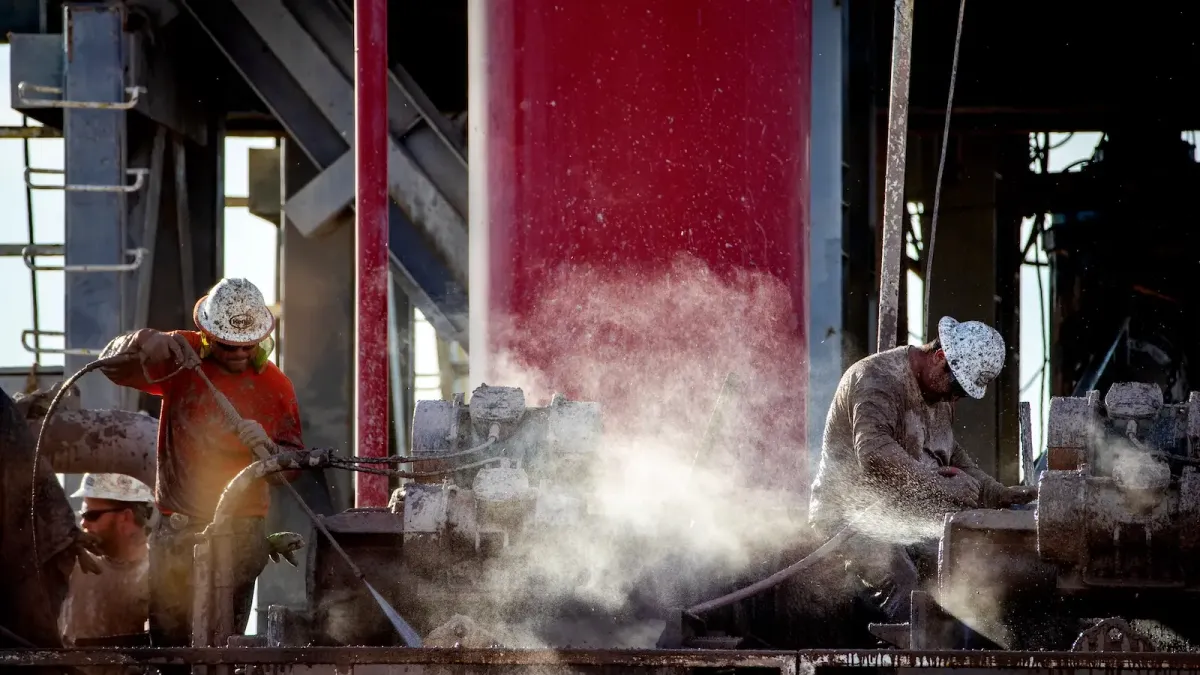
Mike Fleming spent a decade drilling wells in New England before his boss recommended him for a job overseeing geothermal drilling at Phoenix Foundation Company in late 2024. The work felt instantly familiar. "You're making a hole in the ground, you're putting some plastic pipe down there, and you're sealing the hole," Fleming explained. What looked like a straightforward career move was actually something larger: the beginning of a workforce transition that could reshape American energy.
Geothermal currently provides just 0.36 percent of the country's electricity, but the technical skills required to tap it are already sitting in the oil and gas industry. According to a 2024 U.S. Department of Energy report, as many as 300,000 people in fossil fuel work already possess the drilling expertise needed for geothermal projects. The question isn't whether the skills exist — it's whether the industry can move fast enough to capture them.
Why This Moment Matters
There are two types of geothermal being developed. Conventional geothermal, like Fleming's work, involves drilling 200 to 500 feet to access ground temperatures between 50 and 60 degrees Fahrenheit — warm enough to heat and cool homes through heat pumps. Enhanced geothermal techniques go deeper, drilling thousands of feet to reach rock as hot as 750 degrees Fahrenheit, hot enough to power buildings, factories, and entire communities.
We're a new kind of news feed.
Regular news is designed to drain you. We're a non-profit built to restore you. Every story we publish is scored for impact, progress, and hope.
Start Your News DetoxThe political tailwind is real. The Trump administration preserved geothermal tax credits through 2033 and the DOE recently announced $171.5 million for next-generation geothermal field tests — a level of support notably absent from wind and solar initiatives. This creates a rare opening: a clean energy technology with both technical momentum and political backing.
Cindy Taff spent 35 years at Shell before co-founding Sage Geosystems in 2020, frustrated that major oil companies weren't investing in geothermal. She sees the transition as natural. "What people tend to overlook is that the oil and gas industry over the last 100 years has really done a lot of innovative stuff," Taff said. The century-long evolution from simple land wells to offshore operations thousands of feet underwater has created a vast technical toolkit — expertise in hydraulic fracturing, complex rock analysis, and deep-subsurface engineering.
Jonathan Ajo-Franklin, a geophysicist at Rice University, points to one critical difference from oil and gas work: geothermal drilling produces far less problematic waste. Unlike oil and gas wastewater disposal — linked to earthquakes in Oklahoma and West Texas — geothermal fracking should require minimal re-injection of wastewater into the ground. The drilling techniques are transferable; the environmental footprint is not.
Brock Yordy, founder of the Geothermal Drillers Association and a third-generation driller who started at 16, compares the skill transfer to hanging a painting on different wall materials. "The base fundamentals are the same," he said. What changes is the application, not the core competency. The domestic geothermal workforce currently sits at 8,870 people, up from near zero five years ago, while globally the industry employs around 145,000 workers.
Major oil companies haven't yet made substantial investments in enhanced geothermal — they're waiting for the technology to mature — but the pathway is clear. Many workers simply follow contracts, moving from oil companies to clean energy startups as opportunities arise. Energy Secretary Chris Wright, invited to an industry event called MAGMA (Make American Geothermal More Abundant) last year, expressed support for the sector. Jamie Beard, executive director of the advocacy group Project InnerSpace, sees data centers as the near-term market: oil and gas companies already see the opportunity in powering energy-intensive facilities with geothermal instead of natural gas.
What's emerging is a workforce transition that doesn't require retraining from scratch — it requires redirecting existing expertise toward a different heat source. For workers like Fleming, it's less a career change than a sideways step into work that feels remarkably similar but points toward a different future.