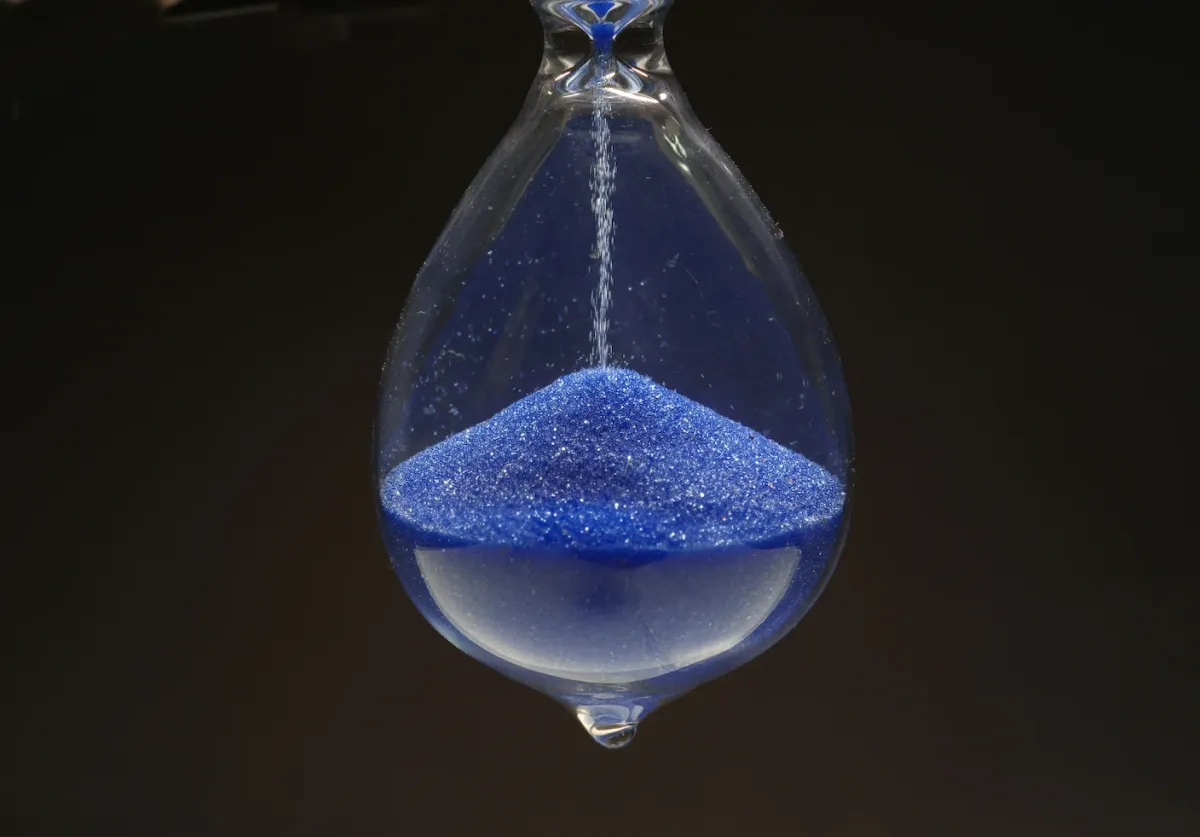
You've probably said it a hundred times: time flies. Time waits for no one. But here's what neuroscientists and physicists are increasingly convinced of — that sense of time moving forward isn't something happening out there in the world. It's something your brain is doing right now, in this moment.
We speak about time as if it's a river we're moving through, events drifting past us into memory. But when you actually sit down and ask "what is time," the answer gets slippery fast.
Ancient philosophers noticed this first. Parmenides of Elea couldn't make sense of how events could move from future to present to past — the whole idea seemed logically broken. Aristotle wondered about it. Augustine puzzled over it. They were onto something real: the experience of time flowing might not match how time actually works.
We're a new kind of news feed.
Regular news is designed to drain you. We're a non-profit built to restore you. Every story we publish is scored for impact, progress, and hope.
Start Your News DetoxThen Einstein arrived in the early 1900s and made it official. His theories of relativity showed that time isn't universal. It's relative. Two people in different places or moving at different speeds won't agree on when things happen simultaneously. There's no single, objective "now" that exists everywhere at once. Physics, it turns out, doesn't need a flowing present moment to work.
So why does it feel like time moves?
If physics has no room for a dynamic, flowing time, why is the sensation so universal? Researchers propose it's a "psychological projection" — not an illusion exactly, but a cognitive construction. Your brain represents your experiences in a way that includes the sense of time passing, even though that representation doesn't match objective reality.
Think of color. When you see red, you experience redness as a property of the object. But physics tells a different story: there's no redness in the light itself, only wavelengths. Your brain translates those wavelengths into the experience of color. The color isn't a lie — it's a useful way your brain represents information about the world.
Time works similarly. The passage of time isn't a feature of the universe. It's how your brain makes sense of your experiences — memory, anticipation, the sequence of moments strung together into a narrative. That narrative is shaped entirely by the limits and structures of human perception and cognition.
The confusion, researchers argue, comes from mistaking our perspective on reality for reality itself. We experience time flowing, so we assume it flows. We remember the past and anticipate the future, so we assume those directions are built into the fabric of existence. But our experience is filtered through biological constraints we barely notice.
This isn't nihilism — your experience of time is real and it matters for how you navigate the world. It's just not a fundamental feature of how the universe works. The passage of time is something your brain does, not something the universe does.