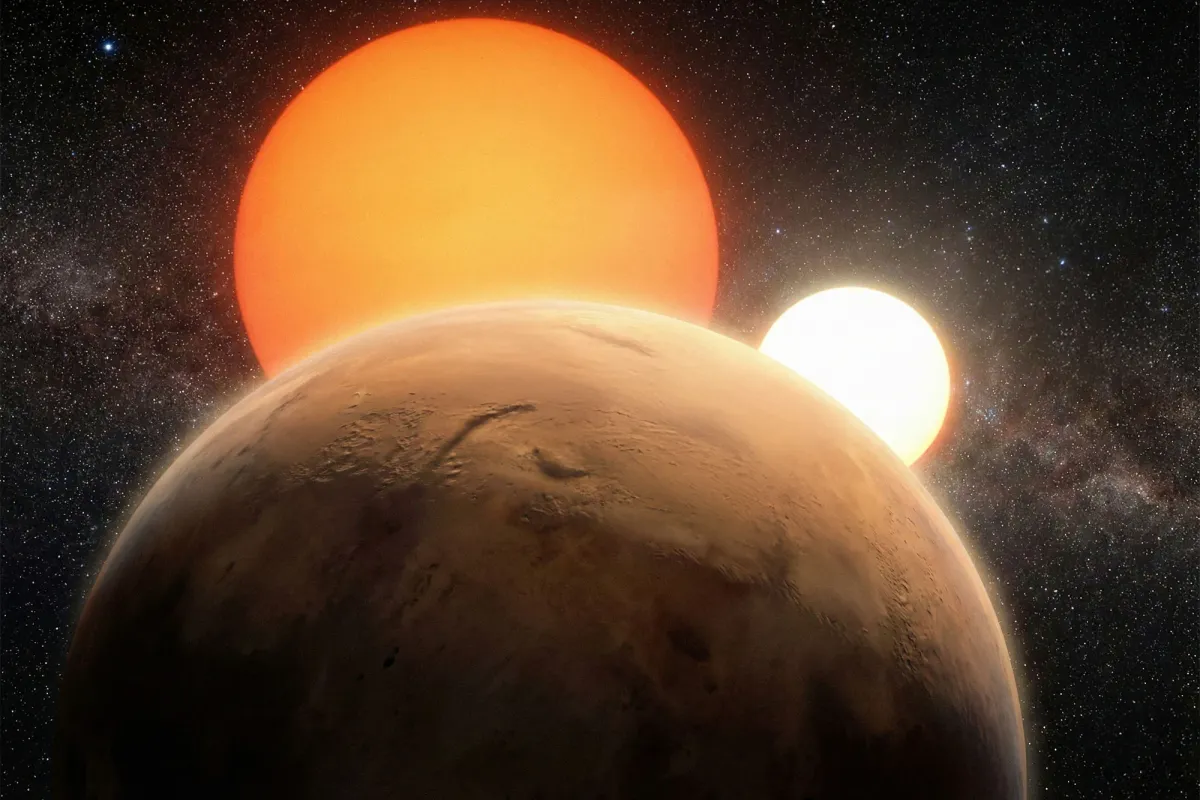
We've found over 6,000 planets orbiting distant stars. Only 14 of them circle two suns at once. Given that binary star systems are common and planets form almost everywhere, this gap feels like a cosmic mystery — the kind that makes you wonder what we're missing.
Turns out, Einstein's theory of general relativity is doing the missing for us.
The vanishing act
Astronomers expected hundreds of circumbinary planets by now. The math seemed straightforward: most stars form in pairs, most stars develop planetary systems, so the overlap should be substantial. Yet when NASA's Kepler telescope and the newer TESS mission scanned the skies, they found almost nothing.
Mohammad Farhat, a researcher at UC Berkeley, and his collaborator Jihad Touma decided to model what happens when a planet actually tries to orbit two stars. The answer is unsettling: most don't survive.
We're a new kind of news feed.
Regular news is designed to drain you. We're a non-profit built to restore you. Every story we publish is scored for impact, progress, and hope.
Start Your News DetoxHere's the problem. In a binary system, two stars orbit each other along an elliptical path. A planet caught in their gravitational embrace feels a constantly shifting pull — stronger when the stars are close, weaker when they're far. This changing force causes the planet's orbit to slowly rotate, a wobble called orbital precession. Think of a spinning top that drifts as it spins.
Now add Einstein's insight. General relativity says that tight binary systems — where the stars orbit each other in less than a week — experience their own precession, driven by relativistic effects. As the stars gradually draw closer over billions of years (tidal forces are slowly compressing their orbit), their precession accelerates. Meanwhile, the planet's precession slows.
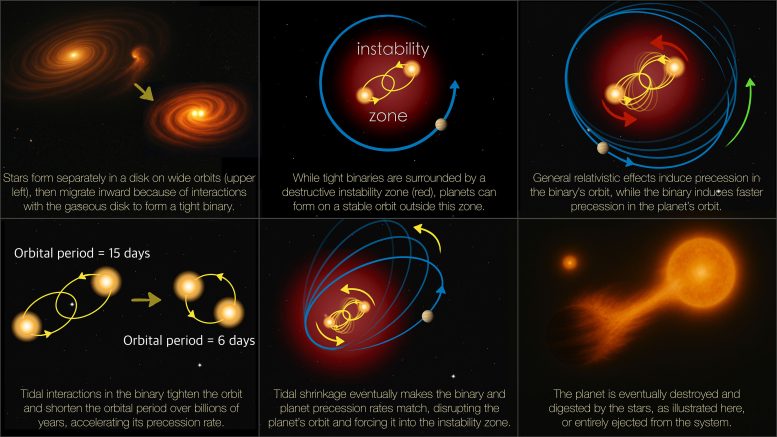
When these two rates match, something violent happens. The planet's orbit stretches dramatically — farther away at one end, dangerously close at the other. "Either the planet gets very, very close to the binary, suffering tidal disruption or being engulfed by one of the stars, or its orbit gets significantly perturbed to be eventually ejected from the system," Farhat explains. "In both cases, you get rid of the planet."
Why we see what we see
Farhat's calculations show that general relativity destroys about 80% of planets in tight binary systems. Of those, roughly 75% are obliterated outright; the rest are flung into the void.
The 14 circumbinary planets we've actually detected are survivors, and they tell a story. Nearly all orbit well beyond the danger zone. This suggests they formed farther out and migrated inward — because building a planet near the instability boundary would be like "trying to stick snowflakes together in a hurricane," Farhat notes. The gravitational chaos is simply too extreme.
There's another reason we see so few: detection bias. The planets that do survive tend to orbit at large distances, where they're far less likely to pass in front of their stars from Earth's vantage point. Our current telescopes rely on spotting these transits. Distant planets are nearly invisible to us, even when they exist.
A broader pattern
The research reveals something deeper about how general relativity shapes the universe. Einstein's theory doesn't just predict gravity; it actively sculpts which planetary systems survive and which collapse. Researchers are now exploring whether the same mechanism explains the rarity of planets around binary pulsars — pairs of rapidly spinning neutron stars where relativistic effects would be even more extreme.
The irony is rich: the same physics that nearly destabilized Mercury's orbit in our own solar system (which Einstein's theory helped explain) is actively dismantling planetary systems around binary stars. General relativity, it seems, is simultaneously a force of stability and disruption — depending on where you are in the cosmos.
As Touma reflects, "Nearly a century following Einstein's calculations, we're still discovering how his theory reshapes the worlds we thought we understood."