Half the world's arabica coffee regions will be too hot or too dry to grow coffee by 2050. That's not speculation—it's the trajectory climate scientists are tracking. But here's what matters more: the knowledge to prevent a coffee crisis already exists. It's just been scattered across decades of research papers, university studies, and farmer experiments across continents.
Now it's all in one place.
Coffee Watch, a nonprofit focused on the crop's future, has built a searchable e-library containing every research study ever conducted on coffee agroforestry—a farming method that could keep coffee growing even as the climate shifts. The library launched this year as a free resource for farmers, companies, and researchers who need practical answers fast.
Why coffee needs help
Coffee is finicky. It demands a narrow band of conditions: not too cold, not too hot, not too wet, not too dry. It thrives only in mountainous tropical regions where those conditions naturally align. As global temperatures rise and rainfall patterns shift, those "Goldilocks zones" are shrinking.
We're a new kind of news feed.
Regular news is designed to drain you. We're a non-profit built to restore you. Every story we publish is scored for impact, progress, and hope.
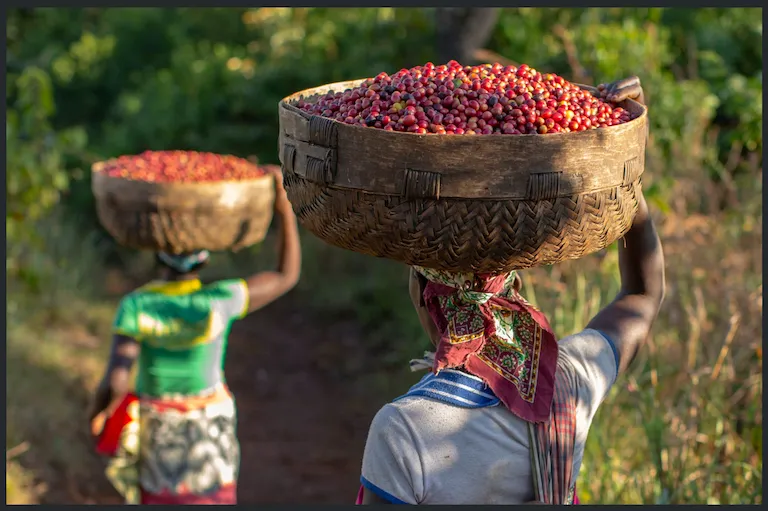
Start Your News DetoxThe stakes extend far beyond your morning cup. Coffee supports the livelihoods of roughly 125 million people globally, many in developing countries where it's the primary income source. A shrinking harvest means lost wages, destabilized communities, and economic pressure on some of the world's most vulnerable regions.
The solution: grow coffee like a forest
Agroforestry flips the conventional coffee plantation model. Instead of growing coffee in neat, exposed rows, farmers plant it alongside other trees and bushes—fruit trees, nitrogen-fixing legumes, native shade species. The result mimics a natural forest ecosystem.
Those companion plants create a moderated microclimate. The shade trees cool the air. Their leaf litter enriches the soil. The diversity supports insects and birds that control pests naturally. Coffee grown this way actually tastes better, produces more reliably in variable weather, and generates additional income through companion crops and products.
"Coffee agroforestry is potentially a win-win," says Etelle Higonnet, founder and director of Coffee Watch. "But only if producers know how to do it."
That's been the gap. A farmer in Ethiopia considering agroforestry couldn't easily access research from Brazil or Indonesia. A company piloting the method might spend years and resources repeating experiments someone else had already solved. Knowledge existed, but it was fragmented.
One library, decades of answers
The Coffee Watch e-library consolidates everything: peer-reviewed research, farmer case studies, technical guides, regional adaptations. A producer in Guatemala can now search for studies on shade tree species suited to their altitude and rainfall. A cooperative in Kenya can find evidence on how agroforestry affects soil health in their climate zone. Companies can stop running redundant pilots and start scaling what actually works.
The library is free and searchable by region, crop type, and research focus. It's designed for people working in coffee, not just academics—practical, accessible, immediately useful.
Climate change isn't pausing while the coffee industry figures things out. But agroforestry adoption is accelerating. In some regions, it's becoming the default approach rather than the exception. The difference between slow adoption and rapid scaling often comes down to access to knowledge. When a farmer can read the research, see what worked elsewhere, and adapt it to their own land, change happens faster.
The e-library won't solve climate change. But it removes one significant barrier between a crisis and a solution that already works.