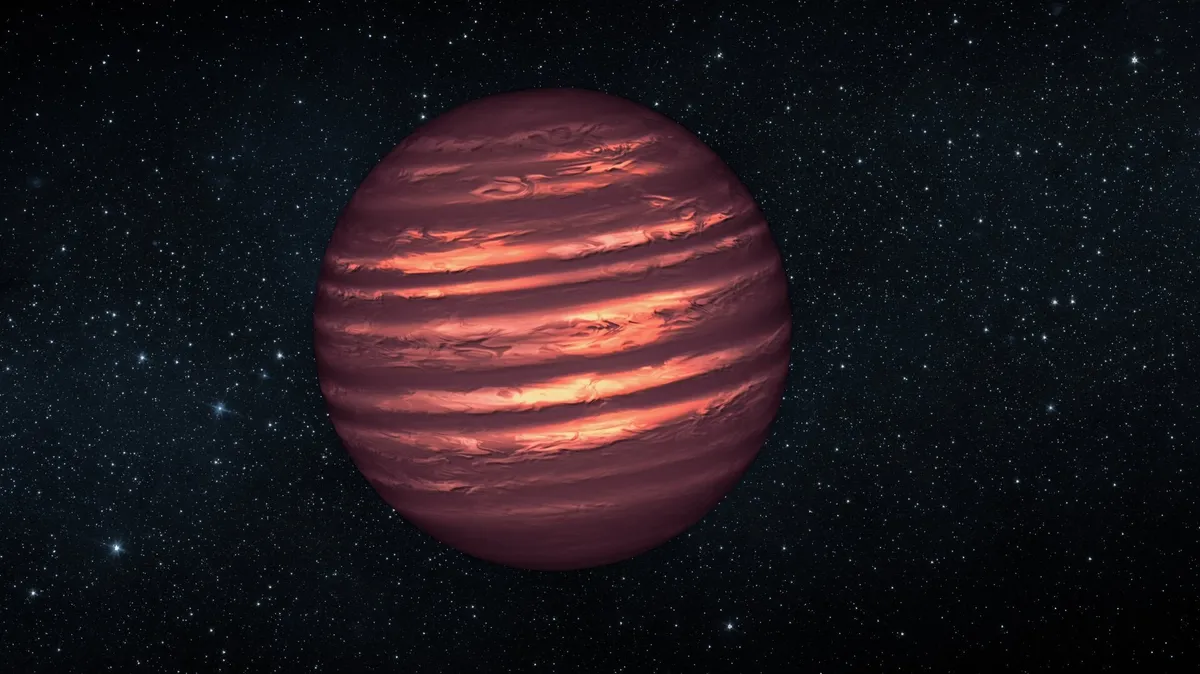
For ages, astronomers have had a hunch: the bigger a planet, the faster it likely spins. Think Jupiter and Saturn, those colossal gas bags in our cosmic neighborhood, each doing a full rotation in about ten hours. They're basically the breakdancers of our solar system, hogging all the rotational energy. And now, that hunch just got a serious upgrade to "confirmed fact."
Scientists, using the rather impressive W.M. Keck Observatory in Hawai'i, pointed their fancy equipment at 32 gas giants and brown dwarfs in other star systems. This wasn't just a casual glance; it was a deep dive into six planets larger than Jupiter and 25 brown dwarf companions. Because apparently, that's where we are now: measuring the rotational velocity of celestial bodies light-years away.
The Cosmic Record Player
The magic behind this revelation is a tool called the Keck Planet Imager and Characterizer (KPIC). It uses high-resolution spectroscopy to analyze the light from these distant worlds. By looking at how the light's spectrum broadens (don't worry about how, just know it's clever), scientists can deduce how fast a planet is doing its thing. It's like listening to a record player and figuring out its RPM just by the sound.
We're a new kind of news feed.
Regular news is designed to drain you. We're a non-profit built to restore you. Every story we publish is scored for impact, progress, and hope.
Start Your News DetoxWhat they found was pretty neat: gas giants spin faster than their more massive brown dwarf cousins. This held true across various masses, sizes, and ages. The team even threw in some historical data, building a sample of 43 stellar/substellar companions and giant planets, plus 54 free-floating brown dwarfs. That's a lot of spinning objects.
Many of these planets are orbiting their stars at truly ridiculous distances — hundreds of times further than Earth is from the sun. How they even form out there is still a cosmic mystery. Was it a slow, deliberate dance within a dusty disk, or a sudden, dramatic collapse like a star forming? Dino Chih-Chun Hsu, a lead author from Northwestern University, calls a planet's spin its "fossil record." It's a clue, millions of years old, to how these behemoths came to be.
The findings suggest that both a planet's total mass and its mass relative to its star's mass influence its final spin speed. Which, if you think about it, is both impressive and slightly terrifying, given the scale.
Magnetic Fields and Future Spins
Take the HR 8799 system, for instance. Here, a gas giant seven times Jupiter's mass spins six times faster than a brown dwarf companion that's 24 times Jupiter's mass. The working theory? The brown dwarf might have had a super-strong magnetic field when it was young, which could have acted like a brake, slowing its rotation down by interacting with the surrounding material disk.
Understanding this cosmic spin budget even helps us unravel the secrets of our own solar system. Hsu notes that how angular momentum (aka rotational energy) gets divvied up among planets affects the entire layout of a system. Even Earth's rotation and magnetic field are tied to how that spin budget was allocated when everything first formed. So, yeah, it matters.
KPIC is a bit of a trailblazer, allowing scientists to measure planetary spins in ways that were basically impossible before. Next up? "Rogue planets" – those free-floating rebels wandering through space – and a deeper look into planetary atmospheres. Tools like the Keck Observatory's upcoming HISPEC (High-resolution Infrared Spectrograph for Exoplanet Characterization), slated for 2027, will take things up a notch.
Jason Wang, an Assistant Professor at Northwestern and co-author, explains that HISPEC will be even more sensitive, allowing them to measure the spins of even more planets, including those similar to our own Jupiter. Because, frankly, we need to know if Jupiter is just showing off or if it's actually typical. Scientists, Hsu adds, are just scratching the surface of what planetary spin can tell us. Get ready for more cosmic revelations.