Physicists often use the Boltzmann distribution to understand random movements, like molecules in the air. This principle describes the chance a system will be in a certain state, rather than tracking every single particle. It helps make sense of large systems where individual movements are too hard to predict. Think of it like rolling dice: each roll is random, but over many rolls, you see a consistent pattern of probabilities.
A Universal Rule for Randomness
Ludwig Boltzmann, an Austrian physicist, first came up with this idea in the late 1800s. It's still used widely today, not just in physics but also in fields like artificial intelligence and economics. In economics, it's known as the multinomial logit model.
Recently, economists looked at this basic concept again and found something surprising. Their study shows that the Boltzmann distribution is uniquely good at describing systems where different parts don't affect each other. These are called independent systems.
We're a new kind of news feed.
Regular news is designed to drain you. We're a non-profit built to restore you. Every story we publish is scored for impact, progress, and hope.
Start Your News DetoxOmer Tamuz, an economics and mathematics professor at Caltech, and Fedor Sandomirskiy, a former Caltech researcher now at Princeton, led the study. Both have backgrounds in physics.
"This shows how abstract math can connect different fields, like economics and physics," Tamuz said. "Caltech's focus on different subjects helps make discoveries like this."
Why Independence Matters in Models
The research looked at how to model independent behavior. For example, an economist studying why people choose one cereal over another wouldn't want a model that creates fake connections. If the model suggested cereal choices depended on unrelated things, like what dish soap someone buys, it would be wrong.
"We don't want to track extra choices that seem unrelated, like which soap a shopper picked," Tamuz explained. "We asked: When would adding that unrelated choice not change the model's prediction?"
The Boltzmann distribution already meets this requirement. But Tamuz and Sandomirskiy wanted to know if any other theories could do the same.
"Everyone uses the same theory," Tamuz noted. "But what other theories correctly keep unrelated behaviors from influencing each other? Should we use those instead? If they exist, they could be useful in both economics and physics. If not, then the Boltzmann distribution is the only theory that makes sense for independent systems."
Dice Reveal Math of Independence
To see if other math ideas could describe independent systems, the economists created new ways to test the logic. Tamuz often uses dice to explain their method. A single die gives random results from one to six. While each roll is uncertain, many rolls show a stable pattern, with each number appearing about one-sixth of the time. This pattern is the probability distribution for one die.

When two dice are rolled and their total is recorded, a different pattern appears. Some totals are less common. For example, a total of two only happens if both dice show one, a 1 in 36 chance. But a total of eight can happen five ways, a 5 in 36 chance.
Importantly, the result of one die doesn't affect the other. They are independent systems. In the cereal example, one die is the cereal choice, and the other is the dish soap choice. Neither decision should impact the other.
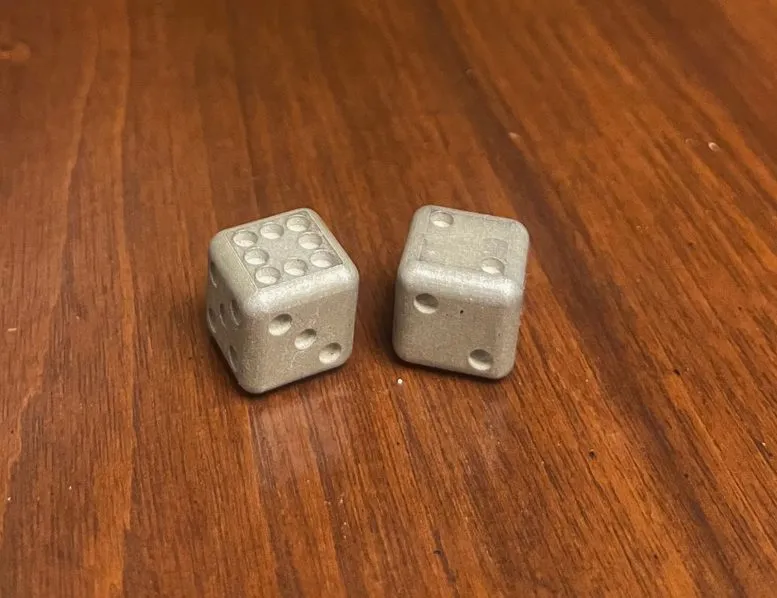
The researchers took this idea further with "Sicherman dice." These unusual dice were created in 1977 by George Sicherman. Tamuz keeps a set on his desk. One die has faces 1, 3, 4, 5, 6, 8. The other has 1, 2, 2, 3, 3, 4.
Even with these strange numbers, when both Sicherman dice are rolled and only the total is recorded, the results are the same as with standard dice. For example, the chance of rolling a two is still 1 in 36, and an eight is still 5 in 36. The distribution of sums is identical.
This gave Tamuz and Sandomirskiy a strong testing tool. They compared how different math theories handled both standard and Sicherman dice. If a theory gave the same sum distribution for both, it correctly showed independence. If it gave different results, it implied a false connection between unrelated systems and failed the test.
Polynomial Proof Settles the Question
To find other valid theories, the economists looked for more unusual dice beyond Sicherman's pair. Each new example helped them evaluate competing theories. Since there are endless possible math models, they created an infinite set of theoretical dice pairs.
By testing these cases systematically, they proved that every alternative theory failed. Their result shows that the Boltzmann distribution, used in science for over a century, is the only framework that consistently works.
Mathematically, the problem can be shown using polynomials, which are functions like f(x)=x + 3x² + x³. Every probability distribution, whether from Boltzmann's idea or another theory, can be written this way.
For example, the first Sicherman die (1, 3, 4, 5, 6, 8) is f(x) = x¹ + x³ + x⁴ + x⁵ + x⁶ + x⁸. The second die (1, 2, 2, 3, 3, 4) is g(x) = x¹ + 2x² + 2x³ + x⁴. Multiplying these, f(x) · g(x), gives a polynomial that shows the distribution of their summed outcomes.
This result matches the distribution from two standard dice, each described by h(x) = x¹ + x² + x³ + x⁴ + x⁵ + x⁶. So, h(x) · h(x) gives the same combined distribution as f(x) · g(x).
This relationship shows that the systems are independent. Reaching this conclusion required new mathematical insights into how these polynomial representations work.
"We didn't know what we'd find," Sandomirskiy said. "We were curious about these strange predictions and what it meant for a theory not to have any. In the end, we learned it has to be Boltzmann's theory. We found a new way to look at a concept that's been a basic part of textbooks for over 100 years."
Deep Dive & References
On the origin of the Boltzmann distribution - Mathematische Annalen, 2025