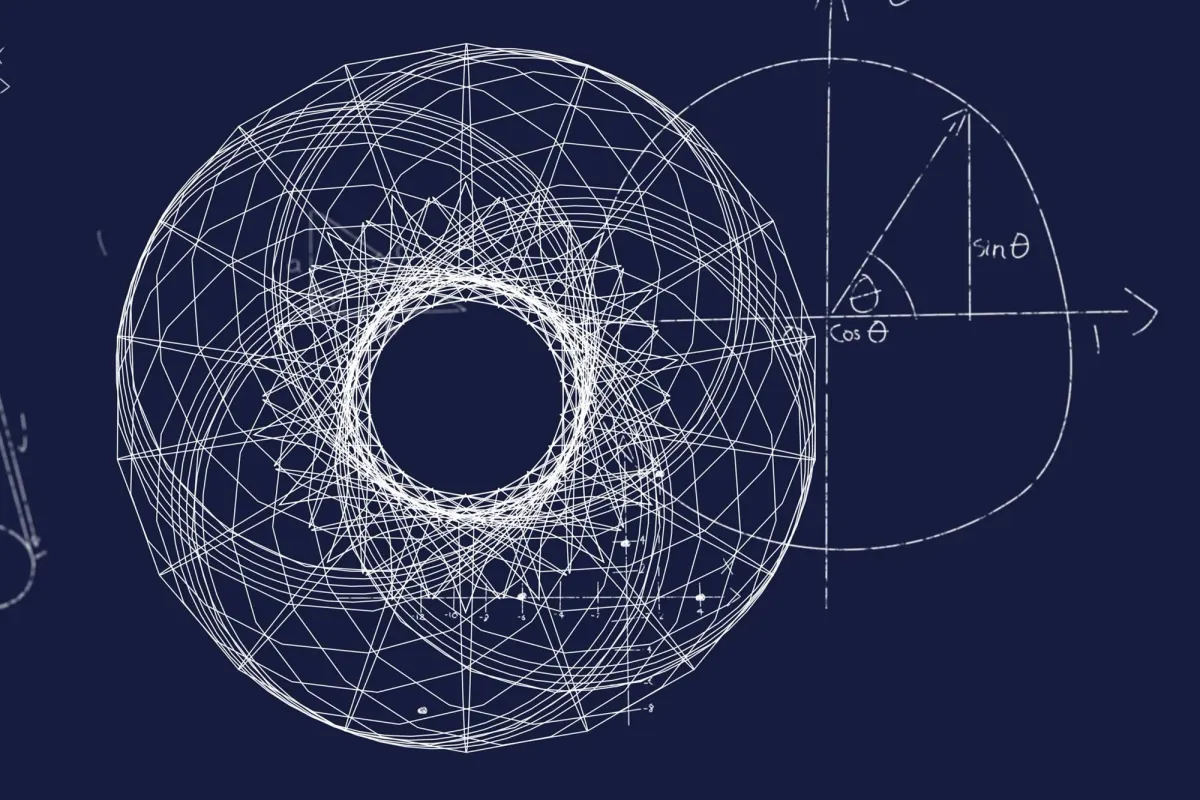
For 150 years, mathematicians lived by a simple rule: if you knew how far apart points were on a surface (the "metric") and how much it curved (the "mean curvature"), you knew its exact shape. Like a geometric fingerprint. French mathematician Pierre Ossian Bonnet laid down this law, and it’s been gospel ever since.
Until now. Because a team of researchers just found two different donut-shaped surfaces — yes, donuts — that share the exact same measurements for both their metric and mean curvature. Meaning, they should, by all accounts, be identical. But they're not. They're distinct. Which, if you think about it, is both impressive and slightly terrifying for anyone who thought math was a done deal.
Think of it this way: imagine two different cars that somehow have identical blueprints, identical performance specs, and even identical tire wear patterns. But when you look at them, they're clearly not the same model. That's what these mathematicians cooked up, but with donuts.
We're a new kind of news feed.
Regular news is designed to drain you. We're a non-profit built to restore you. Every story we publish is scored for impact, progress, and hope.
Start Your News DetoxThe Curious Case of the Compact Donut
Previously, exceptions to Bonnet's rule only applied to surfaces that stretch on forever, or had open edges. But "compact" surfaces, like a sphere or, crucially, a donut (mathematically known as a torus), were supposed to be ironclad. They were thought to be uniquely defined by these two measurements.
Mathematicians knew that for donuts, a single set of metric and mean curvature values could theoretically match up to two different shapes. It was a known possibility, a ghost in the machine. But no one had ever actually found an example. For decades, they searched. They crunched numbers. They probably drank a lot of coffee.
Then, the breakthrough. The team from the Technical University of Munich, Technical University of Berlin, and North Carolina State University finally presented the concrete example that had eluded experts for so long. They built two distinct tori with identical metrics and mean curvatures.
Professor Tim Hoffmann from TUM put it plainly: this is the first time they've found a concrete case showing that even for closed, donut-like surfaces, local measurements don't always lead to a single global shape. It’s like discovering that your phone’s facial recognition software can unlock two different people's devices, even though it swears it's unique.
It’s a tidy little problem solved, a 150-year-old assumption shattered, and a reminder that even in the most rigid fields, there’s always room for a curveball. Or, in this case, a really well-curved donut.