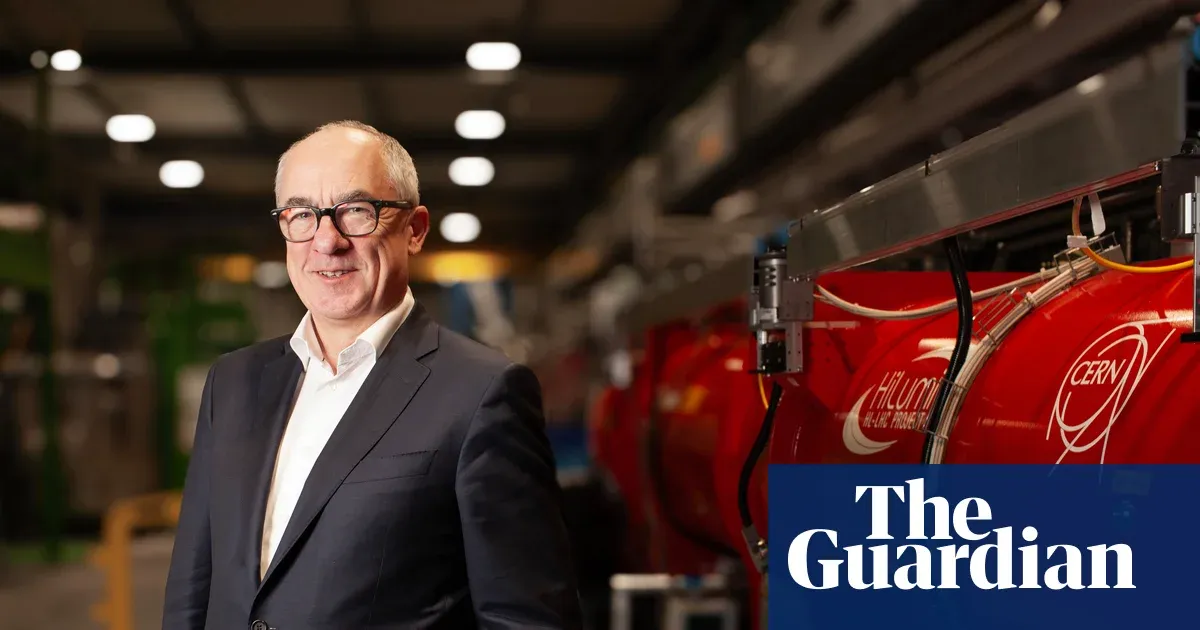
Mark Thomson is about to take over one of science's most prestigious jobs—and his first act is to power down the Large Hadron Collider.
On January 1st, the Cambridge physicist becomes director general of CERN, the nuclear physics laboratory nestled on the Swiss-French border near Geneva. The LHC, buried 100 metres underground, is the largest scientific instrument ever built. It's famous for discovering the Higgs boson in 2012, the particle that gives other particles their mass. But starting in June, Thomson will shut it down for five years.
"It's more interesting than just sitting here with the machine hammering away," he says from his office at the Cavendish Laboratory, entirely unbothered by the irony.
We're a new kind of news feed.
Regular news is designed to drain you. We're a non-profit built to restore you. Every story we publish is scored for impact, progress, and hope.
Start Your News DetoxWhy turn it off at all
The shutdown isn't about failure—it's about ambition. The LHC is running brilliantly, collecting vast amounts of data. But Thomson and his team are preparing something bigger: the high-luminosity LHC, a major engineering overhaul that will install new superconducting magnets powerful enough to squeeze the proton beams tighter and brighter. The result: ten times more collisions per second, and detectors sensitive enough to catch the subtle fingerprints of physics we don't yet understand.
This is where the real work begins. Physicists still don't know why the Higgs boson has the mass it does, or how Higgs bosons interact with each other. "We could see something completely unexpected," Thomson says. The upgrade could reveal cracks in today's theories—cracks that become the foundation for tomorrow's breakthroughs.
The five-year shutdown feels long only if you're impatient. Thomson isn't. "The physics results will keep on coming," he notes. Researchers will spend years analysing the mountain of data already collected, squeezing new insights from collisions that happened years ago.
The bigger question: what comes next
But Thomson's real challenge extends far beyond 2029. The LHC reaches the end of its useful life around 2041, and Europe must decide what replaces it. The frontrunner is the Future Circular Collider, or FCC—a machine more than three times larger than the LHC. Building it would require boring a 91-kilometre tunnel up to 400 metres underground, a project that wouldn't begin until the late 2040s.
The scale is staggering. The first phase alone would cost an estimated £14 billion. The machine would start by smashing electrons into positrons, then evolve into a proton collider operating at seven times the LHC's energy. But here's the tension: no one knows for certain what it will find. Dark matter, dark energy, the weakness of gravity, the mystery of why matter dominated antimatter after the Big Bang—these are the targets. But they're not guaranteed hits.
That uncertainty makes Thomson's job harder. CERN's member states vote on the FCC in 2028, and they can't fund it alone. Other countries—the US and China especially—are planning their own advanced colliders. Europe's leadership in particle physics depends on making the case that CERN's successor is worth the investment.
Thomson frames it simply: "We've not got to the point where we have stopped making discoveries and the FCC is the natural progression. Our goal is to understand the universe at its most fundamental level. And this is absolutely not the time to give up." The next phase of particle physics won't be decided by data alone, but by whether the world still believes fundamental discovery is worth the cost.