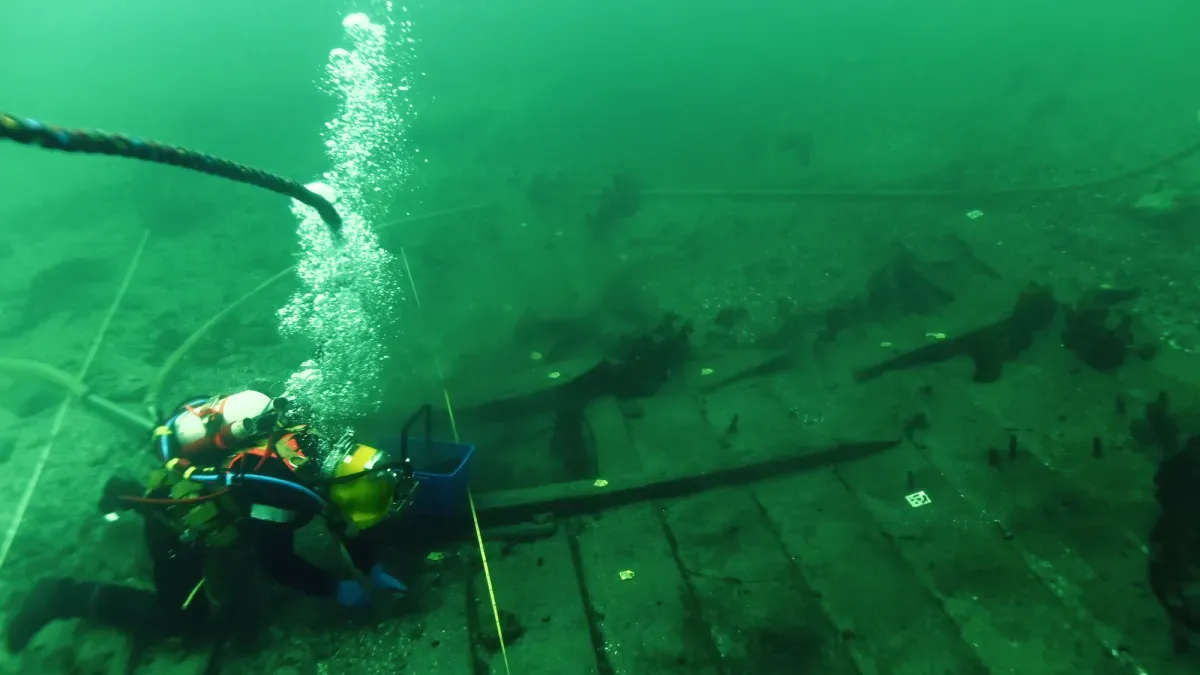
A sunken cog dredged up near Copenhagen has handed archaeologists something they've never had before: a complete blueprint of how the medieval world's largest trading ships actually worked.
Svælget 2, discovered buried under 40 feet of sand and silt, stretches nearly 92 feet long—longer than two school buses. Built around 1410 in the Netherlands, it's the largest cog ever found, and crucially, it's survived in a way that almost no other medieval ship has. Most wrecks leave only the hull. This one still has its rigging intact. The ropes and pulleys that once controlled its sails are still there, waiting to be studied.
"It is extraordinary to have so many parts of the rigging," said excavation lead Otto Uldum. "We have never seen this before."
We're a new kind of news feed.
Regular news is designed to drain you. We're a non-profit built to restore you. Every story we publish is scored for impact, progress, and hope.
Start Your News DetoxFor centuries, maritime historians have relied on drawings and paintings to understand how these ships worked. Medieval illustrations showed tall wooden platforms—called "castles"—built at the bow and stern, presumably to shelter the crew and protect cargo. But no archaeologist had ever actually found one. Until now. Svælget 2's stern castle is so well-preserved that researchers can see the details of its covered deck, a modest but genuine shelter from the open ocean.
"We have plenty of drawings of castles, but they have never been found because usually only the bottom of the ship survives," Uldum explained. "This time we have the archaeological proof."
What makes this discovery quietly revolutionary is the scale of material it offers. Svælget 2 provides roughly 20 times more archaeological evidence than previous shipwrecks—not just fragments, but an entire working vessel frozen in time. Every rope knot, every timber joint, every detail of how a crew of maybe 20 people managed a ship this massive tells a story about medieval innovation.
The cog itself was a technological leap. Unlike earlier Viking ships with their open decks and reliance on oar power, cogs were built for cargo and distance. Their design—with high sides, a deep hull, and the ability to carry enormous loads—helped transform European trade in the 1400s. They made it possible for merchants to move goods across the Baltic and North Seas in ways that previous generations couldn't.
Svælget 2 confirms that medieval shipbuilders could push this design to extremes. "We now know, undeniably, that cogs could be this large," Uldum said. The discovery doesn't overturn what historians thought they knew about medieval seafaring, but it fills in the gaps between theory and reality—the difference between a drawing and the actual thing.
As researchers continue to analyze the ship's timber and structure, they'll be able to answer questions that have lingered for 600 years: How exactly did a small crew control those massive sails? How was cargo secured in rough seas? What was daily life like aboard the largest trading vessel of its era? For the first time, the evidence is there to answer them.