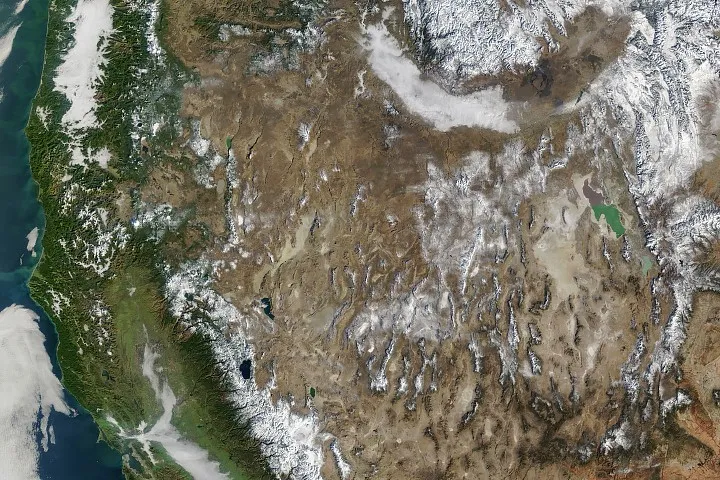
On January 15, 2026, NASA satellites measured snow covering just 142,700 square miles of the western United States. That's the lowest coverage recorded for that date since satellite measurements began in 2001—less than one-third of what's typical for mid-January.
The paradox is worth understanding: the West got plenty of water this fall and winter. Most regions saw average or above-average precipitation. The problem is temperature. Record warmth across the region meant that much of that precipitation fell as rain instead of snow. A December atmospheric river in the Pacific Northwest was one example—warm, wet air dumping moisture that should have accumulated as mountain snowpack.
Snow water equivalent (SWE)—the amount of water actually stored in the snowpack—tells the real story. In early January, monitoring stations across every major western watershed recorded their lowest SWE in at least 20 years. The snow drought was most severe in Washington, Oregon, Colorado, Utah, Arizona, and New Mexico.
We're a new kind of news feed.
Regular news is designed to drain you. We're a non-profit built to restore you. Every story we publish is scored for impact, progress, and hope.
Start Your News DetoxThere's a subtle geography to this crisis. High-elevation peaks in the Southern Sierra and Northern Rockies did accumulate more snow than rain, and some alpine locations held above-average snowpack. But farther downslope, where water supply matters most for reservoirs and agriculture, the deficit was stark.
Climate scientist Daniel Swain at the California Institute for Water Resources called it "a classic climate-change, temperature-driven, elevationally dependent snowpack deficit." That phrase matters because it describes not a temporary weather quirk but a structural shift—the kind of pattern that repeats.
Why does snowpack matter beyond ski resorts. Winter snow that melts slowly through spring provides a metered, sustained water supply throughout drier months. Rain, by contrast, runs off quickly before it can recharge reservoirs or groundwater. A thin snowpack means less reliable water for agriculture, ecosystems, and wildfire suppression when summer arrives. For the Colorado River Basin and Pacific Northwest—regions already stressed by decades of drought—a snow drought now could intensify into traditional drought by summer.
February and March still offer a window for significant snowfall. But catching up to a 25-year low in two months is unlikely. The West's water managers are already calculating what a sustained deficit means for the year ahead.