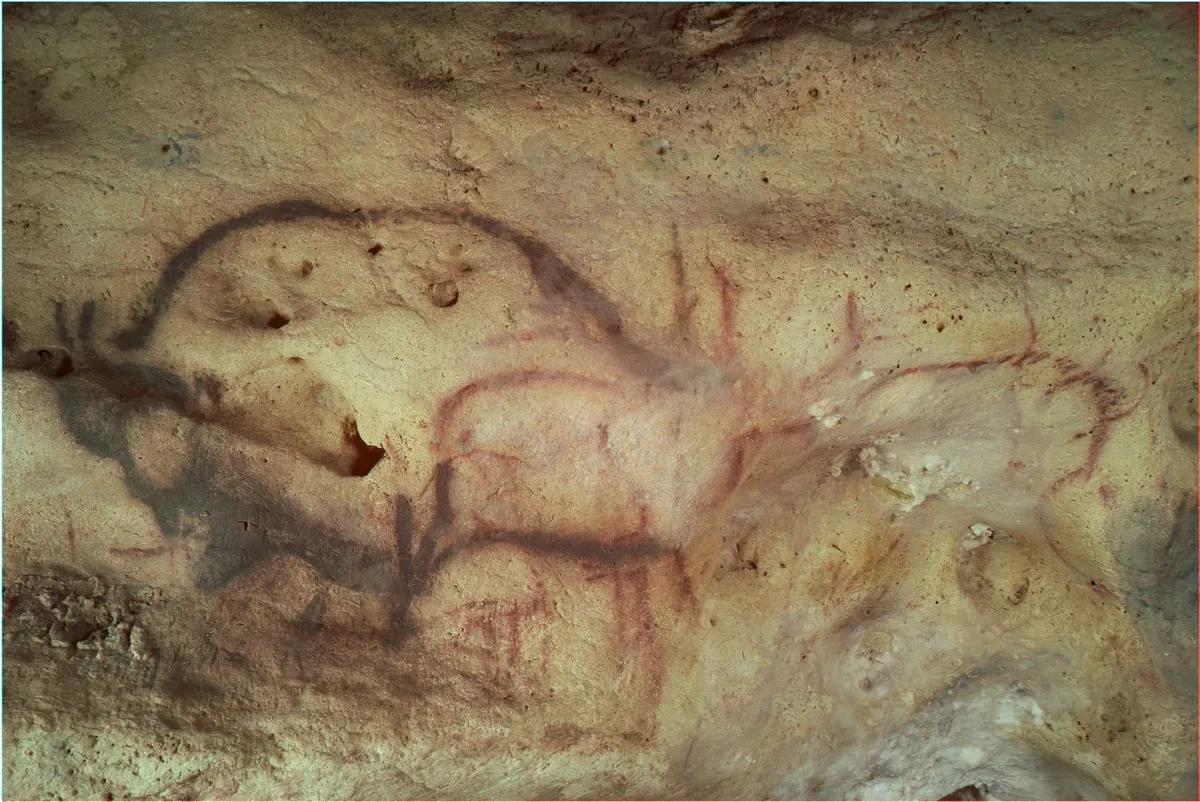
France's Font-de-Gaume cave holds many prehistoric artworks. These include paintings of bison, horses, reindeer, and mammoths. For the first time, scientists have figured out when some of these colorful pieces were made.
Parts of two artworks are between 13,000 and 16,000 years old. This confirms they were made during the Paleolithic period. However, some parts might be slightly more recent than first thought. These findings were published in PNAS on March 9.
Dating the Ancient Art
A local teacher discovered Font-de-Gaume's paintings in September 1901. The cave is in southwestern France. Today, visitor numbers are limited to protect the delicate environment. The limestone cavern is part of the Vézère valley, a UNESCO World Heritage site since 1979. This valley is known for its many prehistoric sites and decorated caves.
We're a new kind of news feed.
Regular news is designed to drain you. We're a non-profit built to restore you. Every story we publish is scored for impact, progress, and hope.
Start Your News DetoxScientists have found hundreds of paintings in Font-de-Gaume over the last century. About two-thirds show animals. The rest show humans, masks, geometric shapes, and handprints. Researchers are still exploring remote parts of the cave.
Based on the art style, scientists thought the works were made between 16,000 and 18,000 years ago. But they couldn't test this until recently. For years, they believed the art used iron- and manganese oxide-based pigments. These pigments don't have carbon, so they couldn't be radiocarbon dated.
In 2023, researchers found traces of charcoal, a form of carbon, in some black pigments. They got special permission to take tiny, invisible samples.
New Discoveries and Future Hopes
Researchers took four samples from two figures: one from a bison painting and three from an abstract mask. Radiocarbon dating showed the bison was painted between 13,162 and 13,461 years ago. Two areas of the mask dated to between 14,246 and 15,981 years ago. The third area of the mask was much younger, dating to between 8,590 and 8,993 years ago.
Why is one part of the mask so much younger? Researchers suggest it might have been touched up later or accidentally contaminated with younger carbon.
Inés Domingo Sanz, an archaeologist not involved in the study, called the research a good start. She noted that any chance to get dates is important. It helps place the art in specific time periods. However, she added that more data is needed to fully rely on the results.
The region has a lot of prehistoric rock art. Researchers hope their work will lead to more discoveries. Since they found unexpected charcoal in Font-de-Gaume, they think similar traces might exist at other sites. This could allow for more radiocarbon dating. The researchers wrote that this discovery is important for the cave and the entire region.
Deep Dive & References
- Absolute dating of Paleolithic rock art in Dordogne - PNAS, 2026