For years, scientists have been trying to figure out why some people respond to cancer immunotherapy like superheroes, while others… don't. The answer, it turns out, might be hiding in plain sight, in a specific type of immune cell that's been quietly doing the heavy lifting.
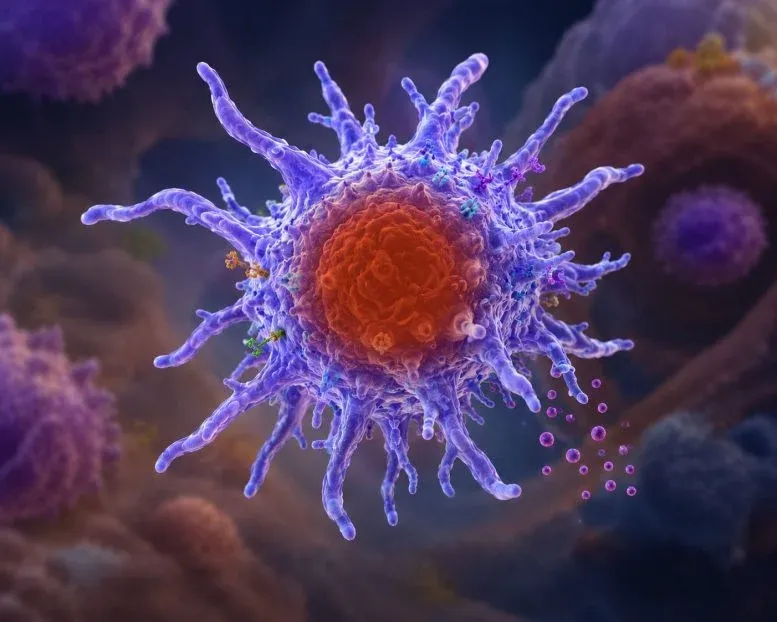
Researchers at the University of Manchester's Cancer Research UK Manchester Institute just dropped a bombshell: a specific kind of "activated dendritic cell" is absolutely vital for keeping those cancer-killing T cells fired up and ready for battle. Think of them as the unsung heroes of your immune system's anti-cancer squad, making sure the main attackers don't run out of juice mid-fight.
Turns out, these cells aren't just starting the party; they're making sure the music keeps playing and everyone stays on the dance floor.
We're a new kind of news feed.
Regular news is designed to drain you. We're a non-profit built to restore you. Every story we publish is scored for impact, progress, and hope.
Start Your News DetoxThe Unsung Heroes of Tumor Combat
Published in Immunity, this discovery basically rewrites what we thought we knew about how our bodies fight tumors. The challenge? These activated dendritic cells were notoriously tricky to study. You couldn't just pluck them out and see what happened.
So, the Manchester team got clever. They engineered the first-ever mouse models that could specifically label or, more dramatically, remove these cells. Suddenly, they could see what happens when the cells go missing. And what happened was… not good.
When these crucial cells were removed, the cancer-killing T cells became surprisingly lackluster. They barely activated, and even if they did, they couldn't sustain their attack once they got inside the tumor. It was like sending your best fighters into battle without their energy drinks.
Boosting the Body's Own Defenses
Maria Koufakis, the study's first author, points out the obvious but crucial implication: if we can boost these activated dendritic cells, we might just be able to supercharge the immune system's response for more patients. This could be a game-changer for those whose cancers currently laugh in the face of modern immunotherapy. Because apparently, that's where we are now.
Professor Santiago Zelenay, the senior author, sums it up perfectly: these cells aren't just the starting pistol for the immune response; they're the ones making sure it crosses the finish line. This new understanding could unlock better, more effective cancer treatments. Which, if you think about it, is both impressive and slightly terrifying that we're still discovering such fundamental players.
Cancer Research UK, who funded the study, agrees that while immunotherapies are saving lives, the "why for some, not others?" question has been a persistent head-scratcher. These new models could finally give scientists the tools to find answers. More research is, of course, needed, but this is one of those discoveries that makes you go, "Huh. Well, that changes things."