Imagine a sieve so precise it could pluck out a single molecule from a swirling vat of industrial sludge. Now imagine that sieve is made of perfectly uniform, one-nanometer holes, thousands of times thinner than a human hair. That's essentially what a team of international researchers has cooked up, and it could revolutionize everything from drug manufacturing to textile dyeing.
Turns out, industries spend a mind-boggling 40-50% of their total energy just separating stuff. Think about that: half the power bill for many factories goes into filtering, distilling, and evaporating. It’s like using a sledgehammer to crack a nut, and it guzzles energy while spewing carbon. Traditional plastic membranes exist, but their pores are about as reliable as a teenager's mood — uneven, prone to breaking down, and generally not up to the task of harsh industrial environments.
Nature's Blueprint for a Better Sieve
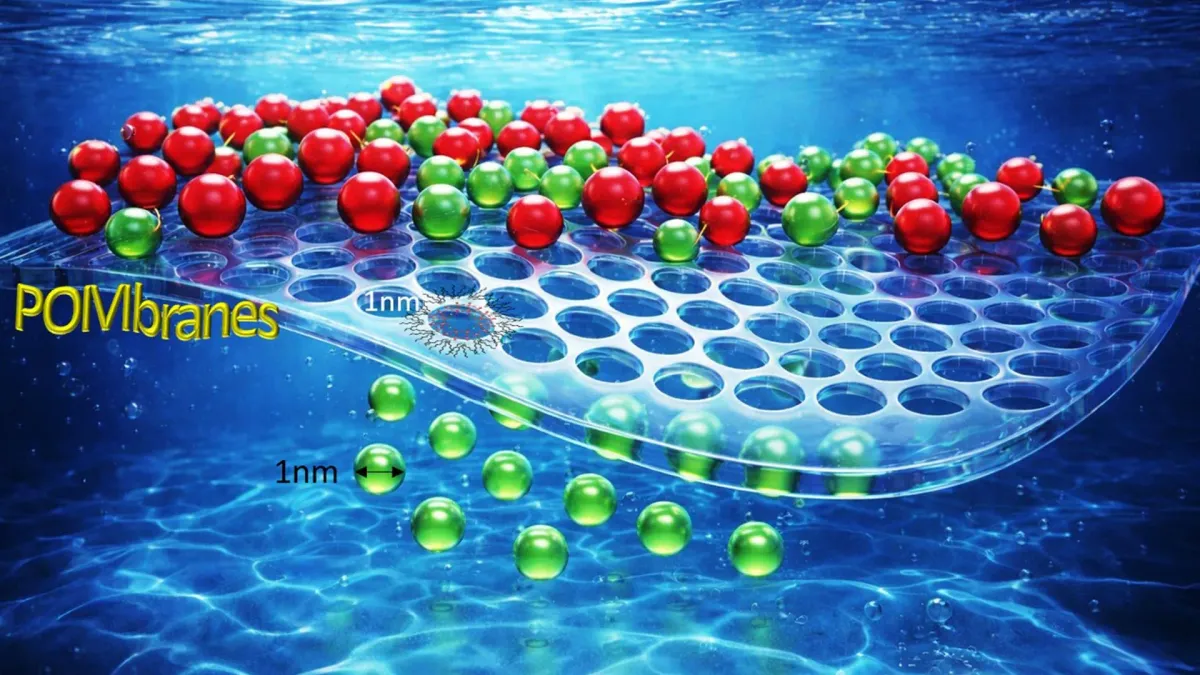
Enter the "POMbranes." These aren't just any membranes; they're ultra-selective, crystalline marvels with pores exactly one nanometer wide. The secret? They're inspired by nature's own super-filters, like the aquaporins in our bodies that precisely manage water flow. The researchers used special polyoxometalate (POM) clusters, which are basically tiny, crown-shaped metal rings, each with a natural, unchangeable, perfectly sized hole in its center.
We're a new kind of news feed.
Regular news is designed to drain you. We're a non-profit built to restore you. Every story we publish is scored for impact, progress, and hope.
Start Your News Detox"This is a big problem with traditional plastic filters," notes Priyanka Dobariya, a research scholar at CSMCRI, with the kind of understatement that makes you realize how monumental this tiny hole really is.
To turn these microscopic rings into a usable filter, scientists added flexible chemical chains to the POM clusters. When these modified clusters were floated on water, they naturally organized themselves into a continuous, ultrathin film. It’s like watching billions of microscopic Lego bricks snap into place, forming a flawless, molecular-level sieve. This forces molecules to cross the membrane only through those perfect one-nanometer holes.
Ten Times Better, Billions of Dollars Saved
And the results? These POMbranes can differentiate between molecules that differ by a mere 100-200 Daltons – a level of precision that makes standard polymer membranes look like a colander trying to catch sand. They perform almost ten times better than existing technologies, are flexible, stable, and can be scaled up for industrial use. Which, if you think about it, is both impressive and slightly terrifying for anyone still clinging to old-school filtration methods.
This is particularly huge for industries like textiles, which are notorious for their polluted wastewater. India’s textile sector alone is a $160-225 billion behemoth, and dyeing fabrics creates a truly impressive amount of toxic runoff. Imagine being able to selectively pull out dye molecules, letting clean water flow through to be reused. Less fresh water needed, less chemical waste generated, and a much happier planet.
Pharmaceutical manufacturing also stands to benefit immensely. Drug purification and solvent recovery are energy-intensive processes where precision is paramount. Highly selective membranes mean less energy, higher quality products, and fewer headaches for pharmaceutical companies trying to meet strict standards.
Researchers are calling POMbranes a "platform technology," which is a fancy way of saying these tiny, perfect holes could underpin a whole new era of sustainable manufacturing, from wastewater treatment to advanced chemical production. Because apparently, the future of industrial efficiency is going to be incredibly small, and perfectly round.