Every winter in West Bengal, something irreplaceable nearly disappears. The sap stops flowing from date and palm trees, the shiulis (skilled tappers) pack away their tools, and nolen gur—that golden, delicate jaggery that tastes nothing like the industrial stuff—becomes a memory until next season. For generations, families have marked winter's arrival by this taste alone. But fewer people know how to make it now, and even fewer can afford to buy it.
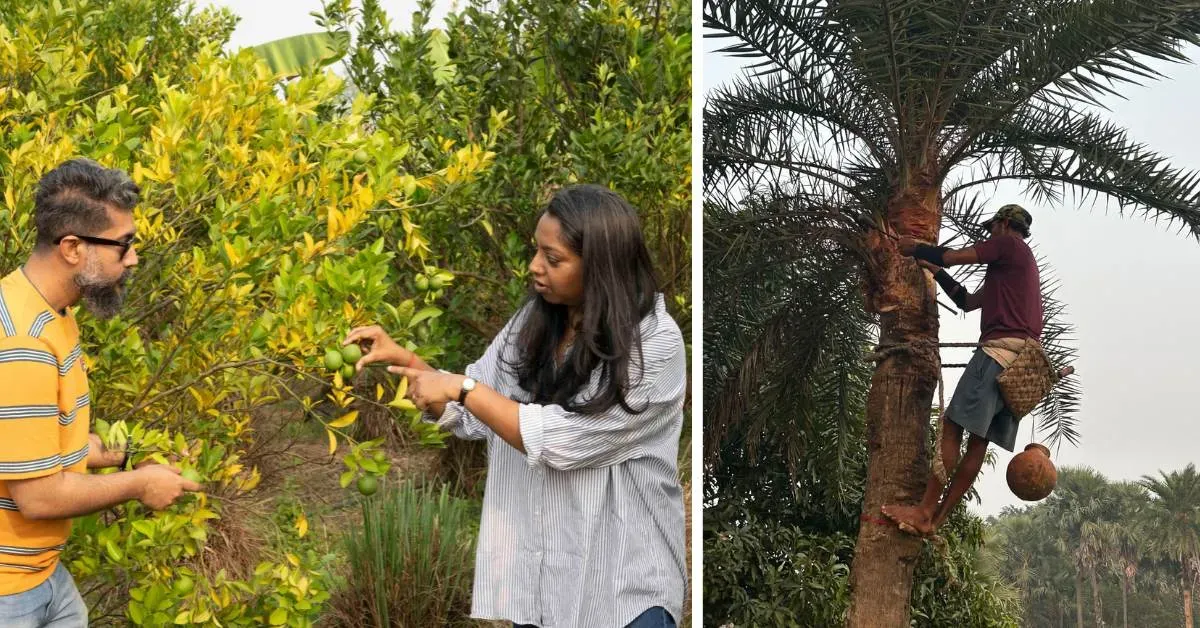
Senjuti Mahato and Abhishek Choudhury saw this slipping away and decided to catch it. In 2020, they launched Earth Story Farms from their own land in Bankura, a region where the red and gravel soil happens to be exactly what date and palm trees need. Their mission wasn't complicated: bring authentic nolen gur back into homes across India, and do it in a way that actually paid the people who knew how to make it.
How nolen gur actually gets made
The magic starts with patience. When the temperature drops and humidity falls—usually November through February—the sap begins to flow. The shiulis make a careful incision in the tree just before sunset, letting the sap collect in earthen pots overnight. By morning, they carry it to the cooking unit, where it goes into a slow, wood-fired process that can't be rushed or automated.
We're a new kind of news feed.
Regular news is designed to drain you. We're a non-profit built to restore you. Every story we publish is scored for impact, progress, and hope.
Start Your News DetoxOver hours, the sap thickens into either "jhola" (liquid jaggery) or "patali" (solid jaggery). The difference between something extraordinary and something mediocre comes down to three things Abhishek describes simply: time, heat, and craftsmanship. Cold, clear skies aren't luxuries—they're requirements. Without them, the taste and color shift. The whole thing depends on weather you can't control, which is partly why industrial producers abandoned it.
What Earth Story Farms did was take that constraint and turn it into a feature. They hired artisans like Mintu, 45, who spent decades worried about how to survive the off-season. "Our biggest concern has always been securing a steady livelihood throughout the year," Mintu says. Working with Earth Story Farms for the past four years changed that. The farm now produces liquid, solid, and powdered jaggery across all seasons, giving artisans year-round work instead of a three-month window.
Prakash, 27, joined three years ago and describes something equally important: he never had to leave. "This partnership has allowed us to remain connected to farming while ensuring a stable livelihood," he says. No migration to distant cities. No separation from family. Just work that stays in the village where he belongs.
Tradition meets the modern kitchen
The founders haven't tried to freeze nolen gur in amber. The production method stays traditional—that's non-negotiable—but the packaging and distribution adapted for people buying online or in city markets. They've expanded into Sundarbans honey, kasundi (Bengali mustard sauce), and cow ghee, all made the same way: pure, seasonal, connected to place.
Abhishek frames it plainly: "We want to ensure that future generations not only enjoy these pure and traditional ingredients but also understand their cultural significance and health benefits." It's not nostalgia. It's reconnection—people tasting what their grandparents tasted, understanding where it comes from, why it matters, and why it's worth the price.
The business is still small, still seasonal at its core. But it's proving something: there's a market for the real thing, and there are people willing to do the harder work to make it. Every winter, when that sap starts flowing again, a few more artisans have steady work waiting.