Researchers at TU Darmstadt have discovered something strange: tiny droplets of liquid can find their way through complex mazes on their own, without any electronics, cameras, or external guidance. They do it by generating chemical signals and sensing how those signals bounce back from their surroundings—a process the team calls "chemical echolocation."
It's the kind of elegance that makes you wonder why evolution bothered with brains.
How droplets think without thinking
The droplets don't follow a preset route or chase a signal placed at the exit. Instead, they continuously emit their own chemical signals and respond to how those signals return from the environment around them. "They're essentially listening to their own echo," explains Dr. Aritra Mukhopadhyay, the postdoctoral researcher who led the study published in the Proceedings of the National Academy of Sciences.
We're a new kind of news feed.
Regular news is designed to drain you. We're a non-profit built to restore you. Every story we publish is scored for impact, progress, and hope.
Start Your News DetoxThe team tested this through a combination of computer simulations and real experiments. In the simulations, they placed chemical droplets at the entrance of labyrinth-like mazes filled with dead ends. The droplets consistently chose the correct path at each intersection and reached the exit efficiently, even as the mazes grew larger and more complex. Traditional navigation strategies—following a chemical signal placed at the destination—fell apart at distance, as the guiding signal weakened the farther it traveled.
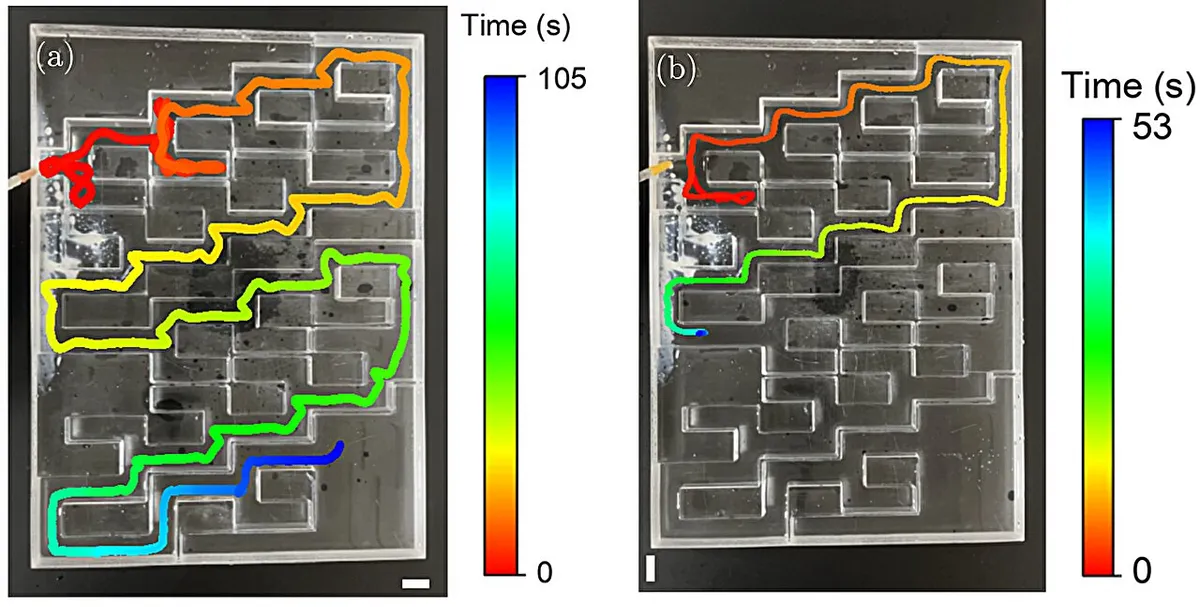
Then came the real test. The researchers created millimeter-sized droplets from simple polymer mixtures and placed them in water-filled mazes. Without any external cues, the droplets spontaneously began moving and navigated to the exit. High-speed video recordings revealed the mechanism in action: the droplets slowed down at intersections, detected the chemical "echo" from dead ends, and turned away before hitting them. In repeated experiments, most droplets successfully solved the maze, and their navigation time increased only gradually as the maze length increased.
Why this matters for microscopic systems
What makes this remarkable is that it works without the biochemical complexity of living cells. "Synthetic active matter systems can achieve sophisticated functionality through pure physics," says TU professor Benno Liebchen, the study's senior author. No integrated electronics. No sensors. No calculations.
Because chemical echolocation requires none of those things, it could theoretically be scaled down to far smaller dimensions than conventional robotics allows. That opens possibilities in environments where remote control is impossible: navigating through microfluidic channels (the kind used in medical devices), exploring confined spaces, or delivering microscopic cargo along intricate routes.
The droplets are showing us that intelligence—or at least the appearance of it—doesn't always require the machinery we assume it does. Sometimes the simplest physical rules, applied consistently, are enough to solve a maze.