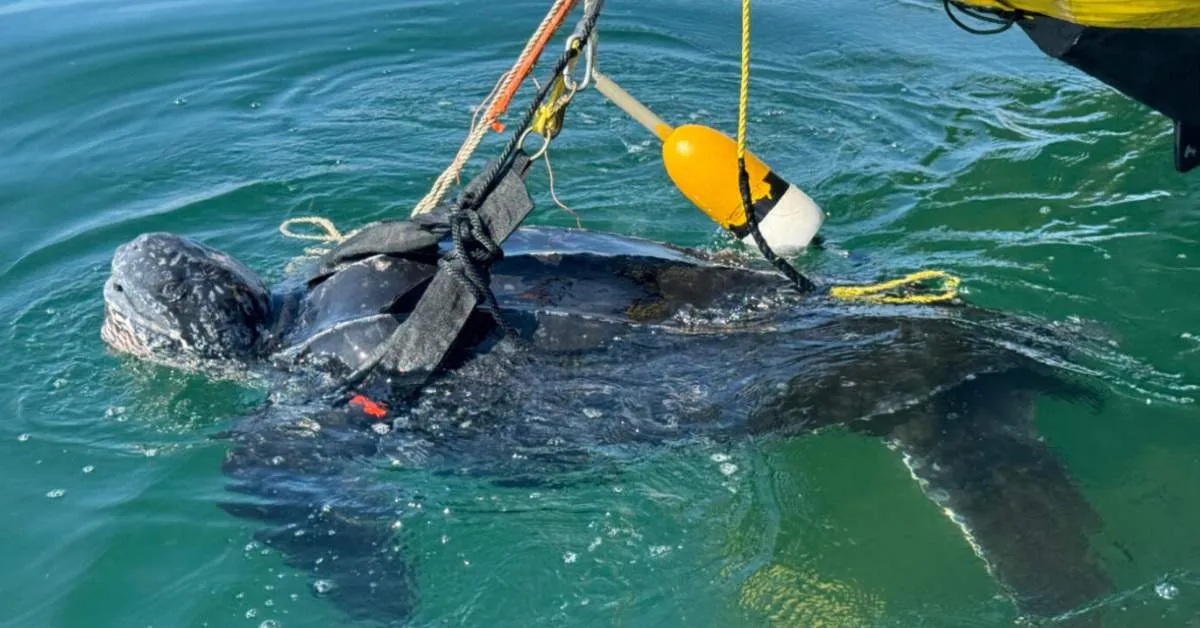
Picture this: you're out fishing for cobia in the Chesapeake Bay. Winds are ripping at 20 mph, turning the water into a choppy mess. Suddenly, you spot it — a 700-pound leatherback sea turtle, a creature straight out of a prehistoric documentary, completely tangled in crab pot lines.
That's exactly what happened to Brandon Watts and his friends this past June. Watts described the giant turtle struggling, looking like it was "crying for help." Which, if you think about it, is a pretty compelling reason to drop everything and act.
Not Your Average Catch
Rescuing a half-ton reptile in a mini-gale isn't exactly a smooth operation. The waves were doing their best to bash the boat into the turtle, and the last thing anyone wants is to injure the very animal they're trying to save. But Watts got close enough to see the problem: buoy lines wrapped around the turtle's neck and flippers, at least ten times over. He grabbed a razor knife and started cutting.
We're a new kind of news feed.
Regular news is designed to drain you. We're a non-profit built to restore you. Every story we publish is scored for impact, progress, and hope.
Start Your News DetoxHis friend, Travis Cullipher, a fisherman since childhood, steered the boat, keeping a careful distance. Cullipher admitted he'd never seen a turtle in such distress. Watts, for his part, figured animals don't ask for fishing gear to be floating around their habitat, so any help makes a difference. And just like that, the leatherback was free.
This isn't an isolated incident, either. Abandoned fishing gear is a notorious menace to sea turtles. In 2018, another leatherback was freed from a crab pot 50 feet underwater. And just this year, the New England Aquarium rescued a 400-pound leatherback named "Phinney" from a similar bind in Cape Cod Bay.
Phinney's entanglement was caught early, thankfully, resulting in minimal damage. Before releasing the healthy, active turtle, scientists gave it a couple of fashion accessories: satellite and acoustic tags. These little gadgets will let researchers track Phinney's movements for up to a decade, from Canada to Florida, via underwater receivers.
Because, as research scientist Kara Dodge put it, knowing what happens to these magnificent creatures after they're untangled is pretty crucial. It helps us understand their survival rates and behavior. And if you're now deeply invested in the lives of rehabilitated sea turtles, you can even follow Phinney and friends on the New England Aquarium's Sea Turtle Tracker. Because apparently, that's where we are now.