Perseverance just drove itself across the Martian surface using artificial intelligence to decide where to go — no human intervention required, moment to moment.
In December 2025, the rover took two drives on the rim of Jezero Crater where generative AI handled the route planning. Instead of NASA's ground team plotting every turn from Earth (a process that takes days due to communication delays), the rover analyzed high-resolution orbital imagery and terrain data in real time, identified hazards like loose rock and bedrock outcrops, and generated its own continuous path complete with waypoints.
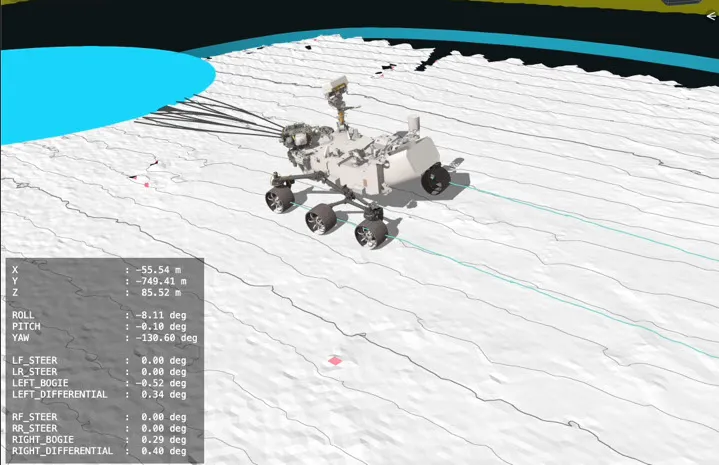
The visualization of this drive is striking: pale blue lines show the actual track Perseverance's wheels took, while black lines branching ahead show the alternative routes the rover was considering at each moment. It's like watching someone think out loud — the hesitation, the recalibration, the decision made and committed to.
We're a new kind of news feed.
Regular news is designed to drain you. We're a non-profit built to restore you. Every story we publish is scored for impact, progress, and hope.
Start Your News Detox"The mission's drivers — that's what NASA calls the rover planners — use this visualization to understand Perseverance's autonomous decision-making," explains the team at NASA's Jet Propulsion Laboratory. They can see not just where the rover went, but why it rejected other options. That insight matters. As rovers become more independent, humans need to understand their logic, trust their judgment.
This isn't magic. The AI was trained on years of rover telemetry and terrain analysis. But it does represent a shift. Perseverance has always had some autonomous driving capability — rovers have to navigate small obstacles without waiting for commands from Earth. What's new is the scale and sophistication. The rover is now planning complex routes across unfamiliar terrain, weighing multiple options, and executing them without a human approval loop.
For Mars exploration, this changes the pace. Instead of the rover waiting idle while its human team plans the next drive, Perseverance can keep moving, keep exploring, keep collecting data. It's not a replacement for human judgment — the AI still operates within parameters humans set — but it's an expansion of what a rover can do alone.
The next phase will likely push further: more autonomous decision-making, longer stretches between human input, rovers that don't just follow a planned route but adapt it as new terrain appears. Perseverance is proving that's possible.